
...

By Amanda Greenwood
Associate News Editor
0
Share
Newsweek is a Trust Project member
See more of our trusted coverage when you search.Prefer Newsweek on Googleto see more of our trusted coverage when you search.
More than 100 million Americans are under heat alerts this week as a potentially record-setting heat wave grips much of the eastern two-thirds of the United States, bringing dangerously high temperatures just ahead of the July 4 Independence Day holiday.
Forecasters warn that prolonged heat and humidity could create life-threatening conditions across parts of the Midwest, Great Lakes, Ohio Valley, Mid-Atlantic, Northeast and Southeast.
The NWS Weather Prediction Center says the event is being driven by a powerful heat dome—a high-pressure system trapping hot, humid air and preventing temperatures from cooling overnight. The result is several consecutive "dangerously hot" days, with some Independence Day celebrations expected to take place under extreme conditions.
Read More on News
Connecticut Governor Ned Lamont has activated the Extreme Hot Weather Protocol from Tuesday to Sunday, and New York Governor Kathy Hochul has extended state pool hours.
America 250 Celebrations Face Historic Heat
The heat wave is expected to coincide with one of the largest public events in recent U.S. history as hundreds of thousands of people gather in Washington, D.C., for America 250, marking the nation's 250th anniversary.
Forecasts call for temperatures approaching 100 degrees Fahrenheit on the National Mall during many outdoor celebrations, creating significant heat risks for spectators spending hours outside. Federal and local officials have urged attendees to arrive hydrated, wear lightweight clothing, seek shade whenever possible and take advantage of cooling stations and free water distribution points where available.
Public health experts warn that long periods of standing in direct sunlight can substantially increase the risk of heat exhaustion and heat stroke, particularly for older adults, young children and people with underlying health conditions attending all-day events.
World Cup Organizers Adjust for Extreme Heat
The heat is also affecting the 2026 FIFA World Cup, with host cities implementing measures to protect fans during outdoor festivities.
In Philadelphia, officials have expanded heat-safety measures around the official FIFA Fan Festival at Lemon Hill, including cooling tents, misting fans, shaded areas, refillable water stations and hospitality hubs along routes to the venue. The FIFA Fan Festival is actively shifting and shortening its operational hours (closing during peak heat) to protect fans. Organizers are also urging them to check daily operating hours and weather updates, as schedules may vary during the tournament.
Although many matches are scheduled to reduce the impact of peak afternoon temperatures, public health officials continue to advise supporters attending games or fan events to plan for prolonged exposure to extreme heat, particularly as heat index values are expected to exceed 100 degrees Fahrenheit across parts of the eastern United States.
Where the Heat Will Be Worst
...
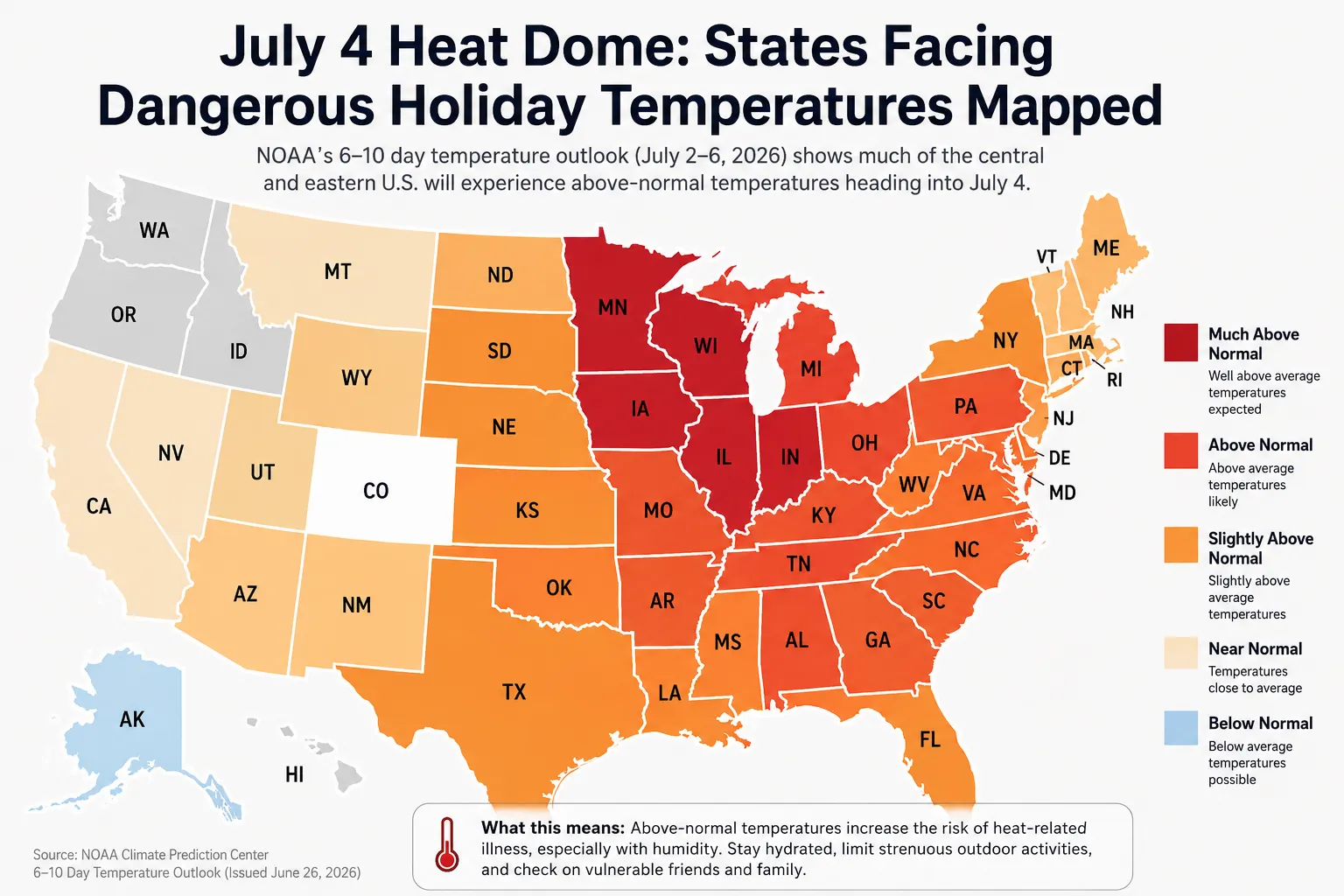
According to National Weather Service heat warnings and advisories, the highest heat risk stretches from the Midwest and Great Lakes through the Ohio Valley into the Mid-Atlantic, Northeast and parts of the Southeast and Gulf Coast.
Major cities across these regions are expected to endure several days of oppressive heat and humidity.
How Hot Will It Get?
Afternoon temperatures are expected to climb into the 90s and low 100s across much of the central and eastern U.S. Humidity will push heat index values to between 100 and 110 degrees Fahrenheit, with isolated locations approaching 115 degrees Fahrenheit.
Parts of Washington, D.C., and the Mid-Atlantic could experience multiple days near or above 100 degrees Fahrenheit, while overnight lows in the 70s and even near 80 degrees Fahrenheit will offer little relief.
Why This Heat Is Dangerous

...
Extreme heat is one of the deadliest weather hazards in the United States, contributing to more than 700 deaths each year, according to the Centers for Disease Control and Prevention.
Prolonged exposure can lead to heat exhaustion or life-threatening heat stroke, while also increasing the risk of heart, kidney and respiratory complications.
The danger is especially high for older adults, young children, outdoor workers and people without access to air conditioning.
Warm nights compound the risk by preventing the body from recovering, particularly in urban areas where roads and buildings trap heat through the urban heat island effect.
How to Stay Safe

...
The National Weather Service urges people in affected areas to drink water regularly, limit strenuous outdoor activity during the hottest part of the day, spend time in air-conditioned buildings, wear lightweight clothing and check on vulnerable friends, relatives and neighbors.
Children and pets should never be left in parked vehicles, where temperatures can become deadly within minutes.
Anyone experiencing confusion, dizziness, fainting or a very high body temperature should seek emergency medical care immediately.
When Will the Heat Ease?
The hottest conditions are expected from late this week through the July 4 weekend.
The Climate Prediction Center says some eastern areas may begin to cool early next week as the heat dome shifts west, although above-average temperatures are forecast to persist across parts of the West and central U.S. over the following two weeks.

...
Elsewhere, Storms and Flooding Continue
While the East battles dangerous heat, other parts of the country face severe weather.
Tornado and severe thunderstorm warnings have been issued across parts of Minnesota, Wisconsin, Iowa, South Dakota and Nebraska, with forecasters warning of damaging winds of up to 70 mph, hail and locally heavy rainfall.
Flood warnings also remain in effect across parts of Montana, the Midwest and the South, where swollen rivers continue to threaten communities.
The National Weather Service urges residents to seek shelter during severe storms and never drive through flooded roads, noting that most flood-related deaths occur in vehicles.
July 4 Forecast
...
The July 4 holiday is expected to bring a sharp weather divide across the country.
Much of the Midwest, Ohio Valley, Mid-Atlantic, Northeast and Southeast will remain exceptionally hot and humid, making outdoor celebrations potentially hazardous during the afternoon and early evening.
By contrast, much of the West is forecast to experience comparatively milder conditions, although some areas could still see unsettled weather and scattered thunderstorms.
Travelers and anyone planning outdoor events are encouraged to monitor local forecasts and heat alerts as conditions evolve.
View 0 Comments
Submit Correction
View Editorial & AI Guidelines