10
Loading video...

By Janee Bolden
Freelance Writer
0
Share
Newsweek is a Trust Project member
See more of our trusted coverage when you search.Prefer Newsweek on Googleto see more of our trusted coverage when you search.
In a city where memory is as layered as the soil beneath its streets, where culture rises defiantly through rhythm, ritual, and resilience, the 20th anniversary of Hurricane Katrina arrives as both a milestone and a meditation.
For Brandan "BMike" Odums, the celebrated New Orleans-based visual artist and founder of Studio BE, it's also a moment of generational handoff—a time to center the voices of youth who didn't live through the storm but still carry its legacy in their bones.
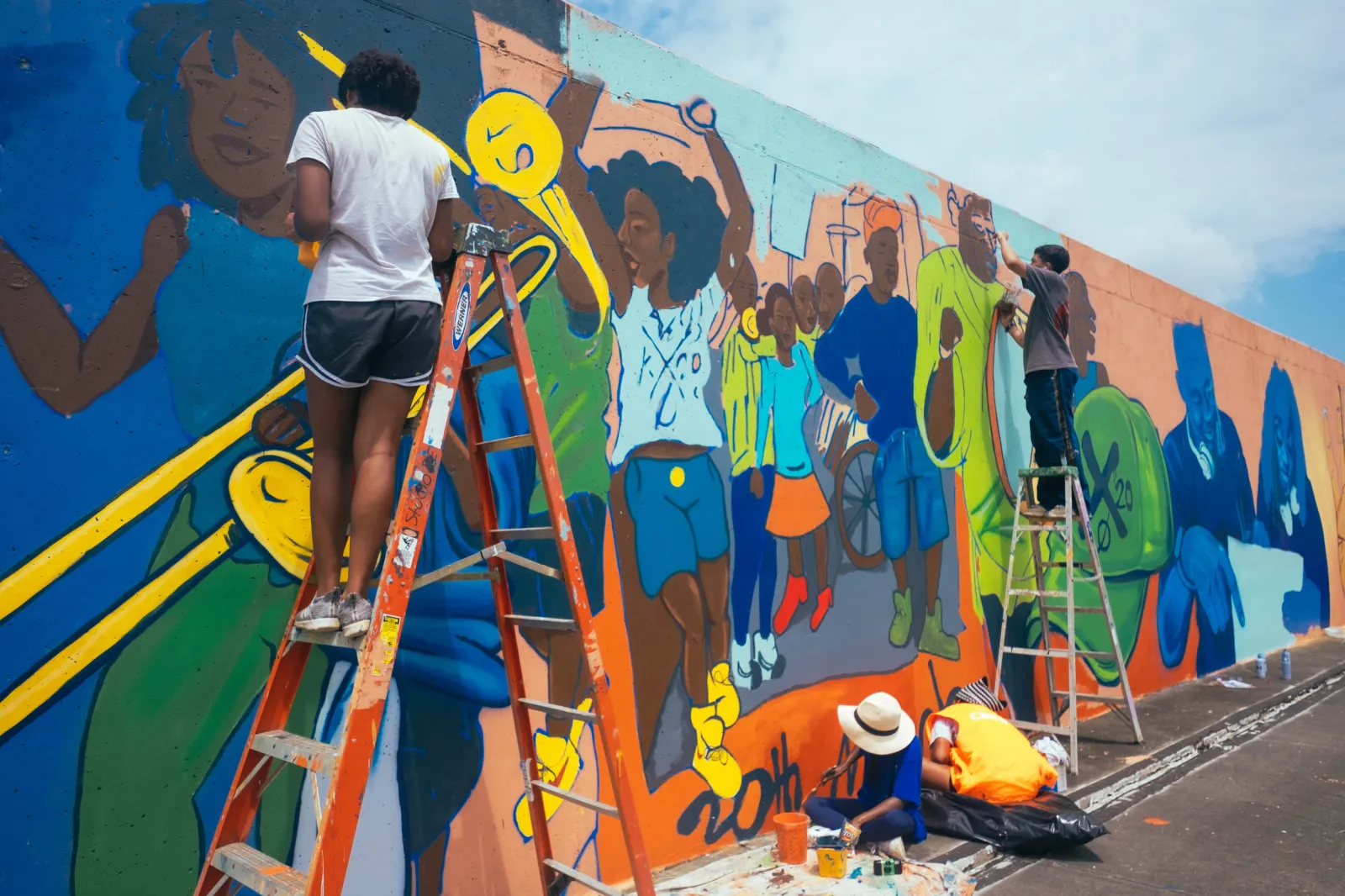
This summer, Odums led a new cohort of students through his Eternal Seeds program, an annual art and mentorship initiative housed at Studio BE. The young artists, all born after the devastation of August 29, 2005, spent six weeks studying Katrina through oral history, documentary footage, poetry, and community testimony. The culminating project: a striking new mural painted on a levee wall in the Lower Ninth Ward, the very ground zero where floodwaters surged when the levees broke.
Read More on U.S.
...
The mural is not a memorial in the traditional sense. It is layered, living, and fiercely imaginative—combining archival imagery, symbolic artifacts, and original artwork by the students themselves.
"We framed this whole summer around three things: memorial, mythology, and imagination," Odums said. "We knew how to approach creating a memorial for Katrina—researching, listening to people's stories, honoring specific moments. But we also wanted the youth to take ownership of those stories. Mythology became about how they see themselves in the legacy.
"And imagination was about looking ahead—how do we want the future of New Orleans to look?"
That question found its answer not only on the wall, but in the process. Hurricane Katrina killed nearly 2,000 people and displaced over a million residents across Louisiana, Mississippi, and Alabama. In New Orleans, levee failures left about 80 percent of the city underwater, with some areas, like the Lower Ninth Ward, submerged under 12 feet of floodwater.
The storm caused an estimated $161 billion in damages, destroying or severely damaging more than 300,000 homes. A disproportionate number of fatalities occurred in Black and working-class communities. The Eternal Seeds curriculum began with a sobering realization: none of the students remembered Katrina. Most of their parents didn't speak about it often. Some had never heard their families recount their own evacuations, losses, or returns.
"We even talked about playing Katrina Babies and then realized—they weren't alive," Odums said.
Trauma and Recovery
Instead of seeing this as a gap, the program treated it as a point of entry. The students spent their Fridays hearing firsthand stories from New Orleanians who lived through the catastrophe and its aftermath.

...
Guest speakers included musician Irvin Mayfield, poet Sunni Patterson, councilman Oliver Thomas, and former mayor Marc Morial. Each offered a personal lens on trauma, survival, and recovery. The mural they produced reflects that layered storytelling. Divided into three sections—pre-Katrina, Katrina, and post-Katrina/future—the work weaves together photographic references, news clippings, household items like keys and family albums, and drawings that envision what comes next.
"There's all these artifacts that are painted on the wall to memorialize pre-Katrina New Orleans," Odums said. "Then there's the flooding, the news, things they found when they researched. And after that, we focused on the return—because that's what we heard over and over: the importance of the right to return. The last part of the mural is the future. It's drawings by the kids about what they want New Orleans to become."
The location of the mural matters. The Lower Ninth Ward was one of the neighborhoods hit hardest by Katrina, and its fate remains a symbol of both devastation and neglect. In the Lower Ninth Ward, floodwaters rose as high as 12 feet after the levees broke—sweeping away homes, scattering families, and displacing generations.
Despite the deep scars, Odums said he believes there's power in returning to the site and painting something new. He sees the mural as a way of reclaiming space and visibility for a neighborhood often overlooked.
"This mural reminds people that the Ninth Ward is New Orleans," he said. That same sentiment was echoed by councilman Thomas, who visited the students during their summer research.
"He told them, 'We're still here,'" Odums recalled. "He wanted the mural to make people feel like they're part of New Orleans—not forgotten."
The assertion "we know this place" became a refrain throughout the summer, inspired by a poem from Patterson. The phrase now appears in bold on the mural itself.

...
From Student to Teacher
The Eternal Seeds program is built not only on artistic skill, but on mentorship. Many of the program's instructors are former students themselves.
"The only adults on staff besides me and Naliah—who's a few years older than me—were all youth from previous years," Odums said. "Paris, Morrah, Cierra, Andre, Nola—all came up through the program. They're now teaching the next generation."
One of those alumni, Paris Porter, was born in August 2006—just a year after Hurricane Katrina. This summer, she returned to Eternal Seeds as an instructor, guiding students who, like her, never experienced the storm firsthand.
"As an Eternal Seeds instructor, this is an unheard of opportunity, where I've been able to teach young artists how to express themselves from a special place but also learn about Katrina myself, because we were all born after," Porter said. "I learned that Katrina isn't a figment of our imagination or a waterline of our parents' past, but an ongoing story in our imaginative futures."
Her perspective reflects what Odums hoped the program would achieve, connecting young artists to the city's past while empowering them to envision its future. This full-circle model ensures that Eternal Seeds doesn't just train artists—it builds a community of caretakers. The lessons go beyond technique.
"We're trying to teach them to push past their limitations," Odums said. "To know what it means to invest in your people, to collaborate, and to realize how capable you are."
Though none of the students were alive during the storm, they emerged from the summer session not just with historical insight, but with a deeper sense of why Katrina still matters—and how their generation can carry those lessons forward.
Policy, Preparation, and Equity
While the mural speaks to memory, State Representative Delisha Boyd works on the other side of the equation: ensuring that what happened during Katrina never happens again.
"Strengthening the levees has been one of the biggest wins," she told Newsweek. "But it's not just the levees. The pumping systems have been upgraded, and there's been a focus on restoring infrastructure in areas like the Lower Ninth."
She also points to federal and state funding streams that support affordable housing and community redevelopment. Boyd, a New Orleans native and licensed real estate broker, serves on the board of the New Orleans Redevelopment Authority (NORA). She cites programs like Lot Next Door, which allows residents to buy adjacent vacant land at deeply reduced prices, and green infrastructure projects aimed at absorbing floodwater before it overtops pumps.

...
Still, Boyd admitted there's work to be done. "We've lost nearly 25,000 young professionals in the past five years alone. We have to foster the neighborhoods and make sure people can stay where they're from," she said. "Revitalization can't become gentrification. We have to be in control of the narrative."
That's especially true, she added, for communities of color. "We don't want another situation where folks are left out of the rebuilding process," she said. "We have to fight for funding, educate families about owning their homes, completing successions, getting insurance. That's what Katrina taught us."
Preparing for the Next Storm
Representative Boyd also highlighted how Katrina reshaped New Orleans' approach to disaster planning.
"Now we have systems to track storms earlier. We have designated lighthouses around the city—places where residents, especially elders or people on oxygen, can go if they can't evacuate."
But climate change is a growing threat. "There are still people on the state level who don't even believe climate change is real," she said. "That makes our job harder. But we're doing what we can at the city level to prepare."
One of her greatest concerns is also one of the most overlooked: mental health. "We want kids to be resilient—which they are. But they're people, too," Boyd said. "They got overlooked in Katrina... and then within 15 years they have this pandemic. I'm finding this rise in Black young adults that are committing suicide. It's mind-boggling." T
he art of the Eternal Seeds youth is more than paint; it is a profound response to the crisis Boyd identifies. By becoming caretakers for one another, they are weaving a tapestry of support strong enough to withstand the echoes of isolation and trauma that shadowed the generation before them.
A City That Remembers
For Odums, the story of Eternal Seeds is inseparable from his own post-Katrina journey. He was 18 when the storm hit, evacuated to Houston and then Austin, and found himself restless and searching.
Eventually, he turned to filmmaking, founding a collective called 2-Cent that documented grassroots organizing and resistance in the wake of the storm. That work, he said, laid the foundation for everything he does today.
"I didn't grow up thinking I'd be a muralist," he said. "But Katrina forced me to ask: what can I do? What stories need telling?"
The story of the Lower Ninth Ward, and of the students who painted its walls with visions of strength and survival, is one he's proud to help tell. But it belongs to the city now. As he reflects on the mural, Odums returns again to that phrase: "We know this place."
"Yes, you might not have experienced Katrina, yes, you might not have grown up in the 9th Ward, but we know this place. And I think that's what I hope this mural speaks to everyone who sees it."
"When Black people come together, when poor people come together, when working-class people come together—when they're neglected, when they recover, when they survive, when they thrive. We know this place."
View 0 Comments
Submit Correction
View Editorial & AI Guidelines