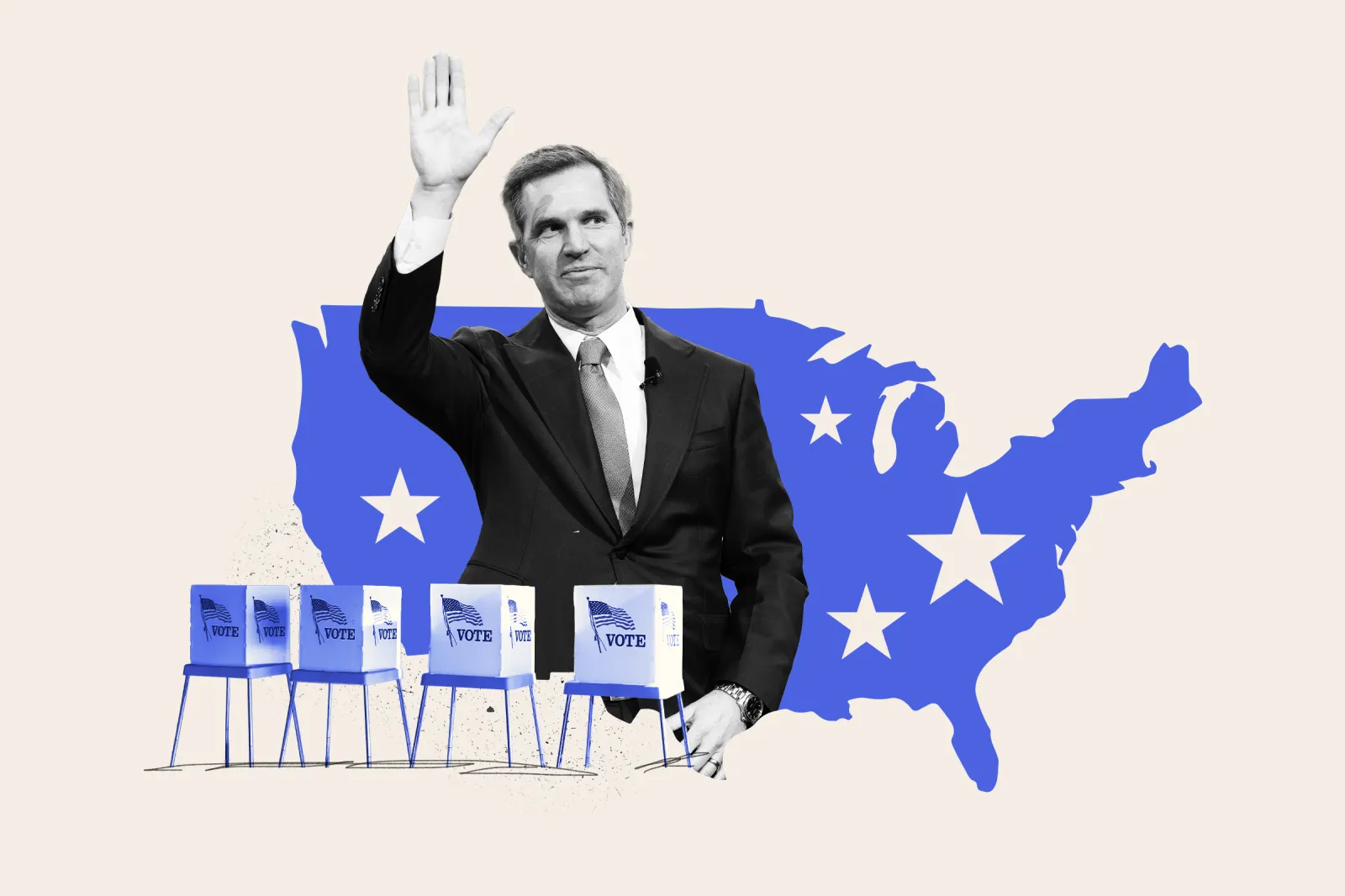
Photo-illustration by Newsweek/Getty

By Jesus Mesa
Reporter
0
Share
Newsweek is a Trust Project member
See more of our trusted coverage when you search.Prefer Newsweek on Googleto see more of our trusted coverage when you search.
Andy Beshear has accomplished something few Democrats can claim: He has won statewide office twice in a state where President Donald Trump crushed the competition by roughly 30 points. He is the most popular Democratic governor in the country, with a 65 percent approval rating. Yet when Democrats are asked who should run for president in 2028, Beshear barely registers.
In the latest national polling, the Kentucky governor garnered just 2 percent support among Democratic primary voters, trailing former Transportation Secretary Pete Buttigieg at 16 percent, California Governor Gavin Newsom at 12 to 19 percent and former Vice President Kamala Harris at 20 to 27 percent. A Reuters/Ipsos poll this year found that 70 percent of Democrats surveyed had never heard of him. The paradox suggests a puzzle worth examining: What does it take for a Democrat to translate red-state electoral success into national primary viability?
The answer, according to Democratic strategists, may hinge less on early polling than on electability—and on Beshear's ability to prove he can win the voters Democrats desperately need.
Read More on Politics
Democratic strategist Eddie Vale argues that front-runner status at this stage carries little weight. "It is so early and whoever is the 'popular' candidate this far out never is the nominee in the end," Vale told Newsweek. "The national attention is usually a combination of who is the best known to insiders and the press and who is making the most noise, and neither of those things are what wins primaries and caucuses in the end."

...
Jim Kessler, executive vice president for policy at the centrist-left think tank Third Way, said early attention is often misleading based on historical patterns.
Beshear's electoral record provides the foundation for that argument. He won his first gubernatorial race in 2019 by less than 1 percentage point, defeating Republican Governor Matt Bevin in a contest hinging on local grievances and pension reform. Four years later, he improved those margins significantly, beating Republican Daniel Cameron by 5 percentage points—a commanding performance in a state where Trump had just won the presidency by 26 points. He even flipped Breathitt County, Vice President JD Vance's family home, by 22 points.
According to a Morning Consult survey earlier this year, Beshear maintained the highest job approval rating of any Democratic governor in the nation.
Can He Win the Moderate Threshold?
What matters most for 2028, however, is not name recognition but electability. Kessler framed the fundamental challenge facing any Democratic nominee in stark mathematical terms: To win a national election, a Democrat must capture roughly 60 percent of self-identified moderate voters.
"That is the baseline reality," Kessler told Newsweek. In 2024, Harris won about 57 percent of moderates—not enough. "The winning Democrat will likely be a pugnacious centrist," Kessler said, "someone who combines a reform agenda with a focus on everyday concerns, especially kitchen-table issues."
Beshear's record suggests he has navigated this balance successfully. In 2023, months before his reelection campaign, he vetoed what he called "the nastiest piece of anti-LGBTQ+ legislation that this state had ever seen"—a sweeping bill banning gender-affirming medical care for transgender minors and restricting where transgender students could use restrooms. Both his veto and a previous one on transgender sports were overridden by the Republican legislature.
But Beshear did not retreat.
Eric Hyers, who served as Beshear's campaign manager in 2019 and remains a close adviser, told Newsweek that Beshear's record demonstrates a different kind of strength. "He has shown the political guts to stake his reelection on vetoing an anti-trans bill and openly running on abortion rights" Hyers said. "He wasn’t going to back down when he believed people were being unfairly targeted."
Beshear's campaign also aired ads featuring Hadley Duvall, a woman raped by her stepfather at age 12, not just in Democratic strongholds like Louisville and Lexington, but in Republican-heavy markets where Democrats typically receive only 20 to 35 percent of the vote. The data revealed something unexpected.

...
"Contrary to expectations, it wasn’t suburban, college-educated women who moved most away from Republicans toward Andy Beshear after watching ads like Hadley’s," Hyers told Newsweek. "And he hasn’t run away from his beliefs—he supports LGBTQ rights, abortion rights, accessible health care, good-paying jobs, and strong public schools. He’s also brought new industries, including green jobs, to Kentucky."
That combination—defending transgender rights while winning approval from rural and blue-collar voters—speaks to Beshear's broader appeal. D. Stephen Voss, a political science professor at the University of Kentucky, told Newsweek that Beshear's strength lies in translation. "Beshear is able to sell a progressive, Democratic message to voters who often resist the party's messaging," Voss said. "One of the Democratic Party's challenges is that it sometimes communicates in ways that feel elitist or disconnected from how ordinary people speak."
The Vulnerabilities: Israel and the Early-State Path
Yet Kessler suggested Beshear's path to national prominence lies not in polling but in early contests. "What will get him national attention, especially as the race firms up, is electability," Kessler told Newsweek. "What really matters is how he performs in early states like New Hampshire, South Carolina, Nevada, and Michigan. That's where campaigns get launched and momentum is built. There is still plenty of time for him to become better known in those places."
Voss also cautioned against overestimating Beshear's bipartisan accomplishments. "His ability to 'cross party lines' is more about voter perception than legislative cooperation," Voss told Newsweek. "What matters is his temperate demeanor. He does not energize opposition against him. He does not provoke strong backlash that increases turnout on the other side."
Beshear is set to chair the Democratic Governors Association during the 2026 midterm elections, a platform other presidential aspirants have used to expand their national footprint. He has launched his own podcast and is meeting with donors and operatives in preparation for a decision in 2028.
One potential vulnerability in a primary contest is his position on Israel and Gaza. Beshear declined to label Israel's actions in Gaza as "genocide," instead critiquing the question as a litmus test among Democrats. "That's becoming one of those new litmus tests that we said we would never do as a party again," Beshear told Politico. While he said "I believe the United States needs a strong Israel, but not one with decisions being made in the way that Netanyahu is making them," his measured stance could prove problematic with the growing bloc of anti-Israel Democratic primary voters—a constituency that has shown increasing influence in recent cycles.
The question for Democrats is whether electability—the paramount concern for primary voters—will prove Beshear's calling card. His record suggests he can win voters Democrats need to recapture: working-class moderates, rural voters, even some Republicans. Whether primary voters come to see him as the candidate most likely to reach that 60 percent moderate threshold remains the open question as the 2028 race takes shape.
View 0 Comments
Submit Correction
View Editorial & AI Guidelines