
By Alexis Kayser
Healthcare Editor
0
Share
Newsweek is a Trust Project member
See more of our trusted coverage when you search.Prefer Newsweek on Googleto see more of our trusted coverage when you search.
This is a preview of the March 12 edition of Access Health—Tap here to get this newsletter delivered straight to your inbox on Thursday mornings.
HIMSS was different this year.
Read More on Health Care
The 2026 show featured less showing than its predecessor. Last March, Microsoft launched Dragon Copilot and attendees crowded the Abridge booth to learn how it worked “Inside Epic.” Epic was still months away from unveiling its own AI capabilities.
This week, Epic announced that 85 percent of their health system customers were utilizing their AI tools.
There were still plenty of tech demos this week, but they weren’t the focus on the floor. I spoke with leaders at a dozen health AI developers between Sunday afternoon and Wednesday evening, and while a few told me that they had to work harder to drop jaws, the majority said that they weren’t really going for that “wow” factor anymore.
“People have been working at this for a while,” Greg Samios, CEO of Wolters Kluwer Health, told me on Wednesday. “One of the things about AI is, it’s really easy to spin up a product right now...it takes a long time to demonstrate value.”
The products are coming at us fast and fraternal. I grew up going on road trips, and I feel like health tech conference halls have come to resemble Midwest highway exits; the moment you pull off, you’re greeted with a mile of fast-food chains, shoulder-to-shoulder, offering slightly different versions of the same burger.
Thus, AI buyers are coming to AI sellers with more complicated questions than “what’s on the menu?” They want a roadmap, a long-term vision, a five-year plan.
One C-suite leader at a prominent AI-assistant developer—speaking on the condition of anonymity—expressed overwhelm at their customers “heightening expectations.” A senior executive from an EHR told me they aimed to provide both “vision and value” to their customers, but couldn’t procure proof of either while keeping a competitive rate of innovation.
It feels like we overnighted from ambient scribes to AI agents. This week, both health systems and health tech giants spoke of a slowing down; establishing processes; standardizing workflows; gathering evidence. (I’m not holding my breath, though. We still had plenty of big AI announcements, some of which I’ll list in the next section.)
One more thing that stood out to me at HIMSS: everyone I spoke to or heard from expressed some level of excitement over this new era of health care. Even the cautious had something good to say about AI, which was not my experience at HIMSS 2025.
When I met with Seth Hain, Epic’s SVP of R&D, he reflected on the company’s User Group Meeting in 2024. That’s where they first demonstrated the technology that would become Emmie, the AI assistant for patients.
Just two years ago, Hain recalls people watching his team’s stage presentation and questioning, “Is this real?”
“Now,” he said, “it’s live at Sutter Health.”
...
In Other News
Major health care headlines from the week
-
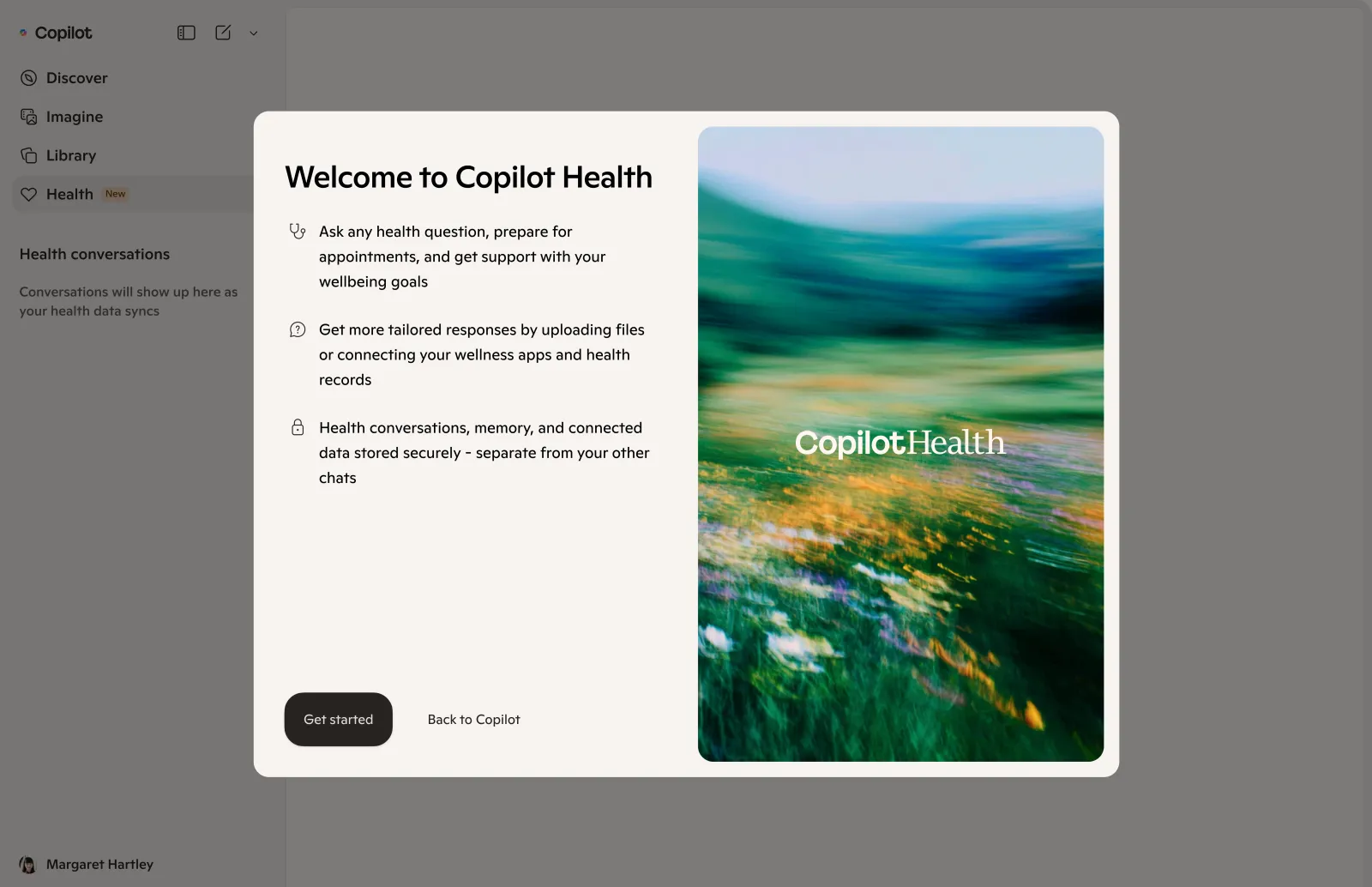
Microsoft unveiled Copilot Health—a separate version of its consumer-facing AI chatbot where users can upload their health records, lab results and wearable device data to receive individualized guidance.
- The Copilot spinoff was informed by an external panel of 230 physicians, according to Microsoft. It was trained on principles established by the National Academy of Medicine and cites materials written by experts at Harvard Health.
- I received a demo ahead of the announcement and spoke with Microsoft health and AI leaders about the tool.
- “We're now in this incredible position where LLMs actually work for the consumer, and we think that is going to mean that over the next few years, everybody is going to have access to a medical super intelligence at their fingertips,” Mustafa Suleyman, CEO of Microsoft AI, told me in an interview. “It is going to be incredibly accurate and reliable. It is going to be able to reason over all of your electronic health records and your wearable data in real time to give you synthesized, personalized insights and support.”
- Stay tuned for more insights from my briefing.
-
Keeping with the theme of public-facing AI assistants, Amazon has expanded its Health AI feature to all users on Amazon’s website and app. Previously, the tool was only available to One Medical users.
- Health AI can also access medical records—if users give permission—and can even pull from a person’s Amazon purchase history to locate relevant health purchases like vitamins or blood pressure cuffs.
- Similar to Copilot Health, it can provide health guidance with or without these medical integrations.
- I chatted with Dr. Andrew Diamond, chief medical officer of Amazon One Medical, at HIMSS on the day of the expansion. He told me that Amazon sees Health AI’s “end-to-end” capabilities as a market differentiator. It can connect patients to One Medical providers and deliver prescriptions via Amazon Pharmacy.
- I asked Diamond how he expects this pipeline to impact patient volume and provider workloads at One Medical. “We are in the process of understanding what the implications are for the human provider workforce, but we're delighted to welcome lots more people to the One Medical family on both the patient side and on the clinician side,” he said.
-
Epic announced that it will continue to expand AI capabilities within the EHR.
- Promised features include conversational AI for clinicians during visits; collaborative visit agendas built off doctors’ conversations with Art and patients’ conversations with Emmie; an “agent factory” platform that will allow health systems to build, deploy and monitor AI agents at their own pace; and a point-of-care tool for differential diagnoses.
-
On March 11, Stryker was the subject of a cyberattack that led to global disruptions within its Microsoft environment, a spokesperson for the U.S.-based med tech company confirmed to Newsweek.
- Cybersecurity analysts have alleged that Handala, an Iran-linked hacktivist group, is behind the attacks. Officials had not yet confirmed a culprit at the time of writing on Wednesday evening.
- This is suspected to be a wiper attack, intended to "destroy or corrupt” a company’s data, by CrowdStrike’s definition—which could cause irreversible damage to Stryker.
- Read more from my colleagues at Newsweek.
Pulse Check
Executive perspectives on key industry issues

...
This week at HIMSS, I connected with Patrick Lane, president and COO of Health Gorilla: a clinical data platform and a designated QHIN under TEFCA. The company is also, as of late, one subject of a high-profile legal complaint from Epic and a handful of its health system customers, including Trinity Health and UMass Memorial Health.
To rehash, Epic claims Health Gorilla enabled a network of companies to fraudulently obtain and sell patient data; Health Gorilla claims Epic is using the courts to tighten its grip on health-data exchange and stifle competition. The case is ongoing, but Health Gorilla filed a motion to dismiss on February 26.
Here’s the emailed statement that I received from an Epic spokesperson that same day: “Medical records are deeply personal and exploiting them is wrong. In their motion, Health Gorilla asserts that they should be dismissed as a defendant in the lawsuit because they had ‘lack of actual knowledge’ of wrongdoing. That is not an acceptable reason—Health Gorilla had a responsibility to safeguard sensitive patient data and know why it was being taken. The public deserves a complete investigation and transparent resolution in federal court. It should not be done behind closed doors.”
In an exclusive interview on Tuesday, Lane shared Health Gorilla’s perspective.
“We must protect our privacy,” Lane told me, “but our privacy is not so important that we need to take it to the grave with us.”
Find a portion of our conversation below.
Editor’s Note: Responses have been lightly edited for length and clarity.
Thanks for taking the time, Patrick. What's been on your mind heading into HIMSS this year?
Expanding access is top of mind for me, both in terms of the quality and usability of data. I started working in interoperability in 2008, left in 2015, and rejoined in 2024—so I was gone for the better part of a decade. I originally left with some degree of cynicism that [interoperability] was much ado about nothing, and came back with enthusiasm, as I saw we were [now] in an era where we could actually expand access, but also enable that access.
Having volumes of health care data is only part of the solution. You really need to be able to turn data into action, and AI is enabling that. That [capability] is certainly not unique to us. It's everywhere around here.
But I think a lot of people believe that interoperability and data access has fundamentally been solved, and that everything we need is digitized. And to some extent, it has been digitized, but it's not accessible. It's not exposed for the interoperability networks. The treatment use case networks that are predominant right now have the most rich, robust data, [but] they probably only tap into about 50 percent of the available data out there. There are a lot of blind spots, and I don't even think we're aware of them until we try to gather up our own health care records as citizens.
People are talking about imaging and such, but there are a lot of spots where the EHRs aren't plugged into the interoperability networks. There are lots of health care providers that aren't traditional or adjacencies—think about dentistry, ophthalmology—they're not exchanging data.
And then you get into the realm of clinically adjacent data. There's clinical grade data that was entered by physicians, and then there's all the other stuff in our lives, like the five years of heart rate [readings] that have been captured by my Garmin, all those steps and dietary choices. That stuff is valuable, but it’s not brought into our care.
So I get excited [about the possibilities]. I feel like somebody is discovering the New World, because I look at health care data like I would look at Europe in the 15th century. They thought the whole world was Europe, and that everything had been discovered. And then—wait—here’s America, here’s South America, here’s Asia.
[Similarly], there's a lot more undiscovered country than discovered country [in health care data]. And as a data network and an on-ramp, that's what gets me really excited. Where we're going, data is everywhere.
Where do you see Health Gorilla sitting in this ecosystem? How would you define your role?
Because we are at the center of the current known world, we're in a position to start to navigate the fringes, to go discover new areas: you know, that area of the map where there'd be “monsters” or whatever. There’d also be data out there.
Health Gorilla distinguishes ourselves by partnering with innovators in this space, which has never been more important than it is now. EHR companies have the traditional health care providers that have existed for 100 years—they’ve got them handled. We partner with the Silicon Valley startups that have unique AI combined with clinical insight. That could be a 12-person firm that doesn’t know how to navigate this area.
That actually puts a lot of regulatory stress on us as well, because it's easy to validate a 15,000-person, traditional hospital network that has a billion dollars for an EHR. But if you're a startup practice in San Francisco that has a wonderful algorithm that could help us identify and treat a variety of cancers, but you don't understand how to navigate this regulatory jungle, we have to be their guide. There are a lot of opportunities out there, and a lot of pressure for us to get it right. But if we don't do it, who is going to do it? Who's going to be the group that works with the innovators, who's going to take that stress?
We need the government's help sometimes, to take some of the risk of those judgment calls. We believe that there should be more centralized vetting, particularly for the treatment use case, that would alleviate a lot of the concerns for fraud.
But quite frankly, I see it much more concerning to open up access. I think that access and privacy aren't a choice; they can both be delivered, and it was really reassuring to see that ASTP and the U.S. government agree with us. We did a little metadata analysis at the ASTP User Conference, and the top three themes were information blocking (mentioned 200 times), TEFCA (175 times), AI enablement (150 times). And fraud was mentioned three times.
That doesn't mean fraud doesn't exist, but fraud exists in every single network. If there's an important network out there, it will be misused at some point. You have to devise policing, increasingly sophisticated controls.
Think about how we operate in the financial world. I mean, we all have credit cards. There has been a fraudulent transaction on your credit card, maybe every month. Sometimes you don't even notice it, because it gets removed before it gets to your billing statement. But the credit card companies and the government have developed rigorous fraud detection, and they get it out of the system before it becomes a problem that gets in the way of the purpose, which is financial liquidity.
In this case, we want data liquidity for valid purposes. We'd like to see more centralized vetting, because we think the government's in a position to come up with clear standards and a central vetting authority that isn't left up to lots of edge case variants. We also think that the federal government should be at the center of information blocking, which is what they are doing, really for the first time.
We must protect our privacy, but our privacy is not so important that we need to take it to the grave with us. That's where information blocking enforcement comes in. I want access to my health care data. I want it with my permission, and I want fine-grained consent controls. That's the future I want, because that allows us to use the health care data for all the purposes that serve our lives, all the purposes that we should control.
It's very hard to do that when there's a climate of fear, uncertainty and doubt, but we're going to persist. We are a 75-person company that is getting shots taken at us by the world's largest health care IT company. But we're not rolling over. We're not giving up. You've seen our press release strategy. We're not saying, “Oh, we're scared.”
We believe we did our job. We're going to continue to do our job.
What do you see as the biggest risk if large health care corporations “gatekeep” their data (as opponents might say), or prioritize data privacy and security over all else (as defenders might say)?
The risk is missed opportunity to expand our lives and save lives. Large, entrenched entities are great because they’re predictable. They are a bedrock foundation, but they're not innovation hubs. They don't move nearly as fast as the entrepreneurial class, and they will not lead in innovation. They will always trail.
We have an opportunity to really scale worldwide health care with the use of AI in an intelligent, responsible manner, and the risk is that [opportunity] it will be lost. Our health care spend can be 10 times more productive, and it can happen in the span of years, not decades. AI has allowed us to move so much faster—at least when you have enough subject matter expertise involved to prevent bad things from happening.
What do you think hospital and health system leaders should be watching at the federal level when it comes to data liquidity and interoperability policy?
They should be paying close attention to the first ever information blocking enforcement actions. I don't mean that as a scare tactic; it's just going to focus on the fact that the data belongs to the patients. It doesn't belong to the physicians, it doesn't belong to the hospitals, it doesn't belong to the EHRs and it sure as heck doesn't belong to my network. It belongs to the people.
I think that the unlock of that data for all person-authorized purposes is something they should be paying attention to, because these people [health care professionals] are in it for the right reasons. Whether you're at a large institution or small institution, I believe you entered the medical practice because you wanted to help humanity. This is how we help humanity, not just here in the United States, but in the world.
But to do so in an AI-enabled era, you've got to get over these persistent silos. We cannot fall victim to the temptation to destroy networks, to cast fear, uncertainty and doubt in them. I am worried that is going to slow things down at a critical moment, when we could be moving fast.
C-Suite Shuffles
Where health care leaders are coming and going
-
Dr. Tim Ferris was named vice president of InterSystems’ health care practice.
- He joins the software and technology company from Red Cell Partners—a venture capital firm that invests in tech companies for health care, cyber and national security—where he was the president.
- Previously, Ferris served as the national director of transformation at England’s National Health Service (NHS), CEO of the Massachusetts General Physicians Organization and senior vice president for population health at Mass General Brigham.
-
Yale New Haven Health selected Arnim Dontes as its CFO, effective April 1.
- Dontes is sliding to the New Haven, Connecticut-based academic health system from Yale School of Medicine, where he spent the past five years as deputy dean for finance and administration. He previously served as executive vice president for business affairs at the University of Texas Southwestern Medical Center in Dallas.
-
Mark Clement is set to retire as president and CEO of TriHealth, the Cincinnati-based system announced on Tuesday.
- Clement will step down on June 30 after 11 years with the health system. Terri Hanlon-Bremer, TriHealth’s current COO, will succeed him.
This is a preview of the March 12 edition of Access Health—Tap here to get this newsletter delivered straight to your inbox on Thursday mornings.
View 0 Comments
Submit Correction
View Editorial & AI Guidelines