...

By Newsweek Editors
0
Share
Newsweek is a Trust Project member
See more of our trusted coverage when you search.Prefer Newsweek on Googleto see more of our trusted coverage when you search.
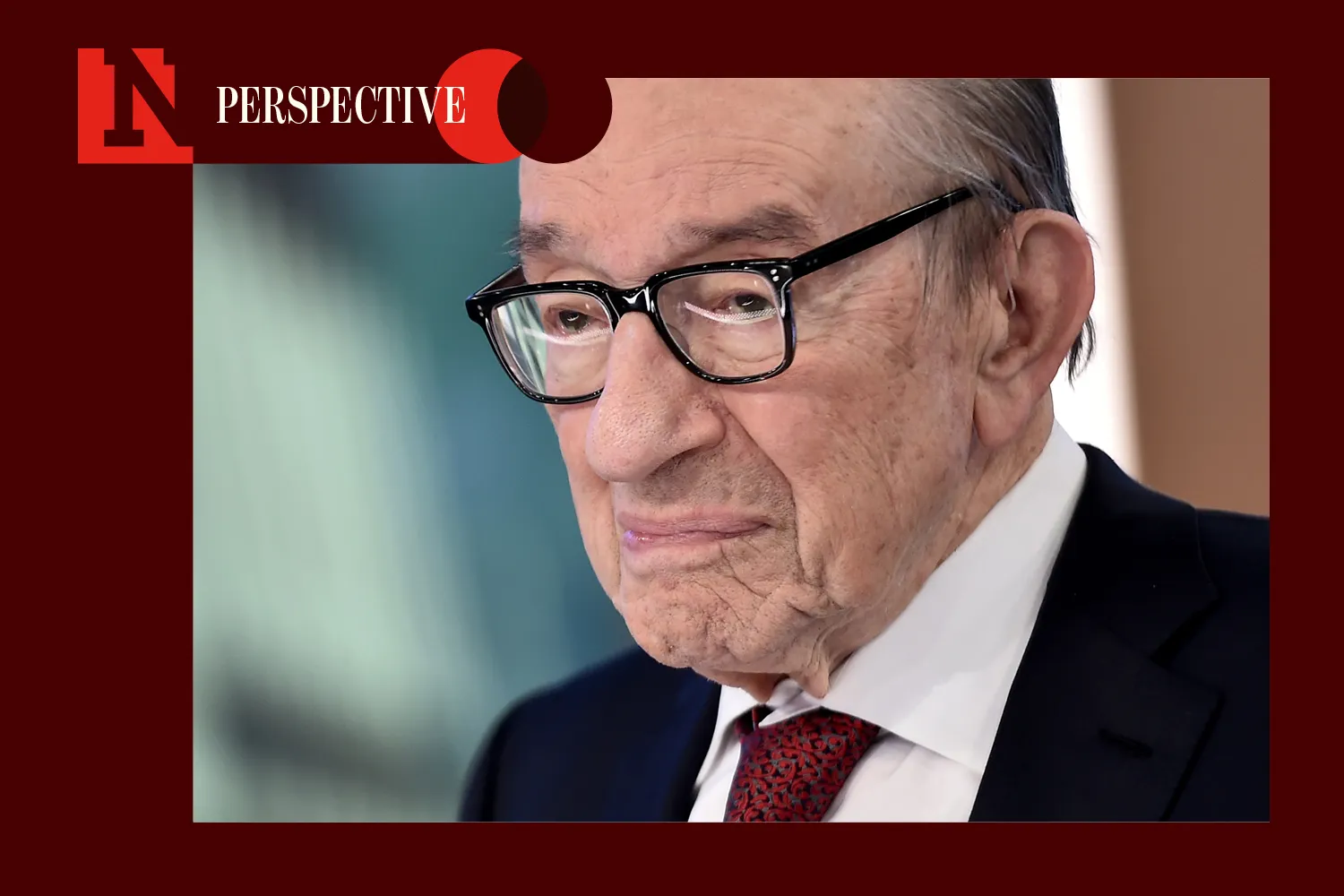
Alan Greenspan died with a résumé almost too neat for Washington mythmaking. He was nicknamed the "Maestro" for good reason.
Five terms as Federal Reserve chairman, appointment by four presidents, a response to the 1987 crash soon after taking office, and a reputation for consensus-building during an era many credited him with helping sustain.
But Greenspan, who died at his home aged 100 after complications from Parkinson’s disease, was also the Fed chair who oversaw the deregulation that led to the 2008 financial crisis.
Read More on Analysis
Or, perhaps more accurately, did not see what he oversaw—the systemic fragility that aggressive financial deregulation had created.
The timing of Greenspan's passing—and the final lesson of his career—gives Donald Trump an awkward inheritance.
Trump had nominated Kevin Warsh as chair of the Fed while pushing for lower interest rates and after repeatedly attacking Jerome Powell for not cutting much sooner.
The president's interventions had upended decades of convention on non-political interference in monetary policymaking.
It also exposed a fallacy that Greenspan himself had pushed back against.
Call it the cult of the chairman: the belief that the right face at the Fed can bend inflation, markets and politics to a president’s preferred script.
Straight From Central Casting
Trump had literally referred to Warsh, who had been an economic adviser to George W. Bush and later a Fed governor, as from "central casting," adding that he "will never let you down."
Powell, by contrast, was pilloried as "dumb," "stubborn," and "too late" to act on rates.
It's rhetoric that turns monetary policy into a casting decision, one that imagines the Fed chair as a star performer whose instincts, loyalty, look, and nerve can fix what committees, models, mandates, and bond markets complicate.
The simplicity of the appeal is obvious. Inflation is painful, rate policy is obscure, and presidents want someone voters can blame when borrowing costs stay high. A single chair gives the public a face.
No modern Fed chief did more to make that face look magical than the policy oracle Alan Greenspan.
Greenspan was known for building consensus on the FOMC and was credited by many with helping facilitate what was then the longest official U.S. expansion.
Trump's error is to treat the oracle role as the job. Greenspan's career suggests something else.
The more successful a Fed chair appears, the easier it becomes to mistake institutional good fortune, committee management, and economic uncertainty for personal mastery.
Greenspan the Flawed Oracle
The Greenspan legend had substance. Ronald Reagan nominated him in 1987, and his tenure ran all the way until January 2006.
Greenspan led the central bank through two recessions, the Asian financial crisis, and the aftermath of September 11.
He had a reputation for being strongly anti-inflation and focusing more on prices than full employment.
If Trump wants a Fed chair who seems to project authority through manner as much as through policy, Greenspan is the model lurking behind the Warsh moment.
His record made the chairmanship seem personal in the most flattering way.
Greenspan appeared to know when to speak, when to blur, when to move, and when to let markets infer the rest.
Then came the hearing that should have weakened the cult.
In 2008, Greenspan openly told the House Oversight Committee that his way of thinking was flawed in the aftermath of the devastating global financial crisis.
"I found a flaw in the model that I perceived is the critical functioning structure that defines how the world works, so to speak," Greenspan said, referring to a laissez-faire approach to financial regulation.
It is a stunning admission that punctures his own mythology.
Greenspan did not confess to lacking intelligence, stature or experience. He acknowledged that a core model failed after decades in which it seemed to work.
The danger was much deeper than a bad chair. It was the human need to treat a long run of plausible judgment as proof that one person had solved uncertainty.
Warsh Still Matters
The chair is no ornament, of course. The rate-setting FOMC, now chaired by Warsh, has 12 members.
Fed chairs have historically wielded major influence over the committee and helped build consensus.
Warsh is already proving that a chair can change the institution’s style.
He is moving the central bank away from forward guidance and toward shorter statements, tighter press conferences and a model of central banking more evocative of the tight-lipped Greenspan era.
In his June 17 press conference, his first as chair, Warsh said the statement was "a bit shorter, a bit simpler" and said forward guidance was absent because it was unsuited to the moment.
That is a real chair-driven change. It affects market expectations, investor behavior and the Fed’s public posture.
Greenspan's Lesson
Warsh can set tone, impose priorities, discipline the message and shape the room.
But the cult of the chairman begins when those powers are inflated into the fantasy of command.
The Fed's dry institutional facts—including its economic role of promoting maximum employment, stable prices, and moderate long-term interest rates—matter more than Trump’s casting language.
A chair can dominate a meeting and still face a committee, a statute, incoming data, market reactions, global shocks, and the lag between interest-rate decisions and economic results.
Greenspan understood that well.
Warsh’s first statement cited solid growth, elevated uncertainty tied partly to Middle East conflict, supply shocks and inflation above the 2 percent goal.
His own press conference described the mission as getting monetary policy right "or as near to it as we can do."
That is the anti-cult sentence, a central banker’s confession of his limits.
It is also Greenspan’s last lesson for Trump. The Fed chair is the most visible human being in a system designed to resist single-person rule.
Trump may get a chair who talks less like Powell and more like Greenspan. He may get a chair with a different theory of communication, a different view of forecasts, and a stronger appetite for institutional reform.
But as we reflect on Greenspan's legacy and impressive career, there's a harder lesson for Trump.
Even the greatest chair-personality story ended with a model that failed.
In a polarized era, the center is dismissed as bland. At Newsweek, ours is different: The Courageous Center—it's not "both sides," it's sharp, challenging and alive with ideas. We follow facts, not factions. If that sounds like the kind of journalism you want to see thrive, we need you.
When you become a Newsweek Member, you support a mission to keep the center strong and vibrant. Members enjoy: Ad-free browsing, exclusive content and editor conversations. Help keep the center courageous. Join today.


View 0 Comments
Submit Correction
View Editorial & AI Guidelines