10
Loading video...

By Marni Rose McFall
Reporter
0
Share
Newsweek is a Trust Project member
See more of our trusted coverage when you search.Prefer Newsweek on Googleto see more of our trusted coverage when you search.
Researchers are set to head to a remote island in the Pacific Ocean in the hope of discovering and investigating what they believe could be the wreckage of American aviator Amelia Earhart’s Lockheed Model 10E Electra.
Earhart vanished while attempting to become the first female pilot to fly around the world in what became one of the most compelling mysteries of the 20th century.
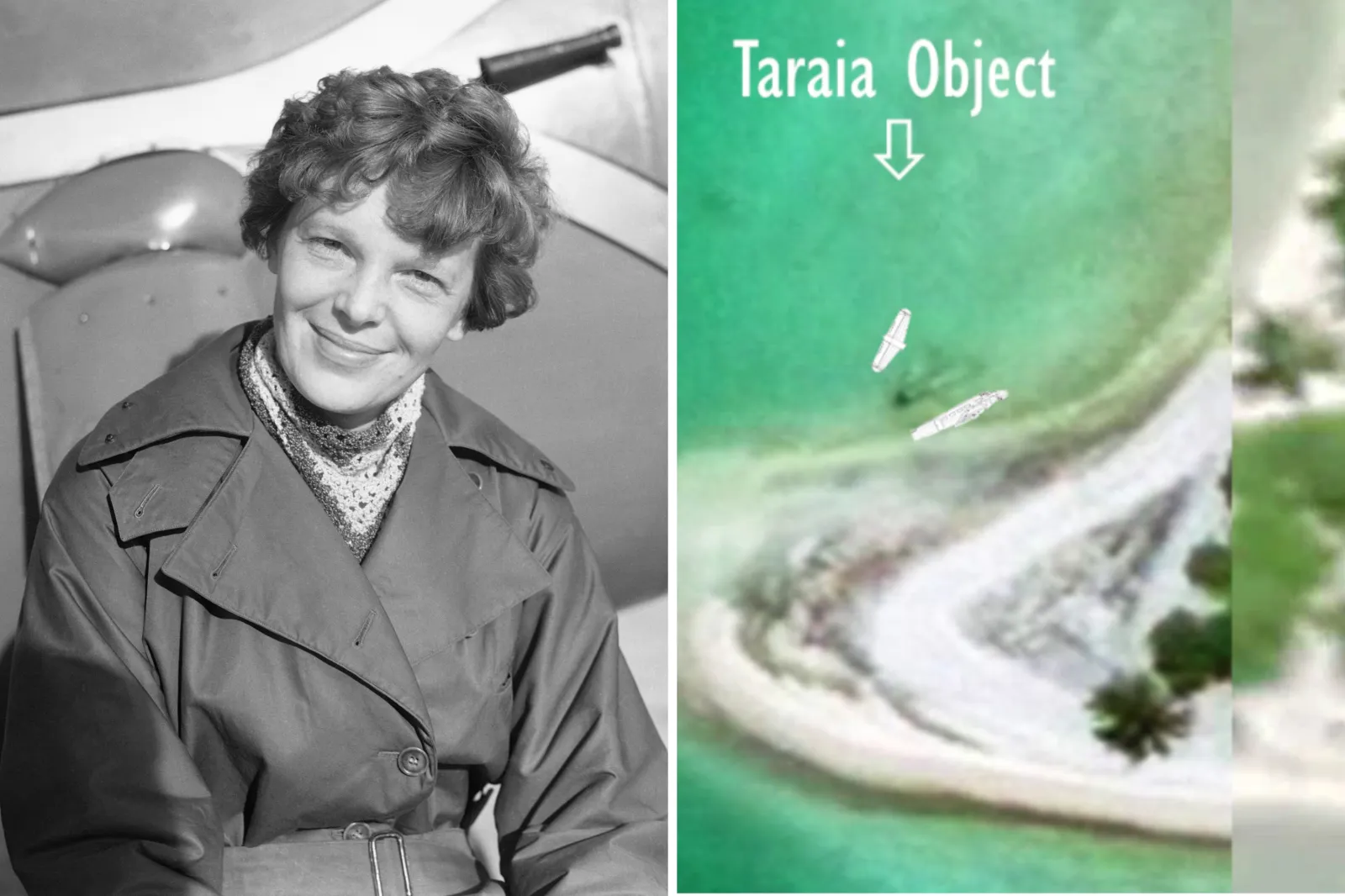
In 2020, an object was discovered in an Apple Maps image. It has been speculated that it captures a submerged object that could be the wreckage.
Read More on News
Now, a 17-person crew is set to head to the potential crash site on Nikumaroro in the island nation of Kiribati.
Leading the expedition is Dr. Richard Pettigrew, executive director of the Archaeological Legacy Institute.
“This case has taken a long time,” Pettigrew previously told Newsweek in an exclusive interview. “But we have some new evidence. There’s an object visible in the Nikumaroro lagoon. Everything that we see indicates it’s very possible, perhaps even likely, that this is what remains of Amelia Earhart’s aircraft.”
...
Who Was Amelia Earhart?
Earhart was an American aviator and aviation pioneer.
She became one of the first female passengers to cross the Atlantic by plane in 1928, and in 1932 she became the first woman to make a nonstop solo transatlantic flight.
In 1937, she disappeared over the Pacific Ocean as she attempted to become the first female pilot to fly around the world.
When she disappeared, Earhart worked at Purdue University as a women’s career counselor and an adviser to Purdue’s Aeronautics Department.
The Taraia Object Expedition is being funded by Purdue University and the Archaeological Legacy Institute.
President Donald Trump in 2025 ordered the FBI to “declassify and release all government records” related to Earhart and her final flight.
Related Story

Is This Amelia Earhart’s Plane? Researchers Say They’re Ready to Find Out
What Is the Taraia Object?
The Taraia Object is the name given to an unusual shape visible in satellite imagery of the lagoon at Nikumaroro, a remote island in the Pacific nation of Kiribati. Researchers believe that it could be the submerged remains of Earhart’s plane.
The object first attracted attention in 2020, when researcher Michael Ashmore spotted it while examining Apple Maps imagery.
When researchers looked back through older satellite images, they found that the shape was already visible in imagery captured in 2015, years before it was brought to their attention.
The earlier appearance has become an important part of the investigation. Researchers believe Tropical Cyclone Pam, which struck the region in March 2015, may have shifted sediment around the lagoon, potentially exposing an object that had previously been buried or obscured.
The feature has attracted interest because its apparent size, elongated outline and reflective surface bear similarities to parts of an aircraft fuselage and tail. Researchers have also identified what they believe could be the same object in other imagery, including aerial photographs and drone footage.
However, its identity remains unconfirmed. The shape could have a natural explanation, and satellite images alone cannot establish whether it is aircraft wreckage, let alone whether it belongs to Earhart’s plane.
Now, researchers from the Archaeological Legacy Institute and Purdue University are preparing to investigate the site directly. Their expedition to Nikumaroro is intended to establish what the object actually is, using underwater surveying and archaeological techniques to examine the anomaly more closely.
What to Know About the Expedition
In a press conference from Purdue University shared on YouTube, Pettigrew said: “There’s something in the lagoon that shouldn’t be there. We see this in satellite imagery, and upon further research we see it in other imagery from earlier times.”
“It seems to be pretty big; it seems to be a shiny metal thing, and it is hundreds of miles from the nearest inhabited place,” Pettigrew said, adding that evidence indicates Earhart had been on the island.
“It’s important for us to go there and look at it," he said. "We have to identify it. We have to confirm the hypothesis.”
If the Taraia Object proves to be the Electra, though, the mission won’t stop there, as further expeditions will be needed for it to be excavated and recovered.
“We would plan to come back the following year and plan to do a full-scale archaeological excavation,” Pettigrew said in the press conference.
The expedition to Nikumaroro will launch on October 7.
Contact Newsweek editors on this story: Ben Kelly and Dave Siminoff.
View 0 Comments
Submit Correction
View Editorial & AI Guidelines