Newsweek/Getty

By Giulia Carbonaro
Senior Reporter
0
Share
Newsweek is a Trust Project member
See more of our trusted coverage when you search.Prefer Newsweek on Googleto see more of our trusted coverage when you search.
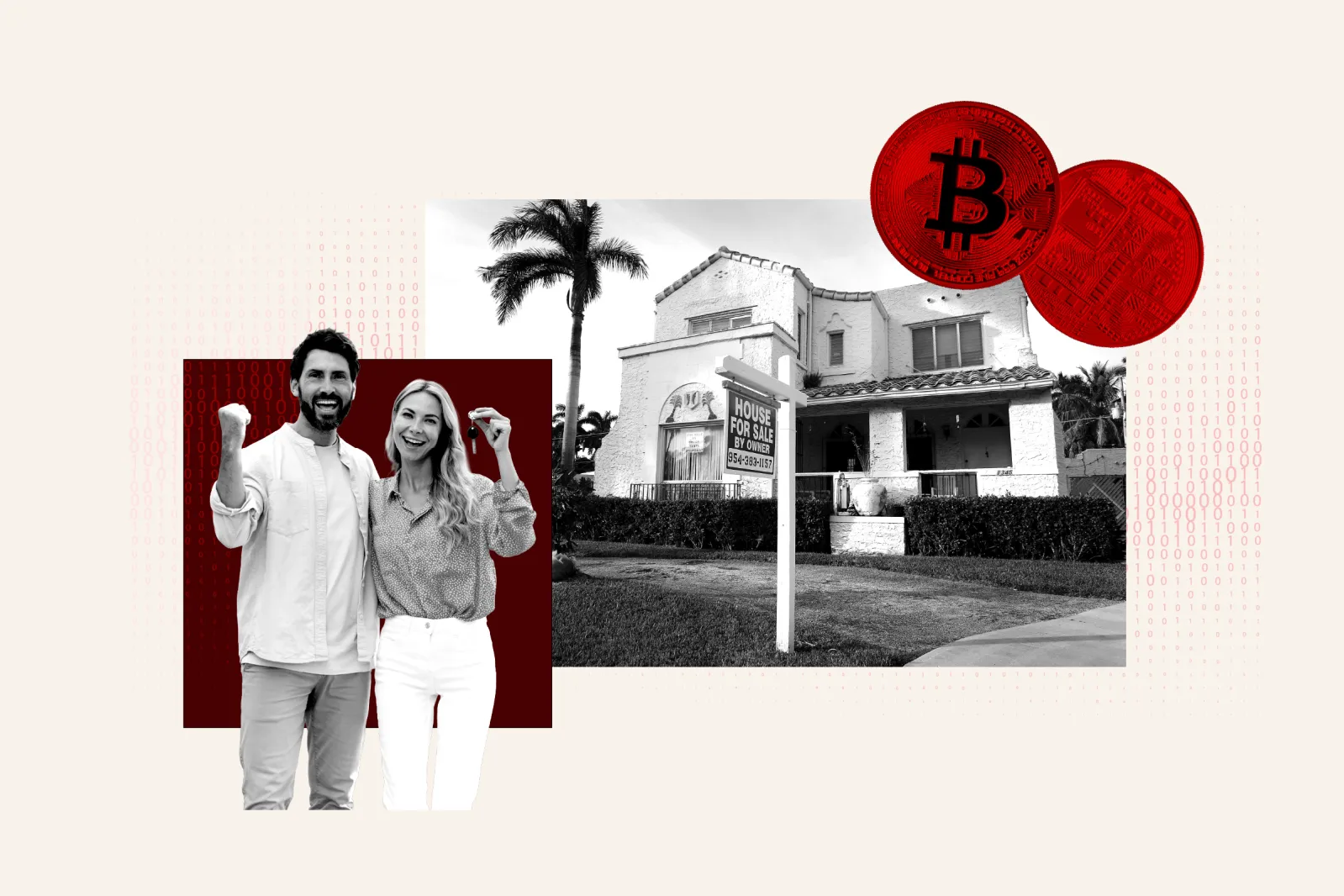
In an increasingly uncertain economic landscape and an often hostile housing market, many Americans are approaching the dream of homeownership in a way their parents and grandparents would not have even dreamed of: with cryptocurrency.
Americans’ interest in bitcoin, Ethereum and other cryptocurrencies has grown massively in recent years, especially among young people. More than 70 million people in the U.S.—about 30 percent of American adults—own cryptocurrency, with roughly one in three holders age 30 to 44, according to the latest data by consumer research company Security.org.
Until now, crypto holders who wanted to use their assets to buy a home in the U.S. could either convert them into fiat currency via a reputable exchange and then fund the purchase in a conventional way or find a buyer who would accept crypto directly. The first strategy can trigger significant capital gains and/or income taxes for the buyer (far from ideal), while the second happens rarely.
Read More on News
Now, Fannie Mae said it will accepts crypto-backed mortgage products, allowing homebuyers to use Bitcoin (BTC) or USD Coin (USDC) as collateral for down payments without selling their digital assets, they can use their crypto assets as mortgage collateral. This will open the crypto wealth world to the most traditional of real-world purchases: homebuying.
Newsweek/Getty
What Is Changing for Crypto Holders?
The Federal Housing Finance Agency (FHFA) directed Fannie Mae and Freddie Mac last year to prepare proposals for consideration of cryptocurrency as an asset for reserves in their single-family risk assessments, without requiring a conversion to dollars.
Under the proposal, only crypto held on U.S.-regulated exchanges such as Coinbase would qualify.
A homebuyer would take out two loans: a traditional 15- or 30-year Fannie-backed mortgage from the mortgage company Better Home & Finance, and a separate loan, backed by either bitcoin or USDC, a popular stablecoin, to fund the down payment on the first, replacing a cash down payment. Once crypto is pledged as collateral, it cannot be traded.
The loans, which are then combined into a single interest rate, term and monthly payment, do not change if the value of crypto falls—as long as the borrower keeps making their monthly payments.
Major cryptocurrencies are seeing mixed performance today amid broader market shifts: bitcoin (BTC) is trading around $76,960, while ethereum (ETH) sits at nearly $2,130, based on Yahoo Finance data.
If pledging bitcoin, the collateral value must be at least 250 percent of the down payment loan, according to Yahoo Finance, while if pledging USDC, the initial value must be at least 125 percent of the down payment loan.
If approved for a loan by Better, borrowers using Coinbase would be eligible for a lender credit against closing costs equal to 1 percent of the mortgage amount, up to a maximum of $10,000.
Regardless of the fine details, Fannie Mae’s crypto-backed mortgages are a massive change for crypto holders unwilling to sell their crypto investment to help fund their down payments, as they are now able to use these assets to become homeowners without turning them into cash.
While not the first crypto-backed mortgage in the country, it is the first accepted by Fannie Mae, which is still under government conservatorship despite talks by President Donald Trump to privatize the two mortgage finance giants.
“This is a niche offering with one lender and one crypto exchange, but it’s important that Fannie Mae will back mortgage loans Better makes that use associated Coinbase crypto loans to fund down payments,” Jeff Taylor, who sits on the board of the Mortgage Bankers Association MBA and is founder and managing director at Mphasis Digital Risk, said in a statement shared with Newsweek.
“Fannie Mae often pilots programs with select parties this way before allowing mainstream adoption.”
“Most people building wealth today aren’t doing it through savings accounts. They’re doing it through stocks, crypto, and other assets, and the mortgage system has been telling them they can’t use any of it to buy a home,” Vishal Garg, CEO of Better, told Newsweek in a statement.
“They’re forced to liquidate their portfolios and trigger painful tax penalties. The down payment bottleneck affects many who are cash-poor but have built up their wealth through other assets,” he added. “We believe the crypto-backed mortgage is a massive step forward in bridging the gap between our onchain future and the traditional tenets of the American Dream.”
The only downside for crypto holders wanting to buy a home is that taking out a second loan makes it more expensive than for conventional borrowers.
The crypto-backed mortgages are not available just yet, but their implementation is imminent. A waitlist to join a pilot program is available online.
A Better spokesperson told Newsweek that the company, together with Coinbase, will announce their “exact plans for availability in the coming weeks, with our current target being Q3 of this year.”
They added: “We’re excited to see strong interest in the crypto-backed mortgage since our March 2026 announcement. There are ~500 prospective borrowers on our waitlist, signaling early demand for the product.”
Revolution for Younger Generations
The new mortgage product has been immediately portrayed as something that younger Americans will take advantage of more than their older peers.
“Token-backed mortgages are a major first step to unlocking homeownership for the younger generations that have struggled with barriers to saving for a traditional down payment,” Max Branzburg, head of consumer and business products at Coinbase, said in a March press release.
That is because younger people appear more interested in crypto than older Americans, and many are desperate for a way to step onto the property ladder at a time when the country is facing a years-long housing affordability crisis with no clear end in sight.
A study published last summer by Redfin found that more than one in 10 (12.7 percent) young homebuyers—including Gen Zers and millennials—were using cryptocurrency to help fund their down payment in May 2025.
Among the older generations, the share of buyers using crypto to finance their purchase was much lower: only 3.5 percent of Gen Xers and 0.5 percent of baby boomers sold crypto investments to fund their down payment.
Young people view bitcoin and other cryptocurrencies as “real money that holds and grows in value, perhaps even more than fiat money, therefore it's easier to create a ‘stacking goal’ or savings goal and be more disciplined and frugal,” Yaël Ossowski, deputy director at the Consumer Choice Center and a fellow at the Bitcoin Policy Institute, previously told Newsweek.
“A lot of people who shun traditional financial tools or plans have put more of their hope in cryptocurrencies like bitcoin because it at least has a chance of appreciation,” Ossowski said.
“With the backing of Fannie Mae, this is just the first step toward meaningfully integrating digital assets into the core financial infrastructure of the U.S. housing market,” said Mark Troianovski, the head of Consumer and Platform Business Development at Coinbase.
“We can build the foundations for a trusted crypto-backed financing framework that can eventually grow outward to other asset classes and industries,” he added. “It goes hand-in-hand with our vision for a world where every asset can be tokenized, and where consumers around the world can leverage any part of their balance sheet to secure property at market-low conforming rates.”
Are you a young person who just bought a home using crypto assets, or considering doing so? I’d love to hear from you. Contact me at g.carbonaro@newsweek.com.
Trump Is Behind the Push for Crypto
Trump and his administration are largely behind the recent push to embrace cryptocurrency within the mainstream in the U.S., which has included the establishment of a Strategic Bitcoin Reserve and the appointment of David Sacks as the nation’s first “crypto czar.”
In June 2025, FHFA Director William Pulte ordered Fannie Mae and Freddie Mac to prepare to count cryptocurrency in mortgage risk assessments—as Fannie has done—saying the move was in line with the president’s vision of making the country “the crypto capital of the world.”
But the U.S. is not exactly being swayed by the promise of crypto, as volatility, security concerns and regulatory oversight remain issues for many.
The poll run by Security.org, which surveyed 992 U.S. adults, found that 61 percent of current crypto holders plan to invest even more in digital currencies this year, while just 6 percent without crypto plan to join the market in 2026.
Correction 5/21/26, 11:19 a.m. ET: The article previously incorrectly stated that the FHFA had directed Fannie Mae to accept crypto-backed mortgages. It only directed Fannie Mae and Freddie Mac last year to prepare proposals for the consideration of cryptocurrency as an asset for reserves in their single-family risk assessments, without requiring a conversion to dollars.
View 0 Comments
Submit Correction
View Editorial & AI Guidelines