10
Loading video...

By Mark Hannah
0
Share
Newsweek is a Trust Project member
See more of our trusted coverage when you search.Prefer Newsweek on Googleto see more of our trusted coverage when you search.
As Washington spends billions to weaken Iran, it may be damaging one of its most important strategic relationships: the one with India.
I felt the geography of that miscalculation somewhere over the Arabian Sea, on a flight back to New York from Mumbai. When I landed, I learned that Iranian missiles had been fired toward the U.S. military base on Diego Garcia around the time we were in the air over the same ocean.
The Iran war is widely seen as a Middle East story. On my trip, however, it looked like a war spilling into India’s strategic neighborhood, with consequences for a relationship the United States can't afford to mishandle.
Read More on Opinion
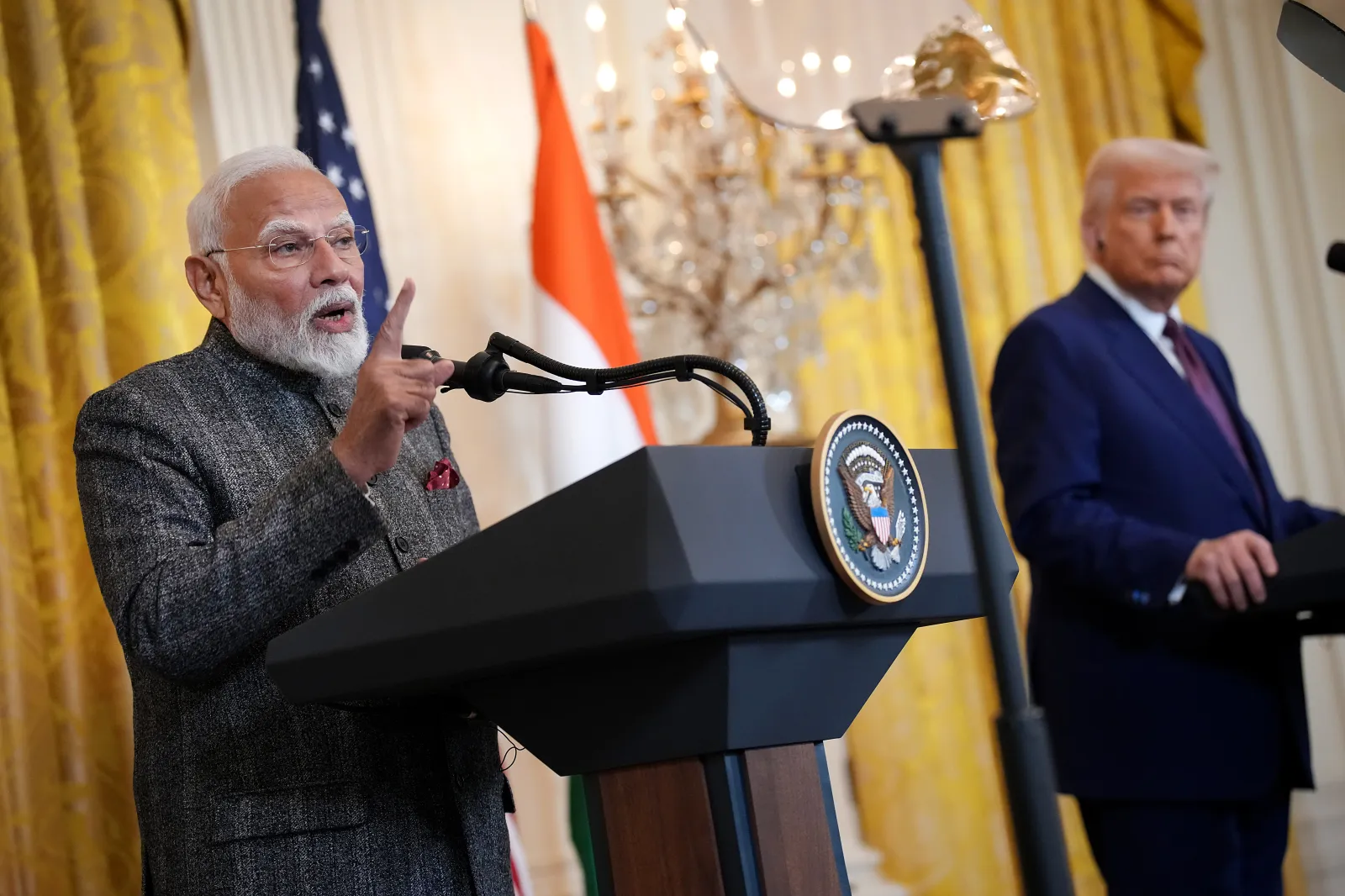
The timing could hardly be worse. Last year, Prime Minister Narendra Modi visited the White House where President Trump called India a “great friend” and praised the India-Middle East-Europe Economic Corridor, or IMEC, as a historic trade route. The corridor was meant to anchor U.S.-India ties for decades, linking Indian ports to Europe and offering a counterweight to China’s Belt and Road Initiative.
...
On that trip to India a few weeks ago, I stopped in Gujarat to see two projects developed by Adani, the Indian energy and infrastructure conglomerate: Mundra Port, India’s largest commercial gateway handling roughly a third of its container traffic, and Khavda, where Adani is building what will be the world’s largest renewable energy plant—a wind and solar complex covering an area nine times the size of Manhattan.
The president of an American energy industry association traveling with me remarked nothing like it could be permitted, let alone built, in the United States. These are not aspirational projects; they are already underway, and they represent the industrial scale and market ambition that brought Modi to the White House. Then came a war.
The Iran war makes this vision harder to sustain. The conflict disrupts shipping, raises fuel costs and deepens uncertainty across the very region IMEC is supposed to traverse. Even if the corridor was always a long-term project, the war has made it less viable.
That matters because India is the world’s largest democracy and a pivotal one at a moment when democratic governance is being contested internationally. Its economy is among the world’s fastest-growing and is expected to become the third-largest within a decade or so. It is a technological power, a major supplier of pharmaceuticals, and an increasingly central player in the Indo-Pacific balance. It is, in short, a country that rewards serious strategic attention.
What it has received instead is strategic whiplash.
Over the past year, Washington has pressured New Delhi to reduce purchases of Russian oil, threatened punitive tariffs and then partially reversed course in a trade deal. Each move may have had its own rationale. Together, they have reinforced an impression inside India that the United States can be a valuable but unpredictable partner.
The Pakistan piece has not helped. As Washington presses India, Pakistan emerges as a regional intermediary in de-escalation talks between the U.S. and Iran. The optics inside India are bad. Pakistan is a longstanding strategic rival, and a critical factor in India’s security thinking, especially for a generation of Indian bureaucrats shaped by partition, cross-border conflict, and suspicion of outside power politics. A U.S. approach that pressures India while giving Pakistan new diplomatic relevance reinforces the older mindsets Washington should want India to move beyond.
It is a costly mistake because India is not simply choosing between Washington and Beijing. It is emerging as a power with growing capacity to shape its own strategic environment.
Its importance lies not only in its size, its growth, or its location, but in the possibility that it can help define what democratic strength looks like in a more multipolar century: sovereign, non-Western, ambitious, and increasingly capable of modeling (not mimicking) what democracy can be. That is the more interesting reality than all the superficial talk of a new Cold War. India is not a pawn on someone else’s geopolitical chessboard. It is becoming a player in its own right.
That is why the most important audience for American policy may be India’s next generation of leaders. A younger cohort of Indian officials, strategists, and business leaders is less enthralled to the logic of Cold War nonalignment and less inclined to see every U.S. initiative as a prelude to dependency. They are more willing to work with Washington, not as junior partners in an anti-China bloc, but as representatives of a rising power with interests of its own.
The danger of this war is not simply that it pushes India away. It is that it vindicates the older view inside India that American power is too erratic, too militarized, and too costly to trust.
But that outcome is not inevitable. A disciplined American exit from this conflict, one that restores commercial stability and avoids a wider regional war, would do more than limit the damage. It would create space for India’s rising generation to argue that engagement with the United States can strengthen India’s agency rather than diminish it. It would give them more room to push back against a stale worldview that treats distance from Washington as the safest expression of Indian sovereignty.
That is the opening Washington should care about. The real opportunity is not to pull India neatly into an American camp. It is to build trust with a democratic power increasingly able to act with its own weight, and in ways that will matter far beyond that region.
Iran may be the immediate crisis but India is the larger opportunity. Washington should end this war with that prioritization in mind.
Mark Hannah is chief executive officer of the Institute for Global Affairs, an independent nonprofit education organization housed at Eurasia Group.
The views expressed in this article are the writer’s own.
View 0 Comments
Submit Correction
View Editorial & AI Guidelines