...

By Dan Gooding
Associate News Editor
0
Share
Newsweek is a Trust Project member
See more of our trusted coverage when you search.Prefer Newsweek on Googleto see more of our trusted coverage when you search.
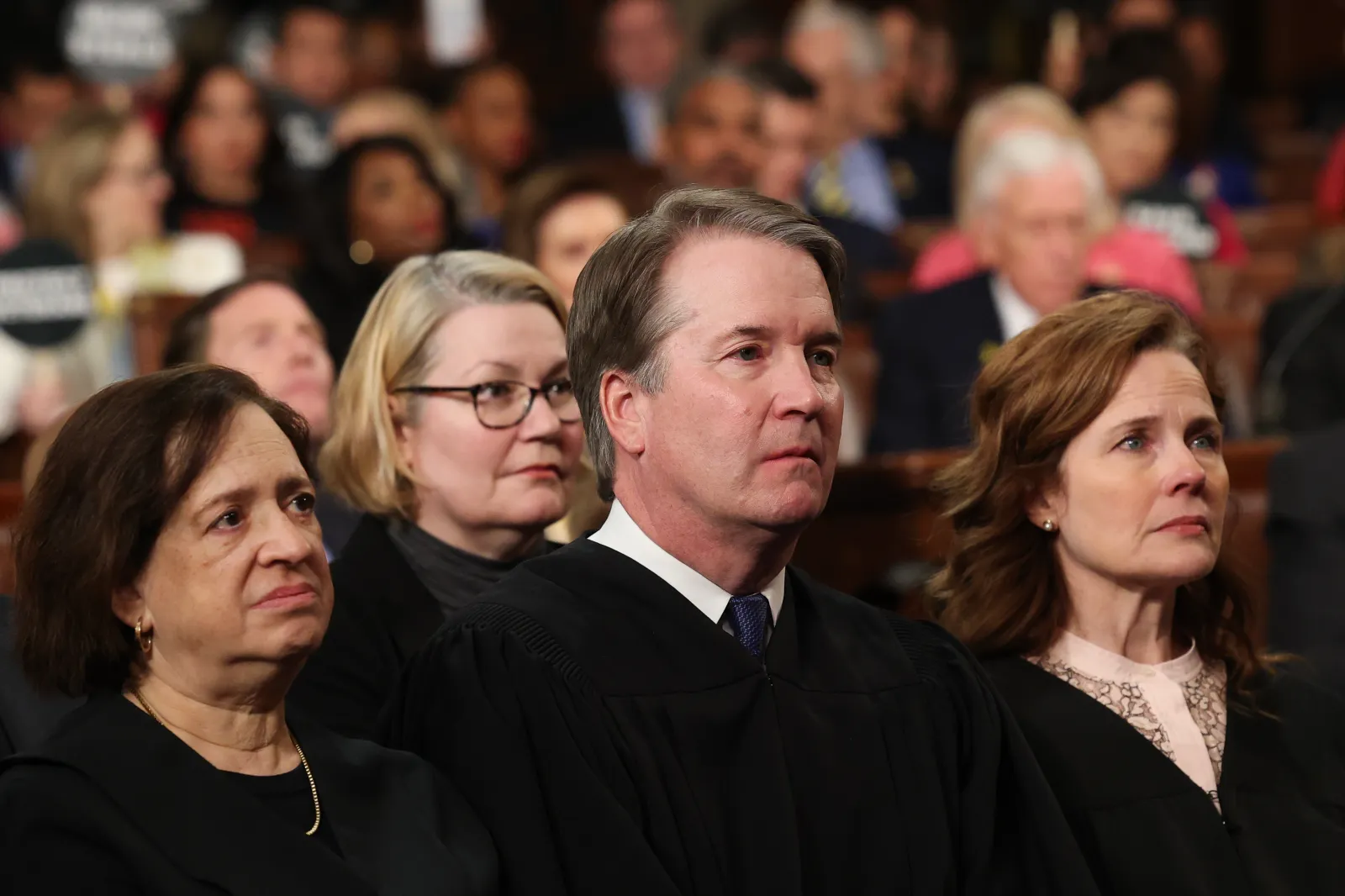
Two members of the Supreme Court—Justices Amy Coney Barrett and Elena Kagan—are set to make a rare appearance before House and Senate appropriations panels Tuesday, as the judiciary seeks additional funding for security amid a yearslong rise in threats against jurists.
The appearance is unusual not only because Supreme Court justices seldom testify before Congress, but also because the request comes at a moment when concerns of judicial security have become a defining issue across the federal court system.
According to the judiciary's fiscal year 2027 congressional budget request, security incidents deemed "of significant concern" by the U.S. Marshals Service rose 57 percent for judges in fiscal year 2025 and are on pace to increase again in fiscal year 2026. The document says the trend has made protective programs "more urgent than ever."
Read More on Politics
"The funding they seek for added security is testament to the hyper-polarized era in which we live," Charles Gardner Geyh, judiciary professor at Indiana University Bloomington, told Newsweek. "Federal judges have always had to worry about unhinged litigants threatening the lives of judges who rule against them. But what we are witnessing now is something new.
"President Trump has ramped up his attacks on lower court judges who enjoin his executive orders, calling them radicals and monsters. And he has attacked Supreme Court justices who rule against him, which incites his base to threaten the judges he singles out."
...
Why Are Barrett and Kagan Appearing Before Congress?
The justices' testimony centers on the judiciary's FY2027 budget request, which seeks substantial new spending on judicial security at both the Supreme Court and across the federal court system.
The budget asks for a $14.6 million increase and 84 additional full-time positions to expand personal protection for the justices, their families and their residences. The proposal would fund six additional protective agents for each justice, increase travel-related security when justices are outside Washington, and add personnel to support a growing protection program.
The High Court is also seeking another $2 million for an off-site residential security command post to coordinate protection assignments and coverage, as well as $2.3 million and 12 new cybersecurity positions to address evolving digital threats.
Overall, the Supreme Court is requesting $207 million in discretionary funding for salaries and expenses in FY2027, a 7.2 percent increase over the assumed FY2026 level.
The budget document says the requested increases are intended to expand the Supreme Court Police's ability "to protect the Justices and the Justices' residences" and improve the court's cybersecurity posture.
"Since the justices request a significant, and precipitously growing, amount of money from taxpayers each year, they should be required to justify that request annually before appropriators, just like any other part of government," Gabe Roth, founder of campaign group Fix the Court, told Newsweek.
"A major benefit of having the justices come to the Hill is that the American public will get to see them with their own eyes and will recognize they're just as much a part of our government as officials in the other two branches, who, unlike SCOTUS, often perform their work in front of cameras and who, at least theoretically, have much stricter ethical boundaries under which to operate."
A Rare Appearance by Sitting Justices
Supreme Court justices seldom testify before Congress. Although the judiciary routinely submits budget requests, it is unusual for sitting members to personally advocate for funding before lawmakers.
Barrett and Kagan's joint appearance is likely intended to emphasize that judicial security is an institutional concern that transcends ideology. As one of the High Court's conservatives and one of its liberals, their testimony presents a unified message from the judiciary rather than a partisan appeal.
The hearing also comes as the court argues that post-Dobbs security requirements have permanently changed the landscape for judicial protection. The judiciary's request would increase Supreme Court staffing from 784 full-time equivalent employees in FY2026 to 880 in FY2027, largely because of security additions.
"I have no problem with the justices receiving the funding they're requesting, given the heightened threat environment," Roth said. "But even as they receive the funds, the justices should answer questions about their contracting practices, their increased propensity for using the shadow docket to issue controversial opinions and any ongoing efforts they have to maintain high standards of professional ethics."
Growing Threats Against Judges
The budget request offers one of the clearest acknowledgments yet from judiciary officials that threats against judges continue to escalate.
In March 2025, federal judiciary officials publicly warned about threats against judges amid increasingly heated political rhetoric surrounding court decisions.

...
Richard Sullivan, chair of the federal judiciary's security committee, said the security of judges and courthouses remained a top priority. Reuters reported that Chief Justice John Roberts had highlighted the issue in his year-end report and that the U.S. Marshals Service had investigated more than 1,000 serious threats against federal judges over a five-year period.
Judicial security advocates say the problem has been building for years. The National Center for State Courts reported that threats against judges and court personnel have increased dramatically in recent years, while multiple attacks and killings involving state judges around the country have heightened concern about the physical safety of members of the judiciary.
Geyh told Newsweek that politicians have escalated the public's anger toward jurists by blaming them after court decisions.
"That only makes the situation more dangerous because it incentivizes court critics to escalate their threats in the hope of intimidating the judges they attack," he said. "Asking for increased appropriations to better protect judges from threats to their lives is essential, but it is like applying a Band-Aid to a sucking chest wound. The only real solution is for leaders on both sides to stand up and tell their supporters in unequivocal terms, to stand down."
View 0 Comments
Submit Correction
View Editorial & AI Guidelines