...

By Dan Gooding
Associate News Editor
0
Share
Newsweek is a Trust Project member
See more of our trusted coverage when you search.Prefer Newsweek on Googleto see more of our trusted coverage when you search.
Two U.S. Supreme Court justices declined to take part in decisions released Monday tied to federal appeals cases around a firearms conviction and pensions payments.
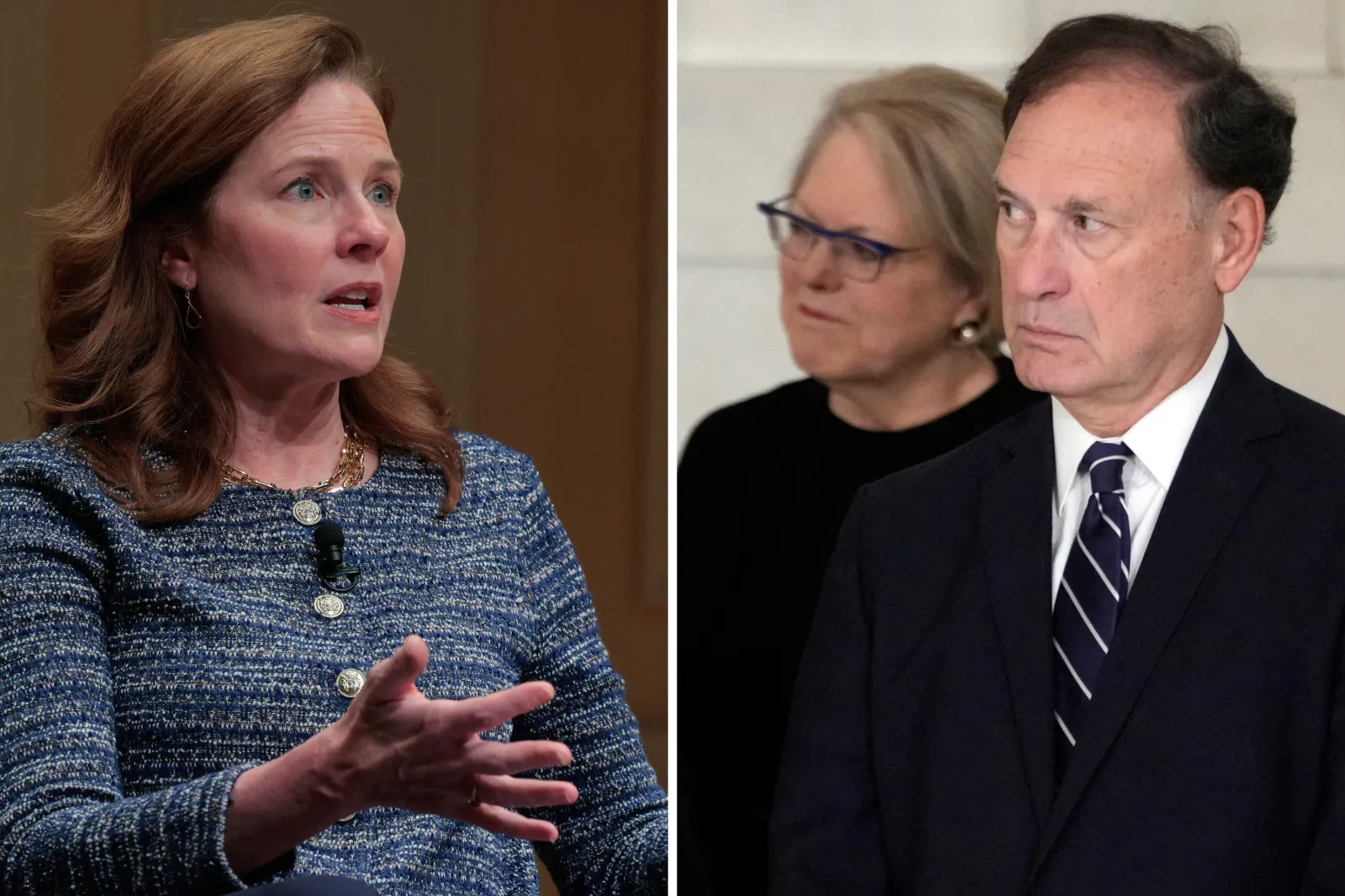
Conservative Justices Amy Coney Barrett and Samuel Alito each sat out separate matters connected to lower-court rulings—moves that were not formally explained but which follow long-established legal standards that are meant to prevent conflicts of interest.
Barrett recused herself from a decision tied to a Seventh Circuit case involving federal inmate Eural Black, while Alito did not participate in a Fourth Circuit-related case concerning a retirement benefits dispute between a former employee and companies linked to DuPont and Corteva.
Read More on U.S.
Why Did Barrett and Alito Sit Out?
The court does not typically explain why justices recuse themselves, but the reasons are often discernible from context.
Legal experts generally group recusals into a few standard categories: prior involvement in a case, financial interests, or personal relationships with parties involved.
Barrett’s absence is consistent with one of the clearest triggers for recusal: prior judicial involvement. Justices routinely step aside from cases they handled earlier in their careers on lower courts, avoiding even the appearance of reviewing their own work, and Barrett served on the Seventh Circuit previously.
Alito’s recusal, by contrast, was not publicly explained, but aligns with another common scenario: potential financial conflicts involving corporate parties. Federal ethics law requires justices to sit out cases in which their impartiality "might reasonably be questioned," including when they hold financial interests in companies tied to litigation.
...
What Happened
In United States v. Eural Black, the Seventh Circuit said a man with a long sentence for multiple gun convictions could not get a reduced sentence under changes made by the First Step Act. He argued the difference between his original sentence and what he would likely receive today should count as a strong reason for early release.
But the court ruled that its earlier decisions still prevent judges from using those sentencing changes to grant compassionate release—even though a new policy from the U.S. Sentencing Commission suggests they could.
In Gasper v. EIDP, Inc., the Fourth Circuit ruled in favor of the company in a dispute over pension payments. David Gasper said his monthly retirement benefits were wrongly reduced after his divorce. The court disagreed, finding the company’s method for calculating the pension—including spreading the cost of a survivor benefit—was allowed.
The court also rejected Gasper’s claim for penalties over delayed documents, saying there was no proof of harm or bad faith.
In both cases, the court upheld the lower court rulings, leaving the original decisions unchanged.
Why These Recusals Matter
The recusals highlight a tension at the court between standard judicial ethics practices and broader concerns about transparency and accountability.
On one hand, recusals are a normal and necessary feature of the court’s work. Justices step aside regularly to comply with ethics rules, ensuring that cases are decided without bias or conflicts. Because the court has only nine members and hears dozens of matters each term, it is common for decisions—particularly procedural ones—to be issued with fewer than nine participating justices.
On the other hand, recusals have become a focal point in recent debates over Supreme Court ethics.
Critics have argued that the system relies too heavily on self-policing, as each justice decides for themselves whether to step aside. Unlike lower court judges, Supreme Court justices are not subject to an external enforcement mechanism for recusal decisions, and they are not required to provide explanations.
That lack of transparency has drawn heightened scrutiny in recent years, particularly in high-profile cases where some justices declined to recuse despite calls from lawmakers or watchdog groups.
For example, Justice Samuel Alito has faced criticism over decisions not to step aside in cases involving political controversies, while Justice Clarence Thomas has been under scrutiny related to undisclosed gifts and connections that prompted questions about conflicts. Those episodes have fueled bipartisan calls for clearer ethics rules and more detailed disclosure requirements.
Against that backdrop, routine recusals—like those by Barrett and Alito—serve as a reminder of how the system is intended to function, even as critics push for greater consistency and openness.
...
The Bigger Picture
While neither case here involved a blockbuster Supreme Court ruling, as the court simply declined to intervene, allowing the appellate decisions to stand, the recusals still illustrate broader institutional dynamics.
They show:
- How frequently conflicts can arise, especially in cases involving large corporations or long litigation histories
- How justices err on the side of caution in some situations, stepping aside to avoid ethical concerns
- How little the public often knows about those decisions, due to the court’s longstanding practice of silence on recusal reasoning
As debates over judicial ethics continue, each recusal—routine or not—adds another data point to a growing discussion about how the Supreme Court balances independence with accountability.
View 0 Comments
Submit Correction
View Editorial & AI Guidelines