...

By Aristos Georgiou
Science and Health Reporter
0
Share
Newsweek is a Trust Project member
See more of our trusted coverage when you search.Prefer Newsweek on Googleto see more of our trusted coverage when you search.
Archaeologists have unearthed a "princely" tomb featuring a chariot among more than 150 "exquisite and precious" artifacts in Italy.
The tomb was found in the Corinaldo Necropolis in the Ancona province, located in the central Italian Marche region.
This burial ground dates back to the 7th century B.C. and is associated with the Piceni—an ancient Italic people who lived across what is now Marche and parts of the Abruzzo region, just to the south, between the 9th and 3rd centuries B.C.
Read More on Science
The Romans referred to the territory of these people as Picenum. This ancient region was eventually incorporated into the Roman Republic.
The Corinaldo Necropolis has already yielded an exceptional find: what researchers dubbed the Tomb of the Prince of Corinaldo, uncovered in 2018.
...
Archaeologists have now discovered another princely tomb from the 7th century B.C. at the site, the local municipality of Corinaldo announced in a statement.
The research was undertaken as part of the ArcheoNevola Project, directed by the Department of History Cultures Civilization at the University of Bologna (UB).
This project has been active since 2018, in collaboration with the Municipality of Corinaldo and the Superintendency of Archaeology, Fine Arts and Landscape (SABAP) for the provinces of Ancona and Pesaro Urbino.
Federica Boschi of UB and Cecilia Carlorosi and Ilaria Venanzoni of SABAP are leading the work at the site.
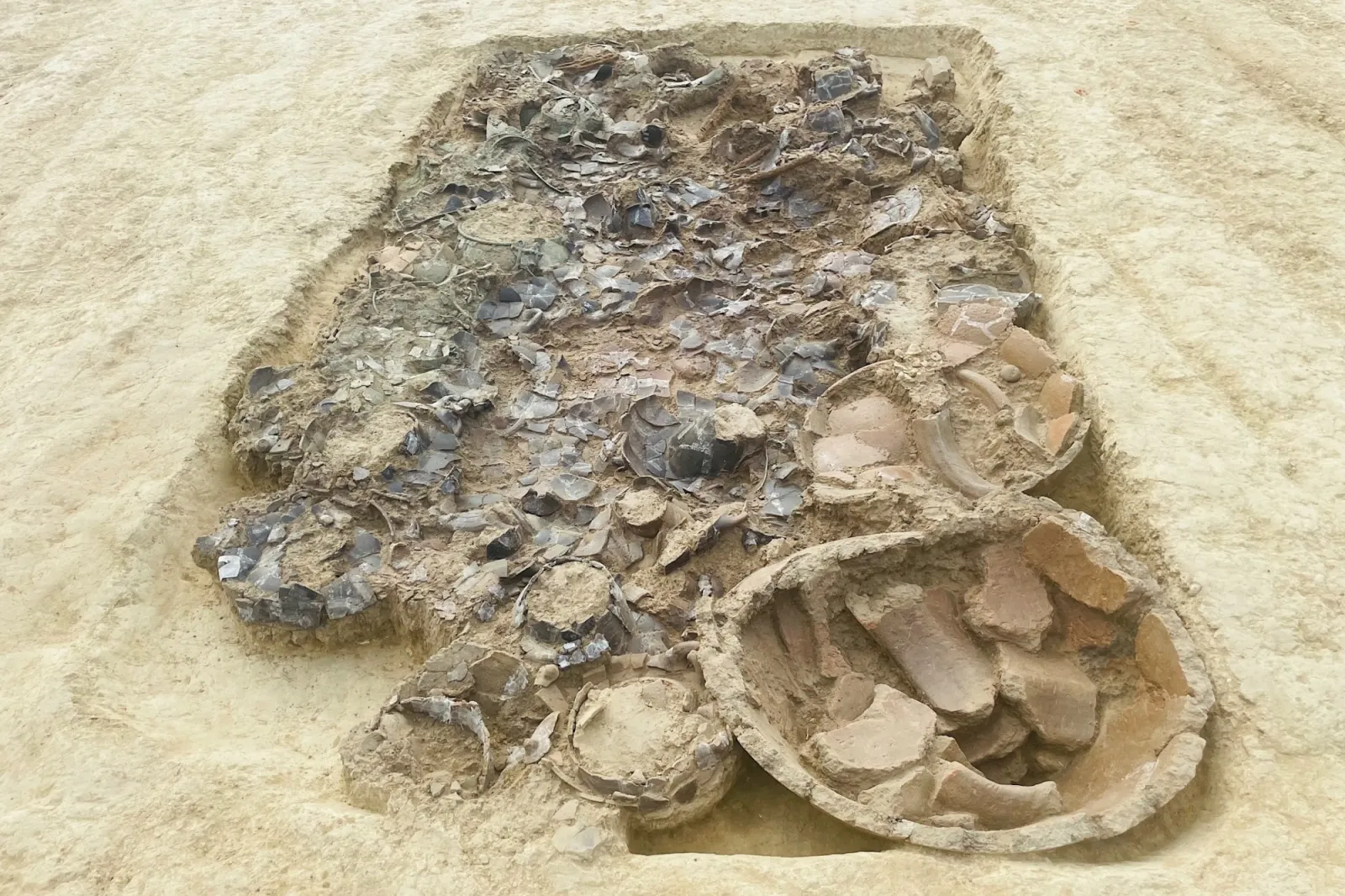
Recent investigations led to the discovery of a quadrangular pit of considerable size—about 12 feet by 7 feet—containing more than 150 artifacts. This pit, in turn, lies within a large, circular ditch with an original diameter of roughly 100 feet.
"Of particular note is the presence of a two-wheeled chariot and a prestigious set of bronze objects, including a helmet, a cauldron and numerous finely decorated containers," the municipality of Corinaldo said in the statement.
A number of the objects are clearly associated with banqueting, such as an iron ax for the processing of meat, as well as pottery designed to serve food and drink. Such finds paint a picture of the tomb's owner as a celebrated person "of the highest order," according to the statement.
"The importance of the archaeological discovery is undoubted and contributes to our knowledge of the Iron Age in the Marche region," Boschi and Venanzoni told Newsweek. "The quantity and quality of the set of objects make it possible to identify in the celebrated deceased a personage of the highest level.
𝐍𝐄𝐂𝐑𝐎𝐏𝐎𝐋𝐈 𝐂𝐎𝐑𝐈𝐍𝐀𝐋𝐃𝐎: 𝐏𝐎𝐑𝐓𝐀𝐓𝐈 𝐀𝐋𝐋𝐀 𝐋𝐔𝐂𝐄 𝐍𝐔𝐎𝐕𝐈 𝐓𝐄𝐒𝐎𝐑𝐈 𝐃𝐄𝐋 𝐕𝐈𝐈 𝐒𝐄𝐂𝐎𝐋𝐎 𝐀.𝐂. Importante ritrovamento dell’Università di Bologna nella area archeologica in località Nevola del paese in provincia di...
Several of the objects appear to have come from the Etruscan world, with which the Picene aristocracy had relations and traded. The Etruscan civilization flourished in another region of central Italy between the 8th and 3rd centuries B.C.
The latest findings highlight the importance of the Corinaldo Necropolis site, particularly in reconstructing the earliest inhabitants of the territory.
"Corinaldo can boast the title of the Land of Princes," Mayor Gianni Aloisi said in a statement. "A discovery that confirms the historical and cultural value of the Nevola archaeological area that will allow us to know, and perhaps rewrite, the history of our community."
Do you have a tip on a science story that Newsweek should be covering? Do you have a question about archaeology? Let us know via science@newsweek.com.
Update 08/16/24, 9:30 a.m. ET: This article was updated with comment from Federica Boschi and Ilaria Venanzoni.
View 0 Comments
Submit Correction
View Editorial & AI Guidelines