
10
Loading video...

By Jesus Mesa
Reporter
0
Share
Newsweek is a Trust Project member
See more of our trusted coverage when you search.Prefer Newsweek on Googleto see more of our trusted coverage when you search.
For decades, Apple was the brand most associated with American innovation, the company that turned computers into something people wanted on their desks, put a music collection in their pockets and turned the phone into the device much of the world now reaches for first.
By nearly every financial measure, it remains one of the most successful companies on Earth. What it has struggled to hold onto, in the view of a growing chorus of critics, is the sense that it still invents.
John Ternus, eight days into the job as Apple's third chief executive since 1997, walked onto the stage at the Steve Jobs Theater on Wednesday carrying that question with him.
Read More on News
After cycling through other updates to the iPhone, the Apple Watch and AirPods, Ternus told the audience inside the Steve Jobs Theater that “actually there is one more thing," in a nod to the phrase often used by Jobs, the company's legendary late founder, borrowed from the TV detective show Columbo.
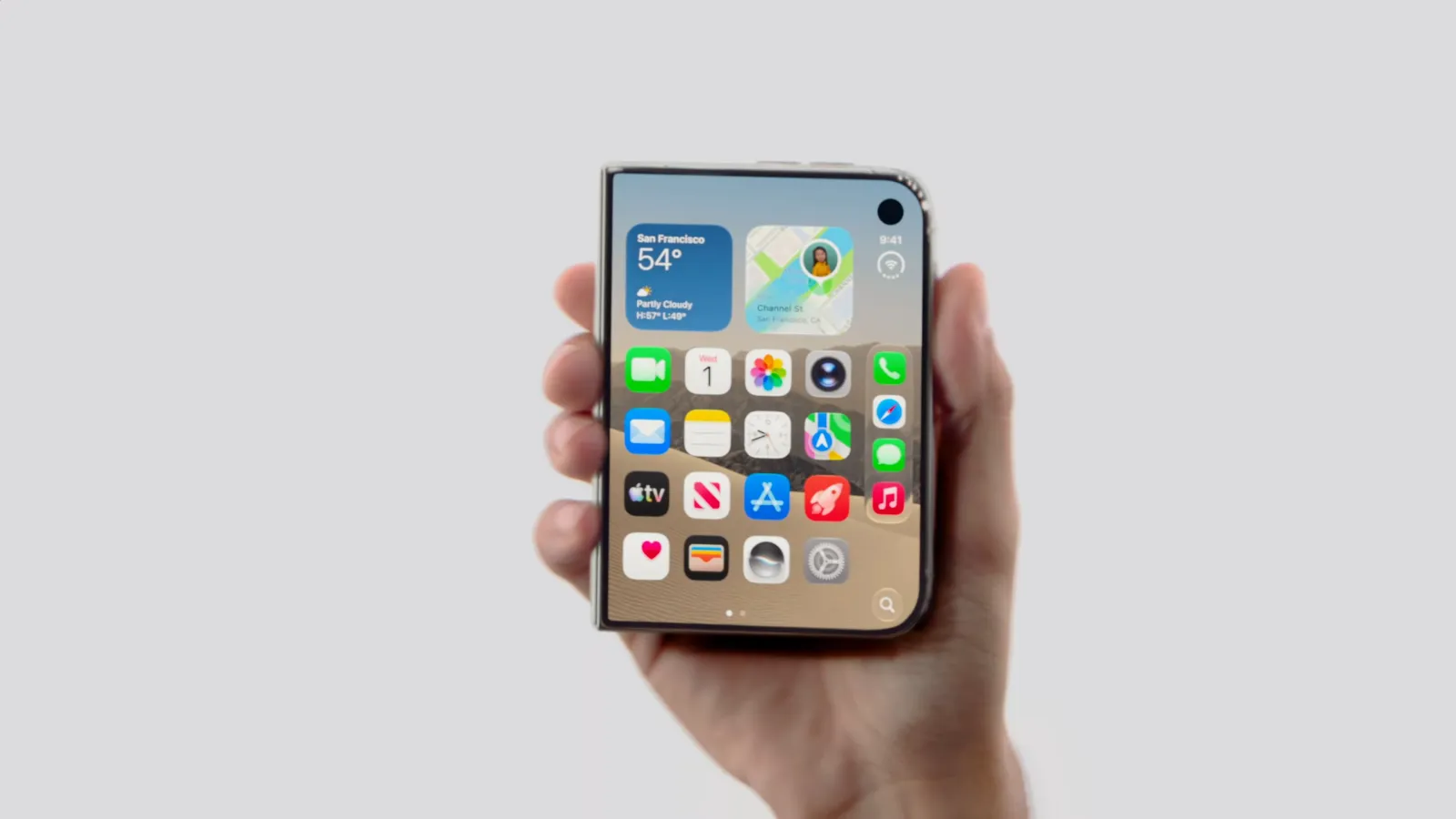
The foldable phone has the "largest display ever on an iPhone, yet fits into your pocket," Ternus said, with another nod to Jobs' words when presenting the iPod in 2001.
Newsweek reached out to Apple via email on Wednesday for comment.

...
The Challenge John Ternus Inherits From Tim Cook
Jobs was remembered for creating products like the iPod or the iPhone, that people did not know they wanted, but it was Cook who turned Apple into the market leader in smartphones and grew the business beyond its signature product. Cook's financial success is clear, but many tech enthusiasts have long argued that his years at Apple lacked the excitement and innovation that defined Jobs.
Meta CEO Mark Zuckerberg made the point during an interview with podcaster Joe Rogan.
"They haven't really invented anything great in a while," he said. "Steve Jobs invented the iPhone, and now they're kind of sitting on it 20 years later."
Billionaire businessman Elon Musk, founder of Tesla and SpaceX and owner of X, has made a similar argument, saying Apple has continued to make "amazing phones" and "great computers" but has failed to produce a breakthrough product on the scale of Jobs' biggest ideas.
"What Apple's missing are the incredible breakthrough products," Musk said in an interview with The Economist in July. "Apple hasn't come up with a sort of Steve Jobs-level breakthrough product."
Related Story
Apple Unveils Foldable iPhone Duo—Timeline of Tech Giant’s Top Innovations
However, Cook's 15 years produced numbers no rival can match. Apple posted $143.8 billion in revenue in its fiscal first quarter this year, up 16 percent year over year, with an installed base above 2.5 billion active devices and gross margin north of 49 percent. The stock is up roughly 15 percent this year.
While Jobs' goal was never simply to make Apple the market leader, but to make a better product, Cook turned it into one. Apple now holds a record 20 percent of the global smartphone market by volume, according to Counterpoint Research. Its share of industry revenue is even larger, at 49 percent, more than double its share of units sold.
By that measure, Cook is arguably one of the most successful chief executives in corporate history.
Much of that growth came from Cook steering Apple away from a company that lived and died by hardware cycles and into one built on services. Apple Pay launched in 2014, Apple Music in 2015, Apple News and Apple TV+ later, alongside Apple Arcade and Apple Card. Services now bring in tens of billions of dollars a year on their own, creating a recurring revenue stream Jobs' Apple never had.
Cook also shipped a run of new product categories: the Apple Watch in 2015, AirPods in 2016, the HomePod in 2018 and the Vision Pro in 2024.
Critics argue that the list is longer on iteration than invention. The Watch, AirPods and services push extended what the iPhone and Mac had already built rather than creating something wholly new the way the iPhone did in 2007. The Vision Pro, Cook's most ambitious original swing, has not found a mass market.
The company's artificial intelligence (AI) push has added to that criticism. Apple advertised personalized Siri features alongside the iPhone 16, but they arrived years late. The Vision Pro launched in 2024 at $3,499 and struggled to find a mass audience. Apple has since cut production and marketing for it, while the research firm IDC estimated that the company shipped only about 45,000 units in last year's final quarter.

...
iPhone Duo Price, Specs and Why the Foldable Is Ternus' Real Test
The criticism has become a backdrop to Ternus' arrival. Cook proved he could run Apple at enormous scale. Ternus now has to show what the company can build next.
Unlike Cook, an operations executive, Ternus spent more than two decades as an engineer, most recently leading the hardware team that built the Duo and Apple's custom Mac chips. Francisco Jeronimo, a vice president at IDC, told Newsweek that the choice reflects what Apple may need next.
"Steve was the genius of disruption and innovation. Tim was the genius of execution and scale," Jeronimo said. "John has the potential to be a mix of both."
He was careful not to call Wednesday a verdict on that question. The Duo itself was years into development before Ternus became chief executive.
"That's a legacy we won't really be able to judge for another five or 10 years," Jeronimo said.
The Duo opens to a 7.6-inch internal display, about 80 percent larger than the iPhone 18 Pro's screen. It uses a custom titanium hinge with more than 100 components and a nano-texture finish designed to make the crease less noticeable, one of the biggest complaints about foldable phones since Samsung helped popularize the category in 2019.
The Duo starts at $1,999, about $500 below what IDC had expected before the event, and will hit stores October 23.
Component costs were supposed to make this the year prices got away from buyers. Memory chip costs have spiked industrywide, and Apple's own lineup showed the strain. The iPhone 18 Pro price rose to $1,199 and the Pro Max to $1,299, each $100 above last year's models.
...
But IDC's forecast has Apple capturing 10 million Duo units and $27 billion in revenue in its first 12 months, enough for category leadership by 2027, because the category's revenue share is growing far faster than its unit count.
"At $1,999, it is Apple's most expensive iPhone ever, but it landed around $500 cheaper than most people were bracing for," Jeronimo said. "Other brands spent years explaining what a foldable even is. Apple gets to skip that. Its opportunity is to teach hundreds of millions of iPhone users why they finally need one."
The same day Apple was presenting its flagship product, the company moved differently on prices, lowering the cost of some products. The new AirPods 5 bring active noise cancellation down to a $129 entry price, well below the $179 that noise-cancelling AirPods carried in 2024. Apple Watch Series 12 remains at $399 and the Ultra 4 at $799, both unchanged from a year ago despite new health sensors.
"They raised the price of entry and expanded access at the same time. Most companies manage one or the other," Jeronimo said. "Apple is turning $129 earbuds and the Apple Watch into the most effective loyalty program in consumer technology. Once you are in, you rarely leave."
Tech experts have long called that combination unusual for any company, especially one entering a new and expensive product category. Jeronimo said Apple understands that customers do not upgrade their phones very often, so expanding its product lineup gives the company more opportunities to gain market share in other profitable categories.
Cheaper AirPods and steady Watch pricing may look like small moves, but they fit into that strategy.
The Innovation Question Ternus Still Has to Answer
None of the new hardware answers the question that has followed Apple since Jobs died: Can the company still innovate, rather than simply upgrade its existing products?
For Cook's defenders, while the criticism is understandable, it can also be unfair. Apple has introduced plenty of new products and ideas since Jobs died on October 5, 2011, from the Apple Watch and iPad Pro to the Apple Pencil, and its massive services business.
"The harder question is whether those innovations feel as significant to consumers as the iPhone did," Jeronimo said. "The technology has matured, and yearly upgrades are often smaller and harder to notice. A better camera, a faster chip or a thinner phone can still be meaningful improvements, but they rarely change the way people use technology overnight."
That is part of the challenge Ternus inherits. Apple has continued to innovate, but the company's biggest advances have become harder to see. The iPhone Duo is an attempt to make that innovation visible again.
On stage, Ternus described the iPhone as “an intelligent personal hub,” pointing to Apple’s privacy record as a reason people should trust the company with more of their data as it pushes further into artificial intelligence. The rebuilt Siri, which runs in part on technology licensed from Google, will not work in the European Union at launch, and a rollout in China is expected to take longer.
Jacob Bourne, an analyst at the research firm eMarketer, said Apple used Wednesday to stop hedging on the word it had avoided for two years.
"Apple's message was clear that the next generation of computing should be personal, private and intelligent," Bourne said. "And Apple is no longer shying away from calling that intelligence AI. From deeper third-party integration with Siri and Apple Intelligence to camera features designed to verify authenticity, Apple is trying to apply AI to real-world problems while reinforcing the iPhone's continued relevance as a device hub."
Winning approval from regulators is one thing. Winning back a more skeptical public is another.

...
Regaining Trust From Disillusioned Customers
Apple no longer operates in the climate of near-total consumer trust it enjoyed under Jobs, or even in Cook's early years. Distrust of the technology industry generally has only grown since, and Apple's AI ambitions put it in the middle of that shift.
"Apple needs to make sure that this data remains private and is treated in a completely secure way," Bourne said.
In many ways, Ternus inherits a company facing a creative vacuum similar to the one Jobs encountered when he returned in the mid-1990s. Apple was known as an innovative company, but it was struggling financially and losing the hardware war to IBM and Windows. Jobs helped refocus the company on products people wanted, first with the iMac and later with the iPod and iPhone.
The biggest difference this time is what Ternus inherits. Jobs returned to a company in crisis. Ternus takes over Apple at the height of its financial power, with a business that remains one of the most profitable in the world.
He also inherits a company in the middle of an executive reshuffle. Kate Adams, Apple's general counsel, and Jennifer Bailey, who leads Apple Pay, are retiring this year. Nearly half of Ternus's executive team is also approaching traditional retirement age, according to The New York Times.
More than 400 former Apple employees now work at OpenAI, according to figures cited in Apple's trade secrets lawsuit against the company, filed in July. OpenAI has moved to dismiss the case.
Cook, 65, remains at Apple as executive chair, giving Ternus something Jobs never had when he returned: his predecessor still sitting at the table. David Yoffie, a Harvard Business School professor who has written case studies on Apple, told the Times that the arrangement will only really be tested if the two men disagree over the company's direction.
Yoffie questioned whether Cook would be comfortable if Ternus reverses course on projects such as the abandoned car program or the future of the Vision Pro headset, which has struggled to find buyers since its 2024 launch.
Contact Newsweek editors on this story: Jason Lemon and Dave Siminoff.
View 0 Comments
Submit Correction
View Editorial & AI Guidelines