...

By Adeola Adeosun
Weekend Night Editor
0
Share
Newsweek is a Trust Project member
See more of our trusted coverage when you search.Prefer Newsweek on Googleto see more of our trusted coverage when you search.
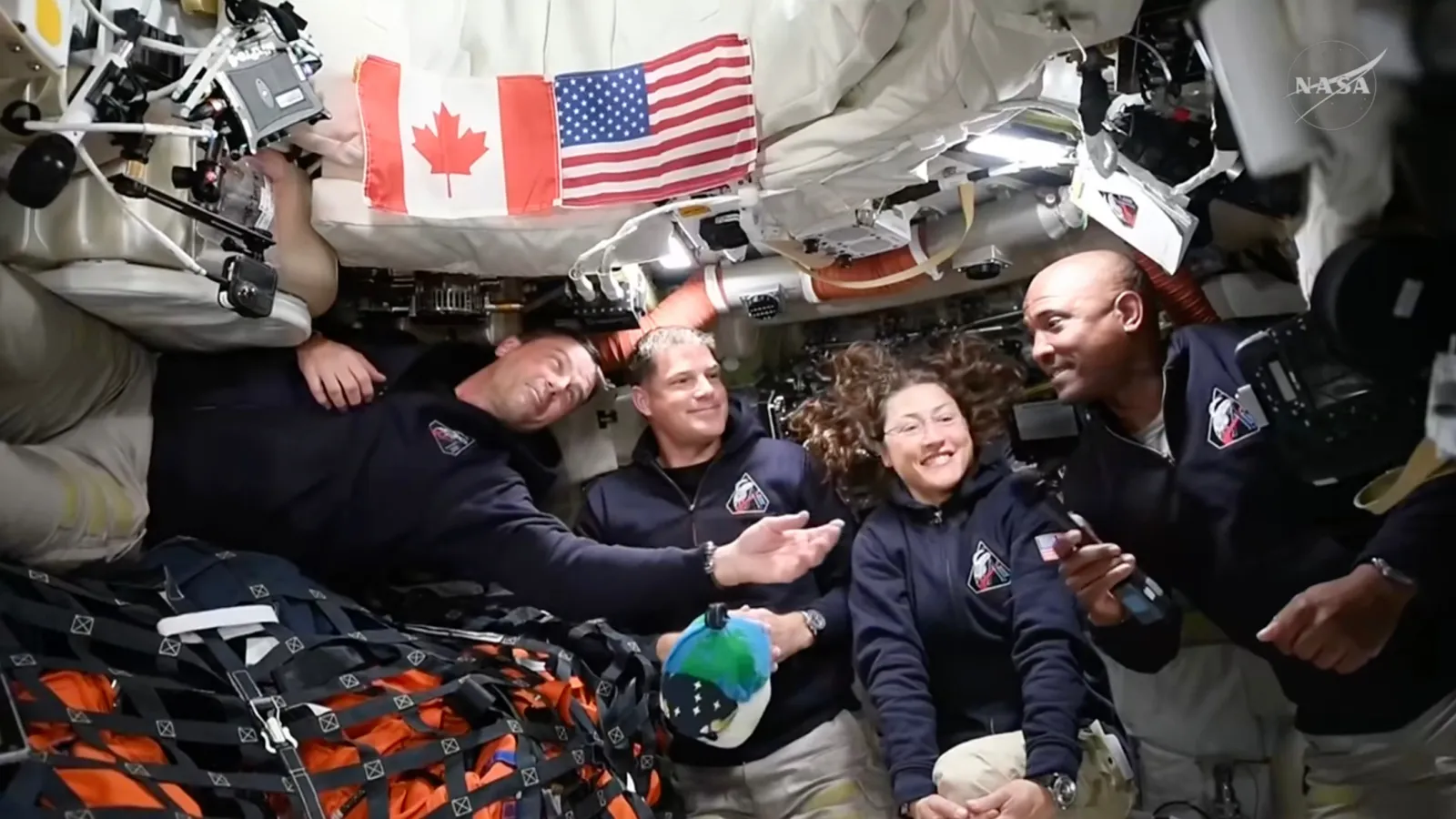
The four-person Artemis II crew has crossed the halfway point of its journey to the moon, with NASA releasing new imagery Saturday as the astronauts prepare for a historic lunar flyby Monday that will carry them farther from Earth than any humans have traveled in more than half a century.
Purpose of the Artemis II Mission
NASA’s Artemis II mission is designed as a critical test flight to prove that the agency’s new deep‑space systems can safely carry humans beyond low Earth orbit for the first time in more than five decades. The mission marks the first crewed flight of NASA’s Space Launch System rocket and the Orion spacecraft, with astronauts tasked with testing life‑support systems, navigation, communications and manual spacecraft controls during a multi‑day journey around the moon, according to NASA.
Read More on News
The crew will not land on the lunar surface, but the mission is intended to validate spacecraft performance before astronauts are sent on more complex missions.
Artemis II is a key step in NASA’s longer‑term plan to establish a sustained human presence on the moon and prepare for future missions to Mars. By flying astronauts on a free‑return trajectory around the moon and back to Earth, NASA aims to reduce risk for later missions that will involve lunar landings, surface operations and assembly of infrastructure in orbit.
President Donald Trump shared a message Wednesday ahead of the Artemis II mission around the moon, saying, "God bless our incredible Astronauts."
Artemis III, currently targeted for 2027, is planned as a crewed test flight in low Earth orbit. NASA has said the mission is intended to test rendezvous and docking operations between the Orion spacecraft and one or more commercial lunar landers, a critical capability for future moon missions.
The first crewed lunar landing under the Artemis program is expected to take place on Artemis IV, scheduled for 2028, following lessons learned from Artemis II and III. NASA says the stepped approach is designed to reduce risk as the agency works toward establishing a sustained human presence on the moon later this decade.
What To Know
Commander Reid Wiseman, Pilot Victor Glover, Mission Specialist Christina Koch and Canadian Space Agency astronaut Jeremy Hansen are on track to reach the moon Monday. During the flyby, the crew will follow the same figure-eight, free-return trajectory used by Apollo 13 in 1970, when an oxygen tank rupture forced Mission Control to abandon the lunar landing and swing the spacecraft around the moon to bring Commander Jim Lovell, Fred Haise and Jack Swigert home safely.
Apollo 13's crew reached a maximum distance of 248,655 miles (400,171 kilometers) from Earth — a record that has stood for 55 years. Artemis II is expected to exceed that mark by more than 4,100 miles (6,600 kilometers), making its crew the farthest-traveled humans in history.
At closest approach, the Orion capsule will come within 4,070 miles (6,550 kilometers) of the lunar surface. The astronauts will split into pairs and take turns photographing the moon, capturing images of the far side — including portions of Orientale Basin — that have never been seen directly by human eyes. A total solar eclipse, visible only from inside the capsule, will also greet the crew as the moon blocks the sun and exposes the shimmering solar corona.
Orion will lose contact with Mission Control for approximately 40 minutes while passing behind the moon — a communication blackout mirroring the tense radio silences of the Apollo era.
The mission carries several historic firsts: Hansen is the first non-American to fly to the moon; Koch is the first woman; and Glover is the first Black astronaut to make the journey.
What People Are Saying
NASA, via X: "The Moon is special in so many ways. Scientifically, it provides opportunities we simply don't have on Earth. It's near enough to reach with robotic explorers and humans. And for all of us on Earth, it's special because it's ours."
Chris Williams, NASA astronaut, via X: "As the @NASAArtemis II crew approaches the Moon, they will get a firsthand view of the Moon's surface. One of the most striking (pun intended) features they will see is the craters which mark its surface, and are especially numerous on the far side, which the crew will be able to directly see. These craters are formed by impacts that have happened over the history of our Solar System and act as a sort of historical record of the conditions around the Earth and Moon."
Adding: "The Earth has had many impacts over its history that have had big consequences on our planet (just ask the dinosaurs…), but plate tectonics, weathering, and volcanism have erased many craters on the Earth, and with them, the record of this history. The Moon helps us fill in the picture and tells us a unique story about our planet's past!"
NASA Artemis, via X on Saturday: "Not bad for a first day in space. Yesterday, as they became closer to the Moon than the Earth, Commander Reid Wiseman and Mission Specialist Jeremy Hansen reflected on the feeling of the translunar injection burn. Rise, the zero-gravity indicator, hung out for the conversation as well."
Jared Isaacman, NASA administrator, via X on Thursday: "Our four astronauts aboard Orion said it was a great ride during launch. Artemis II is on its way to the Moon. This mission is critical in setting us up for success for our next missions -- Artemis III, Artemis IV, and beyond."
...
What Happens Next
After completing the lunar flyby Monday, Artemis II will begin its four-day return to Earth, targeting a splashdown in the Pacific Ocean near San Diego on April 10 — nine days after its April 1 launch from Florida.
During the trip home, the crew will connect via radio with astronauts aboard the International Space Station, marking the first time a lunar crew has had colleagues in orbit simultaneously.
Reporting from the Associated Press contributed to this article.
View 0 Comments
Submit Correction
View Editorial & AI Guidelines