
By Aristos Georgiou
Science and Health Reporter
0
Share
Newsweek is a Trust Project member
See more of our trusted coverage when you search.Prefer Newsweek on Googleto see more of our trusted coverage when you search.
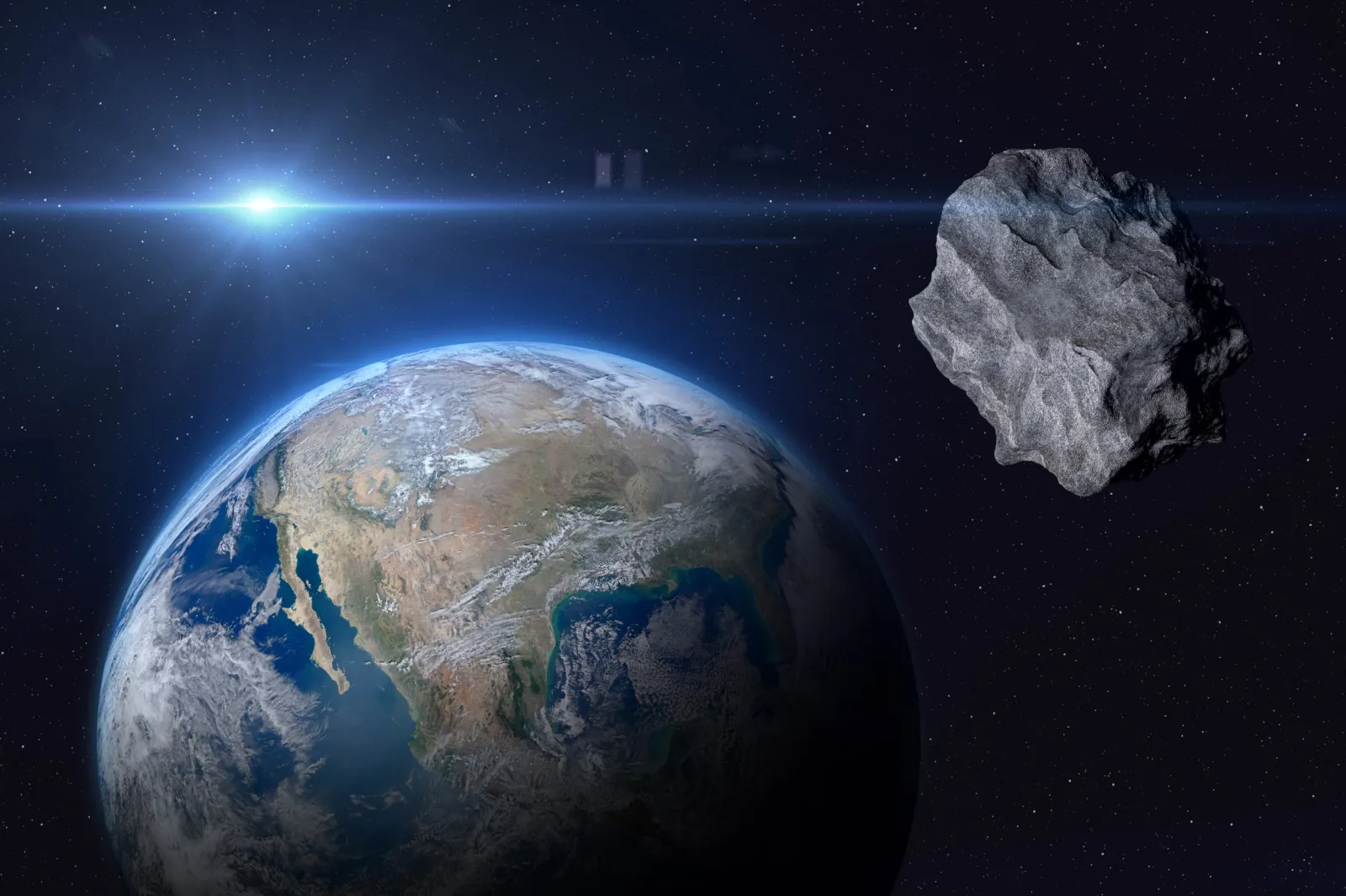
An asteroid thought to measure almost 900 feet across is set to zoom past the Earth—and you can follow the event live online.
The space rock, known as 2019 LH5, will make a close approach to our planet this week. It will come within around 3.5 million miles of Earth just after 4 a.m. Coordinated Universal Time (UTC), or 12 a.m. Eastern Time (ET), on July 7, figures from NASA's Center for Near-Earth Object Studies (CNEOS) database show.
...
Read More
Astronauts’ Immunity Genes ‘Deactivate’ When They Go Into Space4 min read

What Earth Would Look Like to Alien Observers6 min read

Video Shows 200-Foot Asteroid Approaching Earth Before ‘Very Close’ Flyby3 min read

You can follow 2019 LH5's upcoming close approach live online. The Virtual Telescope Project will be providing a livestream that will enable viewers to observe the asteroid as it zooms past Earth. The livestream is scheduled to begin at 9 p.m. UTC, or 5 p.m. ET, on Thursday, July 6.
"We will show [the asteroid] while it moves against the stars, explaining what asteroids are," astronomer Gianluca Masi with the VTP told Newsweek. The VTP is a service provided by the Bellatrix Astronomical Observatory in Ceccano, Italy, that operates and provides access to robotic, remotely operated telescopes.
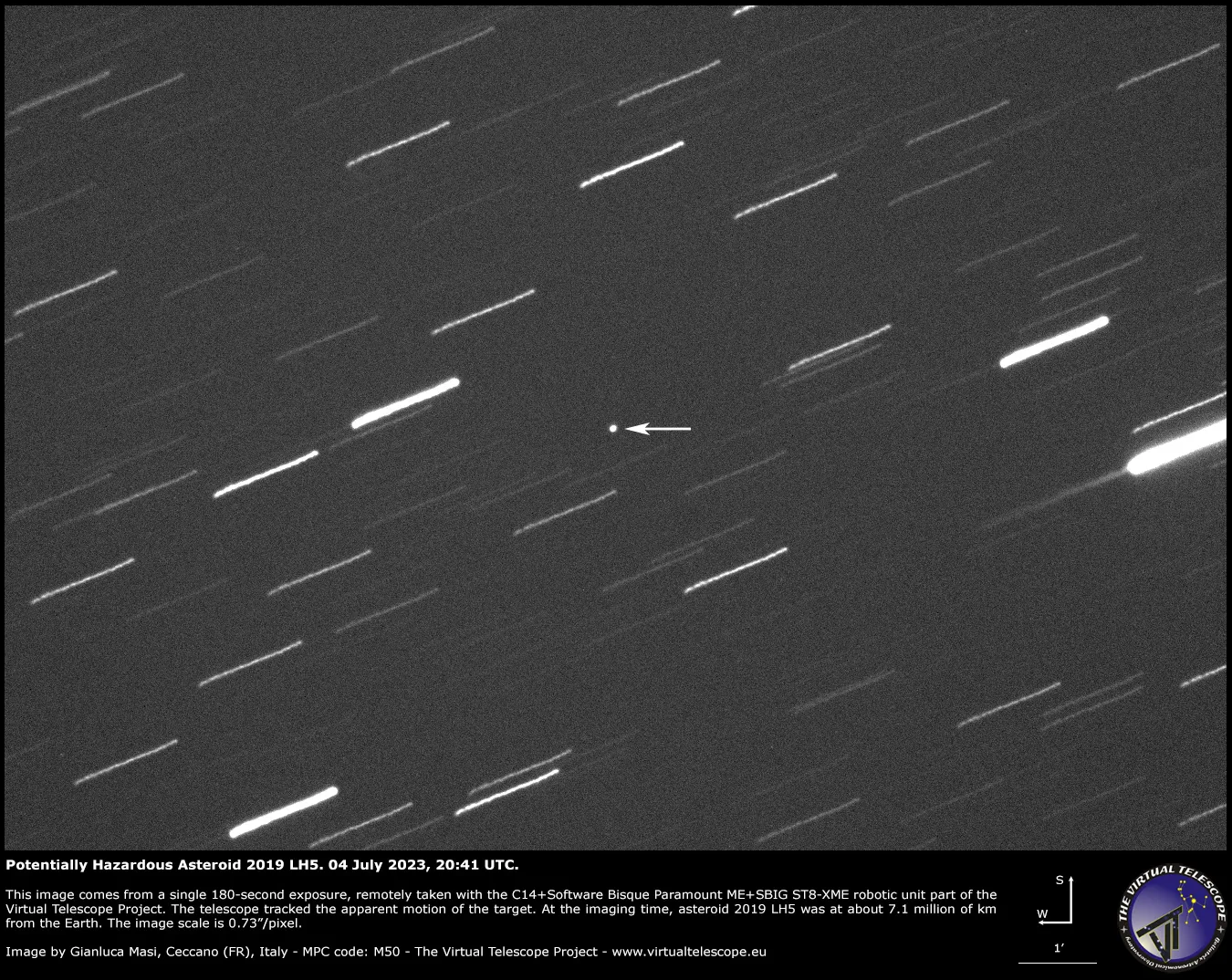
Masi has already managed to capture an image of the fast-approaching asteroid using a robotic telescope based in Manciano, Italy. This was taken on Tuesday, when 2019 LH5 was around 4.5 million miles away, and comes from a single 180-second exposure.
...
NASA's Jet Propulsion Laboratory estimates that the asteroid, which was first observed in 2019, measures approximately 880 feet in diameter, comparing it to a stadium in size. At almost 900 feet across, the space rock would stand taller than the Washington Monument (555 feet tall) if the two objects were placed side by side.
The CNEOS database, however, provides a range of potential sizes for the asteroid. This data indicates that the space rock could measure anywhere between around 689 feet and 1,542 feet across.
At the time of its close approach, the asteroid will be traveling around 48,400 miles per hour relative to the Earth, the CNEOS figures show. This is about 20 times as fast as a rifle bullet.
The space rock is one of more than 32,000 near-Earth objects, or NEOs, that scientists have identified to date. This is a term used to refer to any astronomical body orbiting the sun that passes within 30 million miles of our planet's orbit.
The vast majority of these NEOs are asteroids—most of which are small—although there are more than 100 comets included in this category.
More than 2,300 of these NEOs—including 2019 LH5—are categorized as "Potentially Hazardous," based on their orbits and larger sizes. Specifically, they have orbits that are predicted to come within 4.6 million miles of Earth's path around the sun and are estimated to measure more than 140 meters (around 460 feet) across.
Potentially Hazardous objects are large enough to produce significant damage on at least a regional scale in the event of an impact with Earth.
But orbit analyses conducted by CNEOS indicates that no known Potentially Hazardous object has any noteworthy chance of colliding with Earth in the next couple of centuries. The CNEOS calculates the motion of all NEOs up until the year 2200.
Scientists are constantly monitoring the sky to detect previously unidentified NEOs and track the movement of known ones for planetary defense purposes.
2019 LH5 orbits the sun roughly every two years, but on some journeys through the inner solar system, the space rock comes particularly close to our planet, depending on how the two bodies are aligned at the time.
Astronomers have calculated the orbit of 2019 LH5 accurately, and there is no chance of a collision for at least its next 11 Earth close approaches, up until 2192—the last date for which data is available.
View 0 Comments
Submit Correction
View Editorial & AI Guidelines