
By Ian Randall
Deputy Science Editor
0
Share
Newsweek is a Trust Project member
See more of our trusted coverage when you search.Prefer Newsweek on Googleto see more of our trusted coverage when you search.
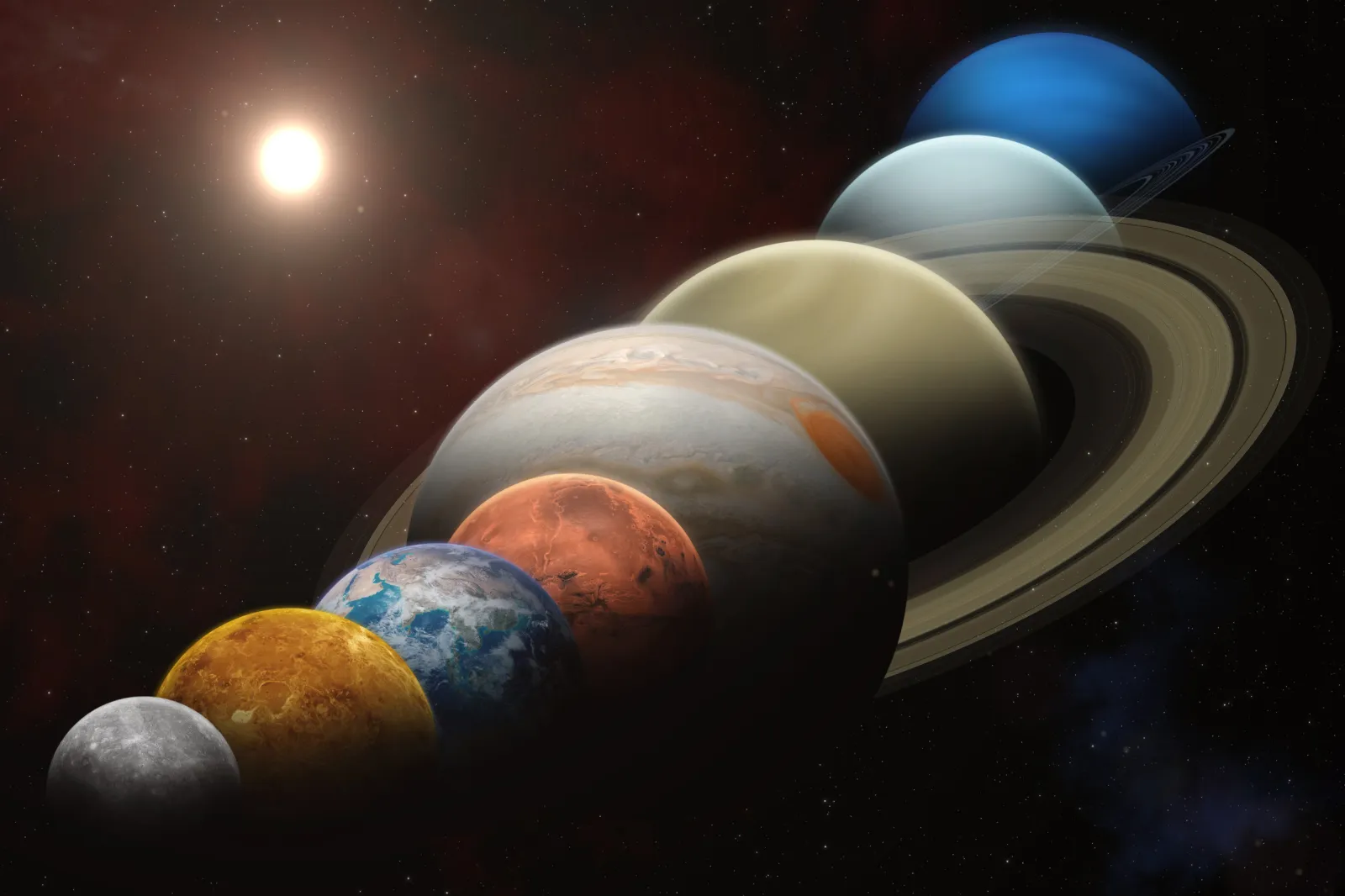
Good news for those with a Pluto-shaped hole in their life, as astronomers may be on the verge of finding a new ninth planet in our solar system.
The researchers—an international team led from Taiwan's National Tsing Hua University—found a candidate for the new world by comparing data from two all-sky surveys.
"The outer solar system is theoretically predicted to harbor an undiscovered planet, often referred to as Planet Nine," the researchers wrote in their paper.
Read More
Dying Stars May ‘Dissolve’ To Create Heavy Elements3 min read

Asteroid Discovery Overturns Long-Held Belief4 min read

Astrophysicists Discover Vast Hidden Star-Forming Cloud Near Solar System4 min read

"However, no observational evidence for Planet Nine has been found so far, as its predicted orbit lies far beyond Neptune, where it reflects only a faint amount of sunlight."
...
In 2006, Pluto lost its erstwhile status as the solar system's ninth planet and was reclassified as a dwarf one. The reason for this was that, since Pluto was first discovered in 1930, many other similar worlds have also been discovered in the icy Kuiper Belt that encircles the sun.
The International Astronomical Union decided that a planet was distinguished, in part, by being able to clear its orbit of all debris—a feat that Pluto has not managed.
However, among these so-called trans-Neptunian objects (those with orbits outside of Neptune's), there are some that are oddly clustered together, suggesting that they might be being gravitationally influenced by a large, unseen body.
It was based on this observation that, in 2016, astronomers Konstantin Batygin and Mike Brown of the California University of Technology proposed the existence of an unseen Planet Nine on an elliptical orbit around the sun—perhaps the core of a giant planet that had been forced out of its original orbit by Jupiter when the solar system was young.
To date, no one has successfully proved Batygin and Brown's hypothesis correct.
In their study, astronomer Terry Long Phan and colleagues compared data from two far-infrared, all-sky surveys: those of the Infrared Astronomical Satellite (IRAS) and Japan's AKARI satellite.
The 23-year separation in time between the two surveys allowed the researchers to look for the expected orbital motion of Planet Nine across the sky.
"Planet Nine is expected to move slowly in the sky due to its great distance beyond Neptune's orbit," the researchers said.
"Therefore, we searched for slow-moving objects that moved from an IRAS position to another AKARI position after 23 years."
The researchers identified 13 candidates that matched Planet Nine's expected movement across the sky—which, via further analysis and visual inspection, was finally whittled down to a single strong candidate.
Before the existence of Planet Nine can be confirmed, however, further observations will be required, the researchers said.
"The IRAS and AKARI detections alone are not enough to decide a precise orbit," they added.
"The verification of Planet Nine's existence via future observational studies will contribute to our understanding of the evolution and structural dynamics of the solar system."
Do you have a tip on a science story that Newsweek should be covering? Do you have a question about space? Let us know via science@newsweek.com.
References
Batygin, K., & Brown, M. E. (2016). EVIDENCE FOR A DISTANT GIANT PLANET IN THE SOLAR SYSTEM. The Astronomical Journal, 151(2), 22. https://doi.org/10.3847/0004-6256/151/2/22
Phan, T. L., Goto, T., Yamamura, I., Nakagawa, T., Chen, A. Y.-A., Wu, C. K.-W., Hashimoto, T., Ho, S. C.-C., & Kim, S. J. (2025). A Search for Planet Nine with IRAS and AKARI Data. arXiv. https://doi.org/10.48550/arXiv.2504.17288
View 0 Comments
Submit Correction
View Editorial & AI Guidelines