10
Loading video...

By Amanda Greenwood
Associate News Editor
0
Share
Newsweek is a Trust Project member
See more of our trusted coverage when you search.Prefer Newsweek on Googleto see more of our trusted coverage when you search.
Astronomers have witnessed what appears to be a giant star swallowing and destroying a smaller companion star, giving scientists their first direct look at a process that had previously been understood mainly through theory.
The extraordinary event took place in the Andromeda galaxy, a neighboring galaxy to the Milky Way. The stellar system contains a giant star estimated to have about seven times the mass of our Sun.
Scientists believe that the giant star, nicknamed “Big Bao,” engulfed a much smaller companion star, “Little Bao”, which was roughly 70 percent of the Sun’s mass, and astronomers were able to follow what happened as the smaller star spiraled deeper inside it.
Read More on News
How Can One Star ‘Eat’ Another?
Stars normally spend much of their lives at a relatively stable size. But as some stars grow older, they can swell enormously during what astronomers call their "giant" phase.
The expansion can be extreme. If a star like the Sun expanded to comparable proportions, its surface could reach Earth's orbit or even farther. If that star has another star orbiting close enough, its expanding outer layers can eventually surround the companion, effectively swallowing it.
At that point, the two stars share the giant star's huge outer layer of gas, or "envelope"; astronomers call this the common-envelope phase.
Being swallowed doesn’t mean that the smaller star immediately disappears. Instead, it continues orbiting the giant star's dense central core while buried inside the giant's outer layers.
But moving through all that gas creates a drag, similar to when an object slows down as it moves through water. That drag takes energy from the orbit, forcing the companion closer and closer to the giant's center in an inward spiral.

...
Eventually, one of several things can happen. The energy released by the shrinking orbit can help blow the giant's outer layers into space, leaving the two stellar cores in a much tighter orbit. Alternatively, the smaller companion can be torn apart and effectively consumed inside the giant.
In this case, the evidence indicates that the smaller star, Little Bao, was eaten.
What Did Astronomers See?
The story unfolded over years rather than in one sudden flash.
Researchers had observations of this particular stellar system going back to 2003. From 2003 to 2015, observations showed small, fairly irregular changes in its brightness.
That changed in 2018, when the star started becoming steadily brighter.
Its brightness continued changing over the next seven years, including a 1,000-day outburst between 2021 and 2023 and another brightening in 2024.
Scientists studying the event concluded that a smaller star was spiraling inward while inside the giant's envelope. As the smaller star spiraled deeper inside the giant, resistance from the surrounding gas took energy from its orbit.
The process ultimately produced a larger eruption that threw around 10 percent of the giant star's outer envelope into space. Observational evidence from both before and after the eruption indicates that the smaller star was eventually ripped apart as it approached the giant's core.

...
In simple terms, astronomers were effectively watching a star being swallowed from the inside out.
Why Is This Event So Special?
Astronomers have long believed that stars go through common-envelope events, but actually catching one while it’s happening has proved extremely difficult.
NASA described the event as a “first-of-its-kind stellar merger,” while others said this was the “first observation of a giant star swallowing its neighbour.”
One reason these systems are so difficult to find is that this phase of a star's life is short by astronomical standards, lasting only months or maybe just a few years. Scientists estimate that “just a few stars exist in this phase” in a galaxy like the Milky Way at any given time.
Related Story
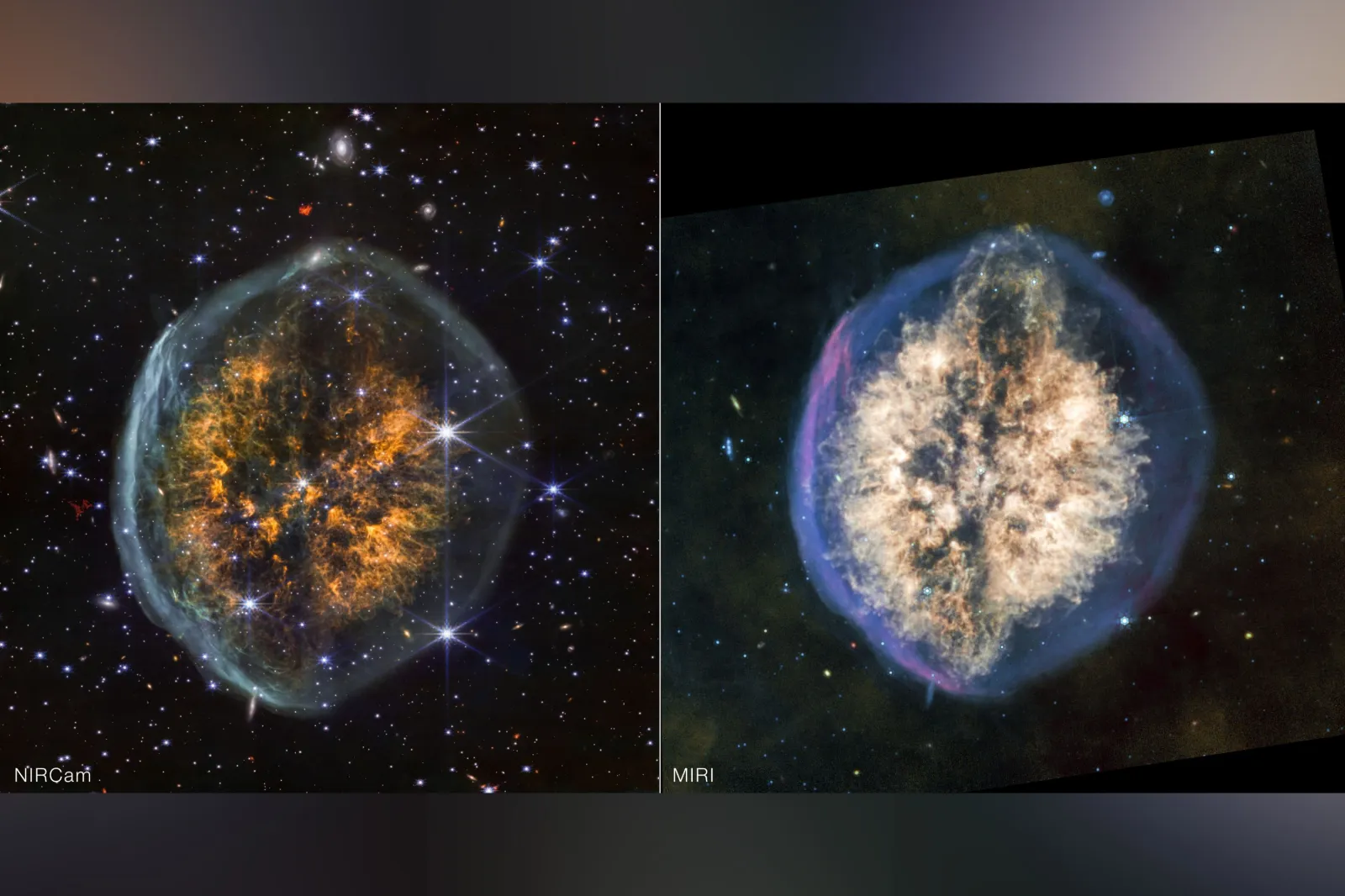
NASA’s Webb Spots Nebula That Looks Strikingly Like a Cosmic Brain
That makes the discovery particularly useful because astronomers can now compare what actually happens with theoretical models that have been developed to help explain the process.
For astronomers, this event offers them something they’ve been searching for for years: a chance to see one of the most dramatic chapters in the lives of paired stars unfolding in real time.
Newsweek has contacted Viraj Karambelkar, lead author on the research paper titled “An Inspiral of a Star Inside a Common Envelope With its Giant Companion,” published in Nature, for comment.
Newsweek’s reporters and editors used Martyn, our AI assistant, to produce this story. Learn more about Martyn here.
Contact Newsweek editors on this story: John Fitzpatrick and Gray R. Thomas
View 0 Comments
Submit Correction
View Editorial & AI Guidelines