...

By Ian Randall
Deputy Science Editor
0
Share
Newsweek is a Trust Project member
See more of our trusted coverage when you search.Prefer Newsweek on Googleto see more of our trusted coverage when you search.
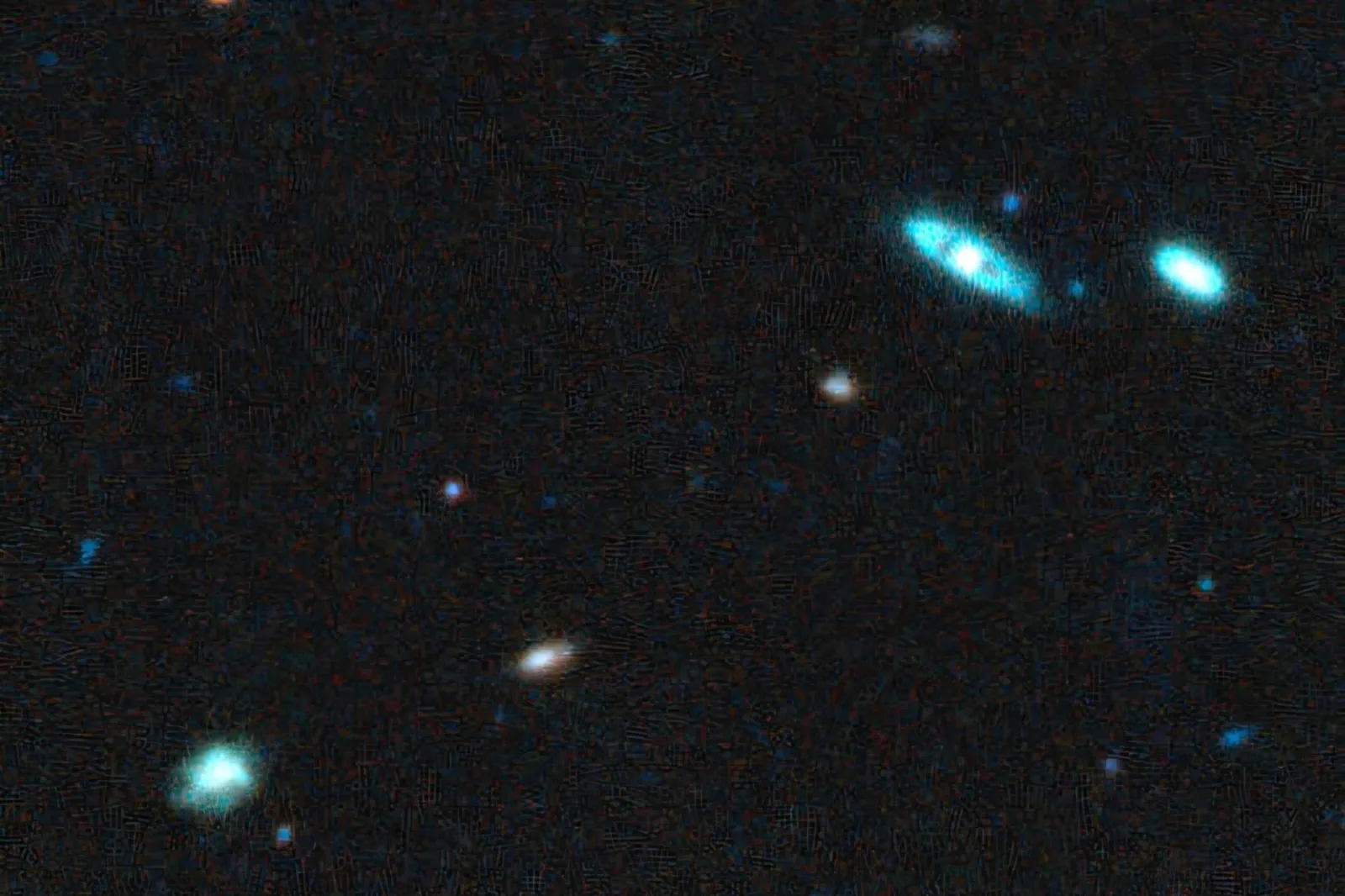
A new survey of distant galaxies undertaken by the James Webb Space Telescope (JWST) is revealing new secrets of the "cosmic noon"—when galaxies in the young universe underwent something of an awkward growth spurt.
According to researchers from the University of Kansas, this mysterious epoch, 2 to 3 billion years after the Big Bang, saw so much star formation that all galaxies today owe half their stellar mass to the cosmic noon.
And now the team's new survey is revealing never-been-seen star formation and black-hole growth from this critical period in cosmic history.
Read More
Hubble Space Telescope Releases New Anniversary Image of Iconic Galaxy3 min read

Cosmic Hit-and-Run Mystery Solved: ‘This Is the Missing Piece’3 min read

Astronomers Discover Planet With a Tail4 min read

...
The James Webb Space Telescope's power allowed the team to peer through cosmic dust to see far enough into the past to observe galaxies during the cosmic noon, 10 billion years ago.
"Our goal with this project is to conduct the largest JWST survey in the mid-infrared across multiple bandwidths," said lead author, Professor Allison Kirkpatrick, in a statement.
"The mid-infrared is where dust emits, so we're looking at dust-obscured galaxies. Dust hides a lot of things, and we want to peer behind the dust.
"We want to understand how these galaxies are forming stars, how many stars they're forming and especially how the black holes at their centers are growing," Kirkpatrick said.
The survey focused on a patch of the sky, between the constellations of Boötes and Ursa Major, known as the Extended Groth Strip (named for the American astrophysicist, Edward John Groth III.) The strip provides something of a clean window into the deep universe.
"The Extended Groth Strip is a region of the sky that has now become one of the premier JWST fields," said Kirkpatrick.
"Within this region, we're able to see about 10,000 galaxies—even though the area is only roughly the diameter of the moon."
Studying the Extended Groth Strip is allowing the researchers to look, for the first time, at galaxies that could be the ancestors of galaxies like the Milky Way today; to measure how fast galaxies form stars and grow their central black holes; and how they change as a result of collisions and mergers.
The full findings of the study are being published in The Astrophysical Journal.
Do you have a tip on a science story that Newsweek should be covering? Do you have a question about the cosmic noon? Let us know via science@newsweek.com.
Reference
Backhaus, B. E., Kirkpatrick, A., Yang, G., Troiani, G., Hamblin, K., Kartaltepe, J. S., Kocevski, D. D., Koekemoer, A. M., Lambrides, E., Papovich, C., & Ronayne, K. (2025, March 24). MEGA Mass Assembly with JWST: The MIRI EGS Galaxy and AGN Survey. arXiv. https://arxiv.org/abs/2503.19078v2
View 0 Comments
Submit Correction
View Editorial & AI Guidelines