10
Loading video...

By Jack Beresford
Senior Reporter
0
Share
Newsweek is a Trust Project member
See more of our trusted coverage when you search.Prefer Newsweek on Googleto see more of our trusted coverage when you search.
The Northern Lights could be visible across parts of the U.S. this Friday.
The National Oceanic and Atmospheric Administration (NOAA), has issued a geomagnetic storm warning. Current projections suggest a G2 level storm, moderate in strength, with the potential to pull the northern lights as far south as Idaho and New York.
The northern lights have forecast with a "Kp index "rating of 4 which, based on the standard scale of 0 to 9, suggests stargazers can expect "more auroral activity" that has the potential to be "quite pleasing to look at."
Read More on Science
The agency's forecasts suggested that the phenomena may appear directly over Alaska, Idaho, Maine, Michigan, Minnesota, Montana, North Dakota, South Dakota, Washington and Wisconsin.
The northern lights are expected to be just as visible on Saturday night with the NOAA forecasting a "coronal hole high speed stream", bringing with it a Kp index of 4 across the same 10 states.
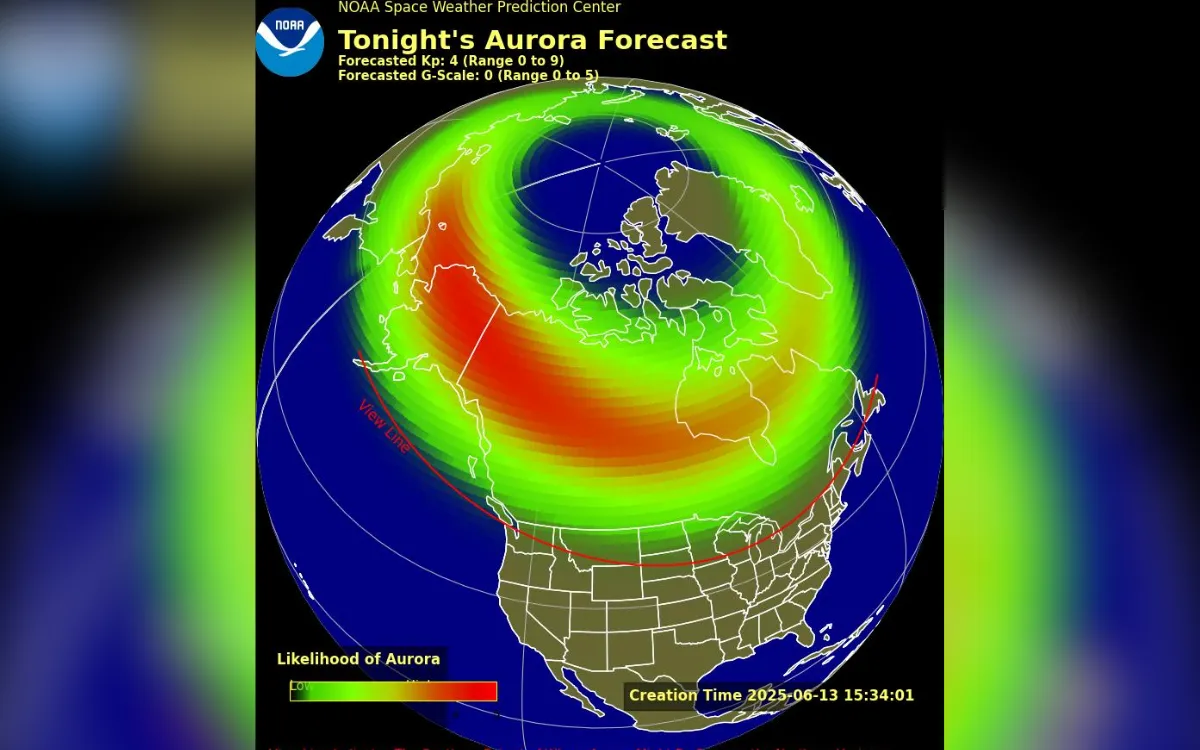
...
How To See the Aurora
To ensure you have the best chance of spotting the northern lights Friday and Saturday night NOAA recommends looking skyward either just after sunset, or just before sunrise. It is not visible during daylight hours.
According to NOAA, the lights are at their brightest from about 10 p.m. to 2 a.m. local time.
"The aurora does not need to be directly overhead but can be observed from as much as a 1,000 km [621 miles] away when the aurora is bright and if conditions are right," the agency explains on its website.
The northern lights are easiest to spot in clear weather and in places where the skies are darker—away from sources of light pollution like cities.
Stargazers are also advised to find a high vantage point and travel as far north as possible.

...
What Causes the Northern Lights?
The northern (and southern) lights form when particles from the solar wind excite atoms in the Earth's upper atmosphere, causing them to glow.
Appearing as curtains of light that trace along the geomagnetic field lines, the aurorae vary in color depending on the particular species of atoms being excited.
As Earth's atmospheric composition is dominated by oxygen and nitrogen, aurorae tend to give off a green hue (from the former) or a blue–pink–purple light (from the latter.)
The geomagnetic storms forecast for this week are the result of a corotating interaction region—a transition zone produced by the meeting of fast and slow-moving streams in the solar wind.
The interaction of the two streams creates a compression region in the solar wind that appears to rotate in step with the sun, hence the name.
The fast stream causing this week's corotating interaction region is being powered by a massive hole in the southern hemisphere of the sun's corona, which is presently facing toward Earth.
Do you have a tip on a science story that Newsweek should be covering? Do you have a question about the northern lights? Let us know via science@newsweek.com.
View 0 Comments
Submit Correction
View Editorial & AI Guidelines