
...

By Soo Kim
Reporter
0
Share
Newsweek is a Trust Project member
See more of our trusted coverage when you search.Prefer Newsweek on Googleto see more of our trusted coverage when you search.
During his eight years in office, former President Barack Obama faced nearly a dozen assassination-related incidents that, in large part, have nearly faded from memory.
Though many of these incidents were reported at the time, they did not leave the same enduring cultural or media impact as similar attempts on President Donald Trump.
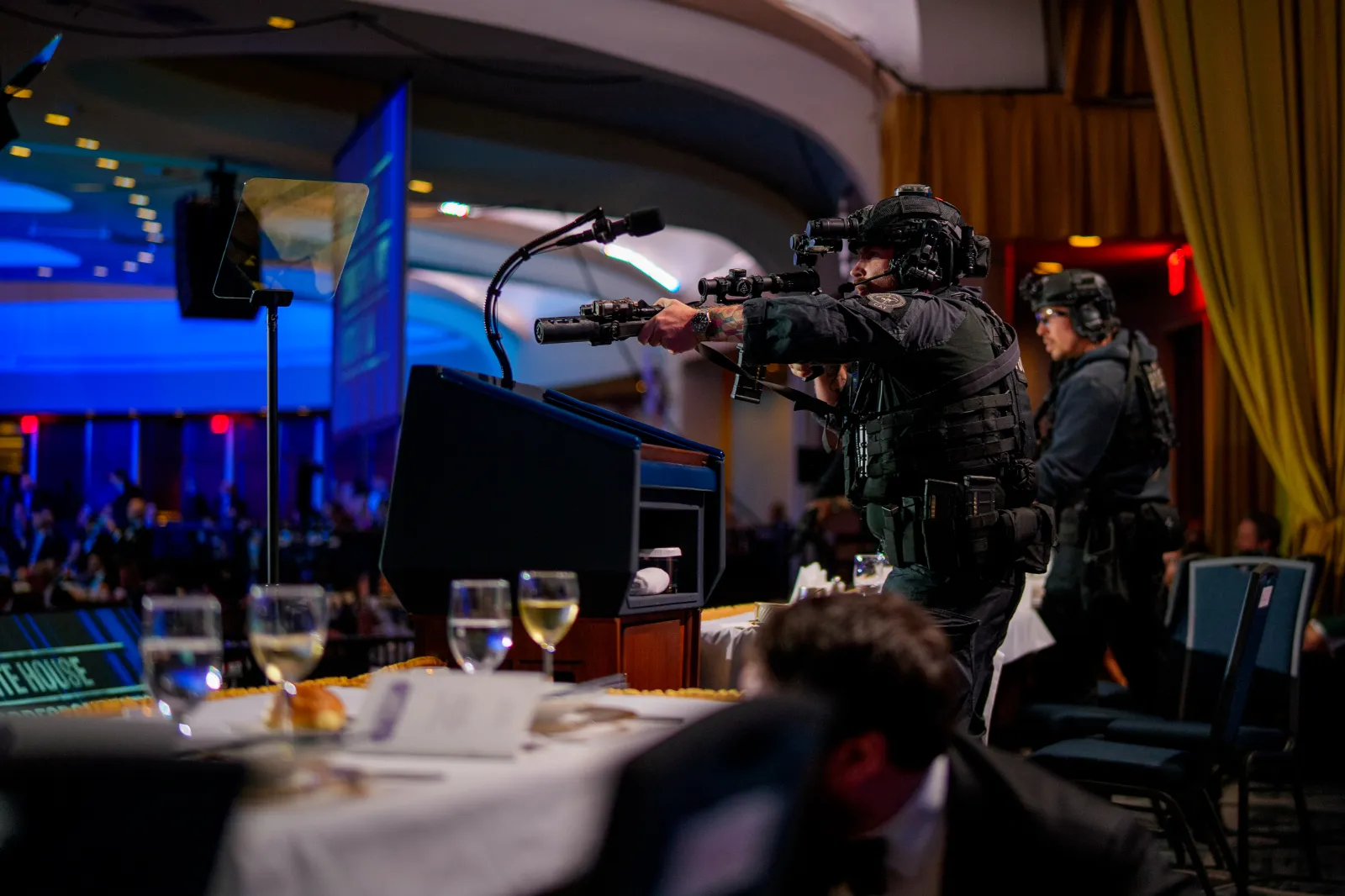
On April 25, a gunman breached security at the White House Correspondents' Dinner and opened fire, forcing the Secret Service to evacuate Trump and senior members of his Cabinet in what appeared to be a possible assassination attempt. The suspected shooter was arrested and is under investigation.
Read More on Politics
The incident marks the latest violent threat involving Trump. Earlier this week, former Federal Bureau of Investigation (FBI) Director James Comey was charged with making threats to harm Trump over a now‑deleted Instagram post shared in May 2025 featuring seashells arranged to spell “86 47."
Trump has survived two known assassination attempts while running for president in 2024, including a narrowly avoided shooting in Butler, Pennsylvania, where a would-be assassin’s bullet grazed his ear. Those near misses, captured in public settings and widely circulated online, have left a lasting imprint on public memory.
Experts say the difference has less to do with the severity of threats and more to do with visibility, media dynamics, and political culture.

...
Assassination-Related Incidents During Obama’s Presidency
Obama faced at least 11 assassination-related security threats during his time in office from January 2009 to January 2017. These incidents, which involved an explicit threat or violent action against Obama, include an assassination attempt, credible plots, biological weapon attacks targeting the president, and reported threats that were investigated and prosecuted by U.S. federal authorities.
Threatening Poem (2009, Kentucky)
Johnny Logan Spencer Jr. in Kentucky wrote a poem, titled “The Sniper,” detailing a fatal sniper shooting of Obama, which the Secret Service said was published on NewSaxon.org. The poem was first shared in 2007, according to an arrest affidavit. Authorities became aware of the poem in 2008, just after the November election that year. The poem was posted again in 2009 after Obama took office.
Craigslist Threat (2010, Texas)
Brian Dean Miller in Texas shared a post on the “Rants & Raves” section of the Craigslist website saying, “It is time for Obama to die," noting he was “actively working to kill the president,” according to the U.S. Department of Justice (DOJ).
White House Shooting (2011, Washington, D.C.)
Oscar Ramiro Ortega‑Hernandez, who is from Idaho, fired multiple rifle rounds at the White House in November 2011, striking the residence.
FEAR Militia Plot (2011, Georgia)
In 2011, four U.S. Army soldiers, who were stationed at Fort Stewart in Georgia, formed a militia group known as FEAR, which stands for “Forever Enduring Always Ready.” They were accused of plotting to overthrow the government and assassinate Obama, reportedly spending at least $87,000 on guns and bomb components.
Threat Disclosed to Therapist (2012, Colorado)
Mitchell Kusick, of Westminster, Colorado, told his therapist he wanted to be known as the man who shot Obama in Boulder in November 2012. The therapist alerted the police, who later arrested Kusick.
Discussed Killing of Obama (2012, New York)
Quazi Mohammad Rezwanul Ahsan Nafis of New York spoke about wanting to kill Obama and bomb the New York Stock Exchange, officials said at the time. He later attempted to detonate a 1,000-pound bomb at the New York Federal Reserve Bank on Liberty Street in October 2012.
Ricin Letters (April 2013, Mississippi)
James Everett Dutschke, from Tupelo, Mississippi, was arrested in April 2013 for mailing “ricin-laced, threatening letters, including one that threatened bodily harm” to Obama, according to the Federal Bureau of Investigation (FBI).
Ricin Letters (2013, Texas)
In May 2013, Shannon Guess Richardson, from New Boston in Texas, posted ricin‑laced letters to Obama and others, and tried to frame her husband for the deed.
Radiation Dispersal Plot (2012, New York)
Glendon Scott Crawford of New York and his accomplice Eric J. Feight built a radiation‑emitting device intended to kill targets, including Obama. Crawford “wanted the lethal radiation device to be used against Muslim Americans” and approached local Jewish groups in April 2012 to seek funding for his plan. “Other targets considered by Crawford included the White House and the New York Governor’s Mansion in Albany,” according to the DOJ.
Armed White House Intrusion (2014, Washington, D.C.)
In September 2014, Omar J. Gonzalez jumped the White House fence, entered the building with a knife, and was arrested inside. Authorities later found hundreds of rounds of ammunition, in boxes and in magazines, hatchets, and a machete in his vehicle. Obama and his family were not at the White House at the time of the incident, having departed minutes earlier by helicopter. Gonzalez was initially charged with attempted assassination, but later pleaded guilty and was sentenced for terrorism and weapons offenses.
ISIS‑Inspired Plot (2014, New York)
Three men in Brooklyn, New York, were arrested after online statements and discussions about killing Obama as part of an ISIS‑inspired plot. One of the men, Abdurasul Hasanovich Juraboev, had posted comments on an ISIS website in August 2014 “about his desire to be a martyr and his willingness to kill President Obama,” a DOJ official noted in a statement in October 2017.
Why Don't We Remember Assassination-Related Incidents From Obama’s Time?
Assassination-related incidents involving Obama didn't have as big an impact on the press as those involving Trump. The reasons for this vary from how close they came to being successful to a change in the media landscape.
How Close the Threats Came
Flavio Rogerio Hickel Jr., an assistant professor of political science at Washington College in Maryland, told Newsweek that proximity to success plays a central role in shaping public attention.
“Part of the difference in media/cultural attention is due to how close the would-be assassins came in succeeding,” said Hickel.
The professor noted that Trump was shot at during a campaign rally, and while on his golf course, before the latest incident at the correspondents' dinner. "It doesn't take a security expert to recognize how close the would-be assassins came in succeeding," he said, noting that although attempts and threats against Obama were “very serious…none of them came this close to success.”
Tim Blessing, a professor of history and political science at Alvernia University in Pennsylvania, told Newsweek that assassination-related incidents involving Obama and those against Trump are very different in terms of proximity and deadliness. Nearly all the threats against Obama "never left the fantasy stage," and "they aren’t remembered because they were not memorable."
David Greenberg, a professor of journalism, media studies, and history at Rutgers University in New Jersey, agreed, telling Newsweek that the main reason the incidents related to Obama aren't remembered is that his life was "never seriously in danger," while the incidents involving Trump were "objectively, a bigger deal."
Greenberg highlighted that although the shooter at the White House Correspondents' Dinner on April 25 "didn’t get very close to the president, he did enter the building where Trump was speaking before being apprehended."
...
Public Spaces and Viral Visibility
Another key difference, according to Hickel, is where the incidents occurred. Trump’s assassination attempts and threats unfolded in semi-public spaces such as rallies, a golf course, and a hotel—environments filled with witnesses and mobile phones.
“That Trump was nearly assassinated on these occasions in semi-public spaces … also means that there were more witnesses who were capable of capturing them on their phones and uploading them to a global audience via social media,” Hickel said.
Changes in the Media Ecosystem
Political scientist Avis Jones-DeWeever, the founder of crisis communications firm Nouveaux Strategies, told Newsweek that during Obama’s presidency, Twitter served as the main hub for political discourse.
“While powerful, it pales in comparison to the rise of TikTok, podcasts, independent media, and the ubiquitous nature of video-first content,” Jones-DeWeever said. The ability to instantly create and distribute video, she added, produces a far more immersive impact than the constraints of early social media platforms.
While viral videos existed during Obama’s presidency, Hickel noted that the current media landscape makes rapid, large-scale amplification much easier. While it may have been possible for video footage to go viral during the Obama years, "it is far easier for that to happen in our current media landscape,” he said.
Hickel noted “the decentralized media environment is like the gas, and the threats against Trump have been the fire. During the Obama years, there was not only less gas, but there was also a smaller fire.”
Deciding Not to Amplify Threats
Jones-DeWeever notes that changes in the media ecosystem explain part of the discrepancy—but not all of it.
She argues that the decisive difference lies in how threats were handled by the presidents themselves. “The larger point here is that President Obama did not seek to elevate threats he received throughout the media ecosystem of his day,” she said.
While acknowledging polarization and shifting norms around political violence, she said the absence of sustained attention led incidents involving Obama to fade quickly—or to go unnoticed entirely. “As a result, they have not only easily faded from public memory...much of the public likely never knew those events occurred at all,” Jones-DeWeever said.
A More Polarized Political Climate
Greenberg highlighted the huge increase in political violence in recent years, from the 2021 Capitol riots to the 2025 assassination of Charlie Kirk.
"In this context, even a less-threatening attack on Trump, like the apprehension of a gunman seeking to shoot Trump on a Florida golf course in 2024, is likely to get more attention than it might otherwise," Greenberg said.
Hickel also pointed to rising “affective polarization”—a term describing the growing emotional divide between political parties—as a major factor in how assassination attempts are framed and remembered.
“It leads people to view partisan opponents not as fellow Americans who happen to disagree, but as enemies to hate,” the professor said. At its most extreme, Hickel explained, that dynamic can foster tolerance for political violence or even quiet approval of it.
The result, he said, is a deeply fractured reaction to assassination attempts. Supporters of the targeted figure may see the incident as evidence of a broader existential threat, while opponents may respond with indifference or worse. Assassination threats/attempts are framed and remembered very differently, “depending on whether you share a partisan affiliation with the would-be victim,” Hickel said.
Hickel added that affective polarization rose significantly during both the Obama and Trump presidencies, further amplifying the attention paid to assassination threats. Affective polarization is “another accelerant” that makes assassinations/threats “more attention-grabbing than in the past,” he said.

...
View 0 Comments
Submit Correction
View Editorial & AI Guidelines