10
Loading video...

By Jasmine Laws
Reporter
0
Share
Newsweek is a Trust Project member
See more of our trusted coverage when you search.Prefer Newsweek on Googleto see more of our trusted coverage when you search.
New satellite images show the damage left by Hurricane Helene in two towns in North Carolina, as the death toll edges past 215 people.
Helene, the deadliest hurricane to hit the mainland U.S. since Katrina in 2005, also leaves dozens of people as yet unaccounted for. About half of the victims were in North Carolina, with dozens more were killed in South Carolina and Georgia.
Homeland Security Secretary Alejandro Mayorkas has said that there is not enough money for the Federal Emergency Management Agency (FEMA) to properly help affected communities, prompting a funding fight as Republicans note that at least $640 million of the agency's cash is being spent on an influx of migrants.
Read More
Helene Floods Highlight Appalachia’s Storm Risk in Warming Climate3 min read

North Carolina Town That Produces Quartz Devastated by Helene3 min read

Map Shows Interstates Being ‘Closed for Months’ After Hurricane Helene3 min read

Secretary Mayorkas' said that FEMA lacked the money required to see out the hurricane season but was "meeting the immediate needs with the money that we have,".
Texas Governor Greg Abbot posted his response on X, formerly Twitter: "This is easy. Mayorkas and FEMA — immediately stop spending money on illegal immigration resettlement and redirect those funds to areas hit by the hurricane. Put Americans first."
An account linked to former President Donald Trump's campaign also posted that it was a "scandal" that this money was being spent on migrants rather than U.S. citizens.
For the 2024 fiscal year, which ended on Monday, FEMA made $640 million available to help the U.S. Customs and Border Protection with processing migrants. The agency's budget for the new financial year, which began Oct. 1, has been laid out at $33.1 billion.
A DHS spokesperson told Newsweek Thursday that accusations by Governor Abbott and others were "completely false".
"The Shelter and Services Program (SSP) is a completely separate, appropriated grant program that was authorized and funded by Congress and is not associated in any way with FEMA's disaster-related authorities or funding streams," they said.
The fight comes after Newsweek has obtained images collected by Maxar from October 2 that reveal areas of the towns of Old Fort and Spruce Pine in North Carolina wiped away or severely damaged after the tropical cyclone made landfall in Florida on September 26 and swept through the southeast of America.
Hurricane Helene was the strongest hurricane on record to make landfall in Florida's Big Bend region, the Weather Channel reported, and caused damage in an area spanning 400 miles, according to ABC News.
More From Newsweek Vault: Learn How to Build an Emergency Fund Quickly
In the before photos, the roads and buildings are all in tact, trees are still standing and the vegetation around appears green. However, in the images taken on Wednesday, damage to the infrastructure can be seen, a lot of the surrounding greenery turned brown from flooding, while trees have been toppled.
It was reported that after Helene, 30 inches of rainfall were recorded in North Carolina, the biggest local flooding in recorded history, according to ABC News.
More From Newsweek Vault: Online Banks vs. Traditional Banks: Learn the Differences
President Joe Biden visited communities impacted by Hurricane Helene in North and South Carolina on Wednesday, and is due to visit Florida and Georgia on Thursday.
Vice President Kamala Harris traveled to Georgia on Wednesday to visit those impacted, two days after former President Donald Trump went.
Harris described the devastation she saw in the area as "extraordinary," and "particularly devasting in terms of the loss of life this community has experienced, the loss of normalcy and the loss of critical resources."
"There is real pain and trauma that has resulted because of this hurricane," she added.
The Biden-Harris administration shared that FEMA assistance in Florida, North Carolina, and South Carolina may include a one-time $750 payment to help with essential items like food, water, baby formula and other emergency supplies.
When Trump visited Georgia, he said that Hurricane Helene had been "just about the biggest anyone had seen," adding that the town is "very badly hurting."
He also referred to the upcoming election, but said that "when a crisis hits, when our fellow citizens cry out in need, none of that matters, we're not talking about politics now, we've got to get together and get this solved."
More From Newsweek Vault: Compare the Best Banks for Emergency Funds
The satellite images obtained by Newsweek show Highway 9 with cars parked outside businesses on the side of the road in the before photo, yet after, brown floodwater appears to have washed the entire area away.
Chris Gloninger, a meteorologist, posted satellite footage on X, showing views of various places in Florida and how the storm surge had completely wiped out homes near the ocean.
AccuWeather had previously predicted the cost of the damage from Helene would be between $95 billion-$110 billion, but now estimates it could be between $145 billion and $160 billion.
The storm surge had been more than 15 feet above ground level in parts of Florida, ABC News reported, and there were more than 20 reported tornadoes across Georgia, North Carolina, South Carolina, Virginia and West Virginia during the storm.
At least 182 were killed in the storm, according to ABC News, and Saturday morning, around 3.7 million Americans in the region did not have power.
More than one million Americans were still left without power four days after the storm.
South Carolina, the worst-affected state, had 755,313 outages recorded early Monday, while Georgia had 580,771, North Carolina 457,941, Florida 133,492 and Virginia 100,584.
Ohio, West Virginia, Kentucky and Tennessee also experienced a loss of power.
The governors of Florida, Georgia and North Carolina had all declared state of emergencies ahead of Helene's landfall, and preparations were being made throughout the days leading up to the forecasted storm.
Hurricane Katrina vs Helene
Hurricane Helene has been ranked fourth among the most deadly U.S. hurricane between 1963 and 2024, two places behind Hurricane Katrina in second, according to Yale Climate Connections.
Katrina hit the south east of America in August 2005, making landfall across Miami and Fort Lauderdale, Florida as a category 3 hurricane.
Katrina had a significantly higher death toll than Helene, however the forecasted cost of damage of Helene is slightly higher.
More than 1800 people died following Katrina and millions were left homeless as houses were destroyed in the storm that cost $170 billion worth of damage, according to the Government Accountability Office.
Helene had slightly stronger wind speeds than Katrina when the cyclone reached land, as the wind speeds of Helene hit land at around 140 miles per hour, according to Zoom Earth, and Katrina's were around 125.
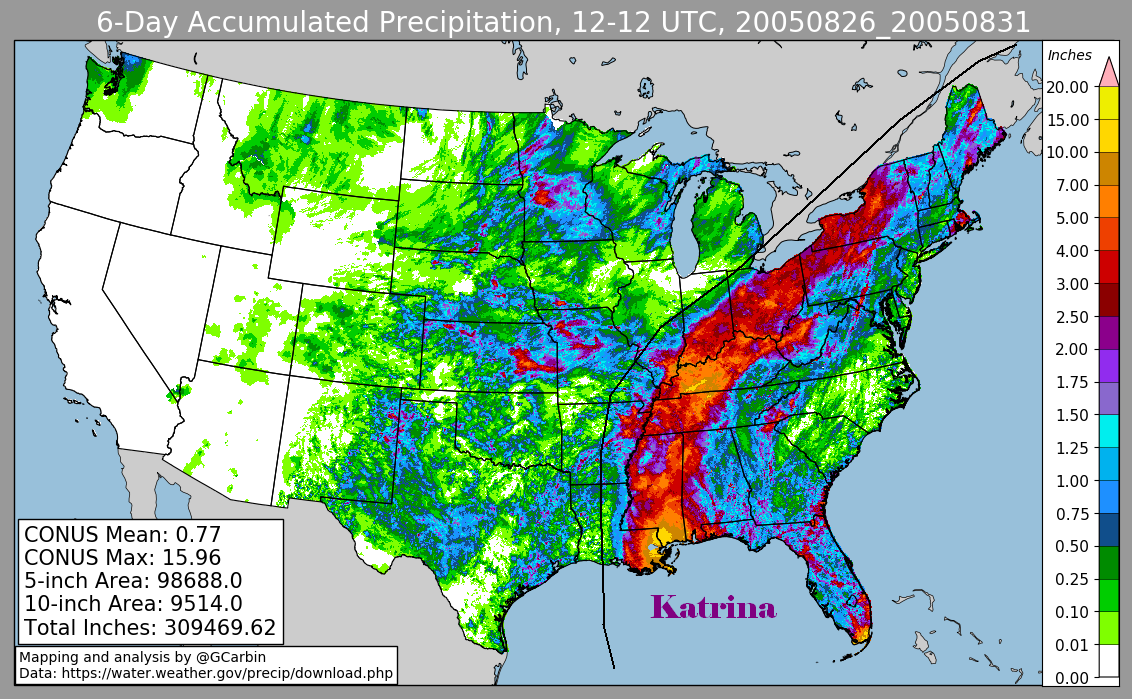
Helene also resulted in greater depths of rainfall than Katrina, as some areas of North Carolina saw as much as 30 inches of rainfall in September, while during Hurricane Katrina there were highs of 15 inches of rain.
Do you have a story we should be covering? Do you have any questions about this article? Contact LiveNews@newsweek.com.
View 0 Comments
Submit Correction
View Editorial & AI Guidelines