
...

By Joe Edwards
Reporter
0
Share
Newsweek is a Trust Project member
See more of our trusted coverage when you search.Prefer Newsweek on Googleto see more of our trusted coverage when you search.
The Biden administration is set to significantly increase tariffs on Chinese electric vehicles, quadrupling them from 25 percent to 100 percent.
The move is the latest salvo in a trade war between the two superpowers that kicked off in 2018, during the Trump administration. Both countries are now in a race to dominate the electric vehicle market and are heavily investing in EV technology and infrastructure. This announcement followed a four-year review into the effectiveness of U.S. tariffs on China.
In a statement, U.S. Trade Representative Katherine Tai said the decision to increase tariffs was made "to encourage the elimination of the People's Republic of China's unfair technology transfer-related policies and practices that continue to burden U.S. commerce and harm American workers and businesses."
Read More
Exclusive: China’s Ambassador Outlines Ambitious Plan to Jumpstart Economy9 min read

Joe Biden Is Delivering on His Green Promises | Opinion5 min read

Tai also proposed numerous other tariff increase targeting strategic sectors, including an increase to 50 percent for semiconductors and solar cells.
Newsweek has contacted Tai for further comment via email to the Office of the United States Trade Representative.
...
The move is part of a broader strategy to protect U.S. industries from competitive pressures, particularly from Chinese firms that have benefited from state subsidies, although the U.S. EV industry received improved subsidies as part of the 2022 Inflation Reduction Act.
A spokesperson for The White House told Newsweek: "This strong action is targeted to specific sectors. China should not view this as an escalation, but if they retaliate, we have the means and the will to defend our interests [...] We have also been vocal that China's non-market excess capacity is unfair. The President and Ambassador Tai will defend American workers and businesses and work to ensure our supply chains are resilient and secure."
American auto industry groups have expressed concerns about the threat China's EV competition poses to U.S. domestic production. An Alliance for American Manufacturing report described it an "existential threat" to the U.S. auto industry.
"Outside estimates suggest that China's unfair practices have resulted in significantly lower costs driven by subsidies and market distortions. These tariffs will combat those practices and level the playing field for America's automakers, which have been the bedrock of our manufacturing sector for decades," a White House spokesperson told Newsweek.
In April, the U.S. Government warned that Chinese-made smart cars could "collect sensitive data about our citizens and our infrastructure and send this data back to the People's Republic of China."
...
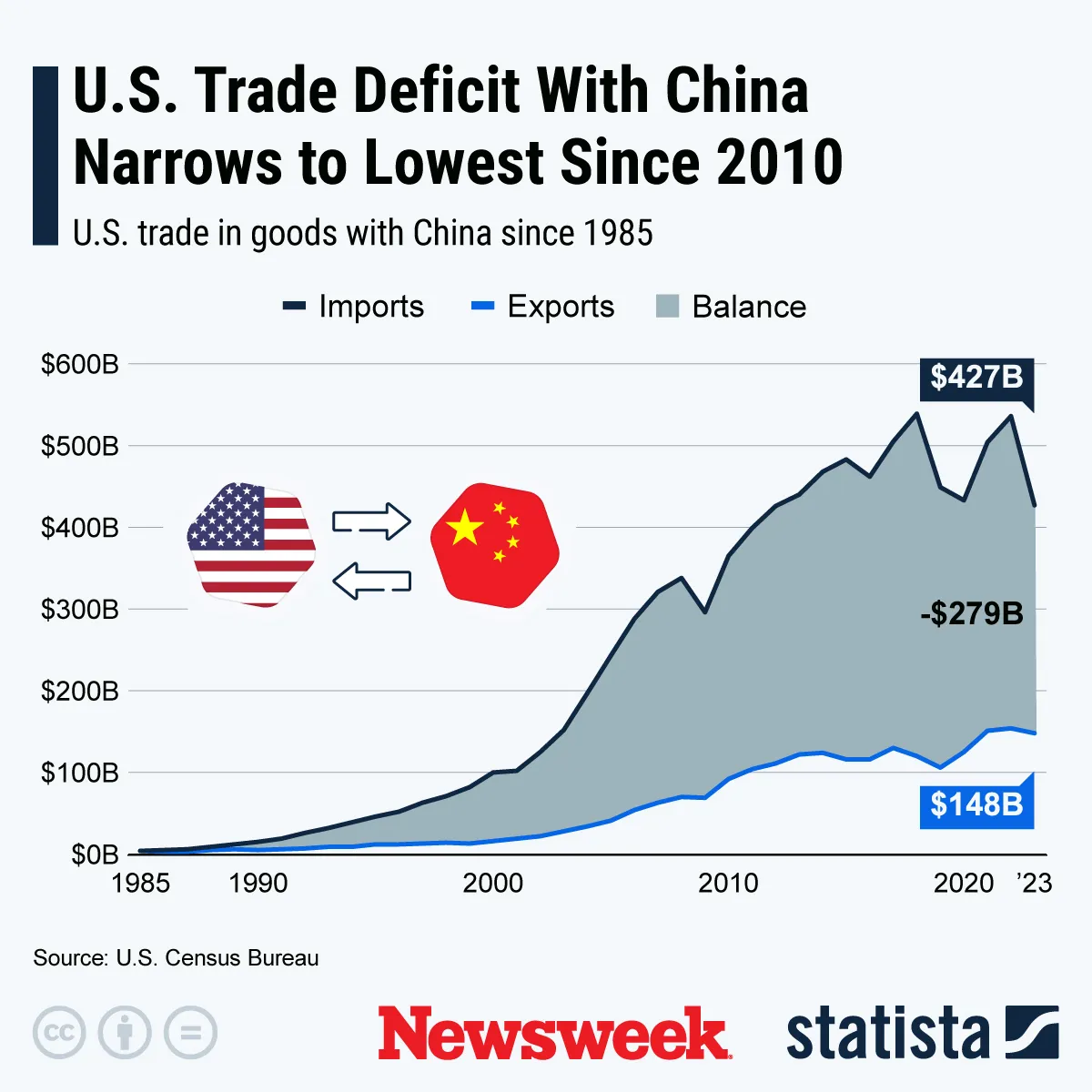
This chart, provided by Statista, shows the U.S. trade in goods with China since 1985.
Speaking at a press conference on Tuesday, Chinese Foreign Ministry spokesperson Wang Wenbin told reporters: "China has always opposed the unilateral imposition of tariffs in violation of [World Trade Organization] rules and will take all necessary measures to safeguard its legitimate rights and interests."
Newsweek has contacted the Chinese Foreign Ministry for additional comment.
Viet Ngyuen-Tien, a research economist at the London School of Economics and Political Science told Newsweek: "Both countries provide subsidies for EVs and other green products, but China has practiced this strategically and persistently for decades, whereas the U.S. has only recently ramped up its efforts in response to China's dominance in green supply chains. This results in uneven levels of production capacity in the competition.
"One may think about tension escalation that may lead to a revival of a trade war. It is a very likely scenario, as it is difficult to imagine China remaining inactive in response to such a bold move and the Biden administration might take further actions leading up to the election."
"However, it should not be viewed solely as a bilateral rivalry. Many other players will watch the movements of the U.S. and China carefully and adjust their strategies accordingly."
Update, 5/15/24, 1:00 p.m. ET: This article was updated to include analysis from Viet Ngyuen-Tien.
Do you have a story we should be covering? Do you have questions about U.S.-China relations? Contact LiveNews@newsweek.com
View 0 Comments
Submit Correction
View Editorial & AI Guidelines