...

By Amanda Greenwood
Associate News Editor
0
Share
Newsweek is a Trust Project member
See more of our trusted coverage when you search.Prefer Newsweek on Googleto see more of our trusted coverage when you search.
A massive sunspot, over 10 times the size of Earth, has appeared on the sun. It is likely to produce multiple solar flares over the coming weeks, which could lead to bright auroras, the famous northern lights. Alongside the sunspot, satellites also detected a powerful X1.9-class solar flare on December 1, which is the biggest, most powerful type of solar flare.
Why It Matters
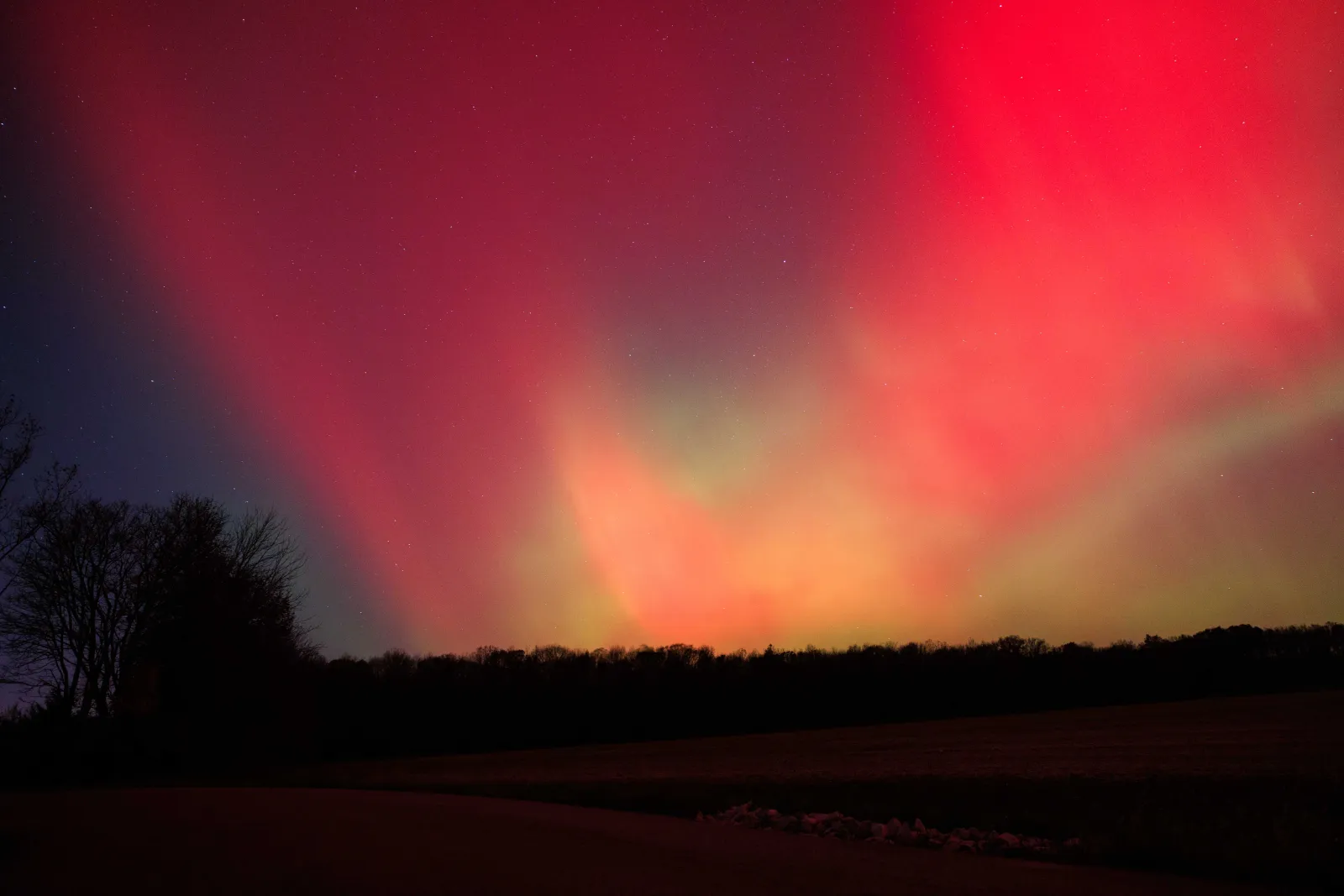
If the anticipated solar storms or flares are strong enough, auroras could be seen further south than normal, well beyond the usual northern states—potentially as far south as Illinois, Oregon, or even Alabama and Northern California, which is rare and brings an exciting opportunity for skywatchers.
Read More on News
What To Know
On December 1, 2025, NASA's Solar Dynamics Observatory detected a sunspot—labeled Active Region (AR) 4294-96—which is the largest recorded in a decade, and is expected to trigger further solar flares in the coming weeks.
An X1.9-class solar flare was detected by Earth-orbiting satellites on the same day, although, according to SpaceWeather.com, it actually originated from a smaller sunspot—named AR 4295, rather than the giant one.
Solar flares are intense bursts of electromagnetic radiation. The strongest are X-class flares, which can disturb Earth’s ionosphere and disrupt high-frequency radio signals. The December 1 X1.9-class flare caused a significant radio blackout in Australia, which affected aviation and maritime signals for about 30 minutes.
While solar flares themselves don’t directly produce auroras, they often indicate the likelihood of coronal mass ejections (CMEs)—vast clouds of charged particles and magnetic fields hurled into space. If a CME follows an X-class flare and is directed at Earth, it can trigger geomagnetic storms and vivid auroras far beyond usual latitudes. As of December 1, analysts have not confirmed a CME heading in the Earth's direction from this event, though monitoring continues.
The activity follows an exceptionally energetic November, when an X5.1-class solar flare on November 11—the strongest of the year—was followed by multiple CMEs that triggered a severe geomagnetic storm and widespread auroras, visible across much of the U.S. and Europe.
...
What People Are Saying
According to NASA: “Solar flares are classified according to their intensity, or energy output. A—the weakest flares, barely noticeable above the sun’s background radiation; B, C, M, X—the strongest flares. Much like the Richter scale for earthquakes, each higher class is a 10-fold increase in energy. So an X flare is 10 times stronger than an M flare and 100 times stronger than a C.”
Patricio León, an amateur astronomer, told Earthsky that: “The enormously huge and complex AR4294+4296 sunspot required more than two days to rotate entirely the eastern limb. Now we can be exposed to any activity, its delta magnetic component may deliver to us.”
What Happens Next
The U.S. National Oceanic and Atmospheric Administration and NASA will likely closely monitor these developments, as they could impact radio communications and power grids, causing potential blackouts in extreme cases.
View 0 Comments
Submit Correction
View Editorial & AI Guidelines