
...

Jack Caporal for The Motley Fool
Content Editor
0
Share
Newsweek is a Trust Project member
See more of our trusted coverage when you search.Prefer Newsweek on Googleto see more of our trusted coverage when you search.
In 2025, biotechnology stocks had their best year since the COVID-19 pandemic, with the market sector’s two major indexes—the SDPR S&P Biotech ETX (NYSE: XBI) and iShares Biotech ETF (NYSE: IBB)—returning between 28 percent and 36 percent, more than double the S&P 500’s roughly 18 percent.
That came after three consecutive years of underperformance. Was biotech’s strong 2025 a fluke or part of a sustained rebound?
The Motley Fool shares a few key trends that might offer direction.
Read More on Personal Finance
...
As biotech stocks staged their comeback in 2025, private investment in longevity science more than doubled, hitting $8.49 billion across 325 deals.
The Food and Drug Administration (FDA) approved 50 new drugs in 2024 and 46 in 2025, including the first drug class that researchers have labeled potential longevity therapeutics.
Big pharma spent more than $65 billion acquiring biotech companies through October 2025, surpassing full-year totals for 2024, 2022, and 2021, according to BioSpace.
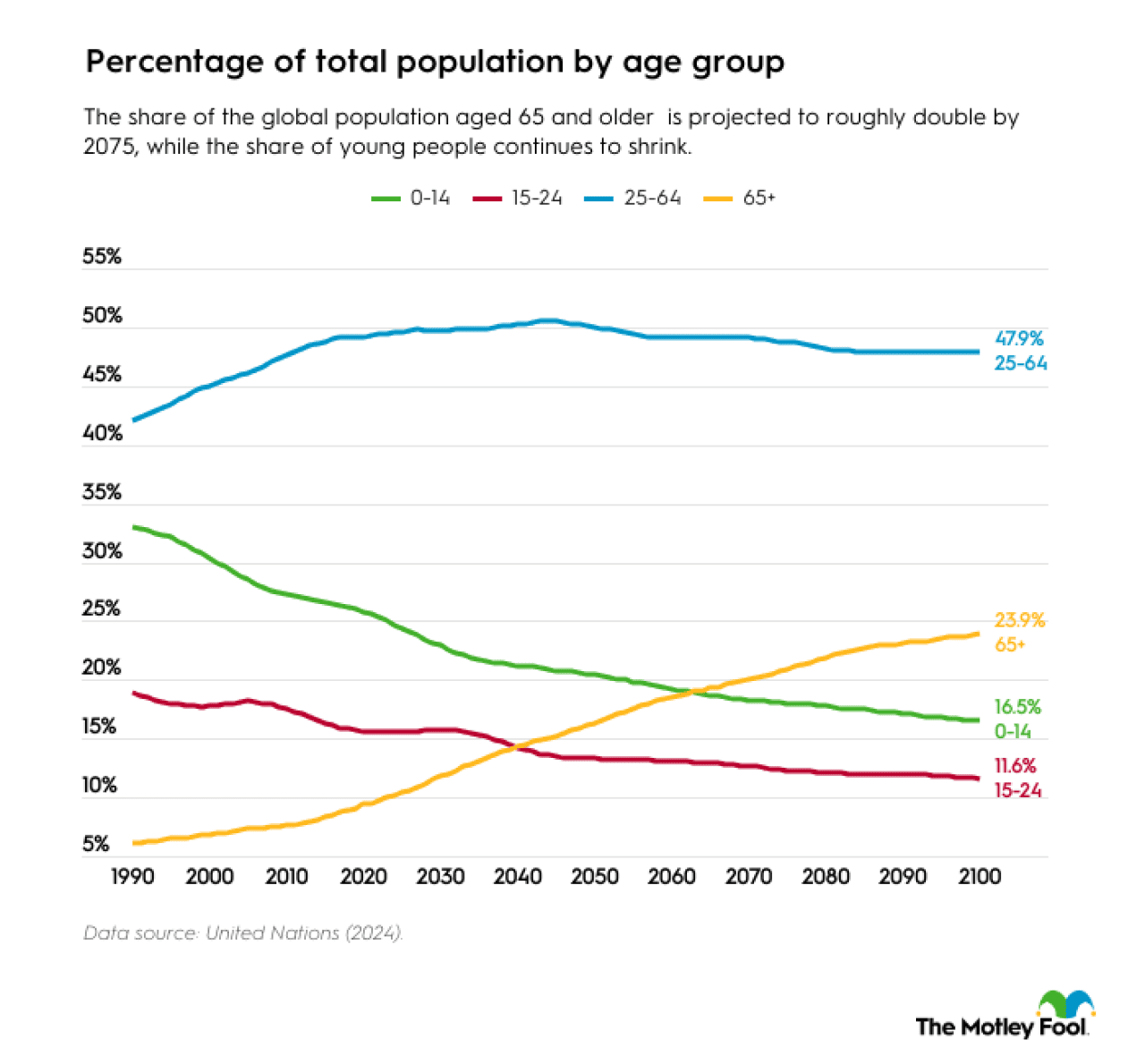
Demographics serve as a strong foundation for potential growth in biotech and longevity. The global population aged 60 and older will reach 1.4 billion by 2030, according to the World Health Organization.
The number of people aged 80 and older will nearly triple by 2050. The patients are here, and more are coming—and biotech stocks are increasingly the companies building the treatments they will need.
Biotech Stocks Staged a 2025 Comeback
After three years of flat or negative returns, biotech stocks broke out in 2025.
The biotech trends discussed above and throughout suggest that reversal could be more structural, meaning driven by lasting forces like an aging population and a mounting patent cliff, rather than cyclical, meaning just a temporary bounce.
- Biotech indexes outpaced the S&P 500 by a wide margin in 2025. The SDPR S&P Biotech ETX returned 35.9 percent, the iShares Biotech ETF returned 28.0 percent, and the Nasdaq Biotech Index (NASDAQ: NBI) gained 31.5 percent, compared to the S&P 500's 17.9 percent.
- Merger and acquisition (M&A) activity more than doubled 2024 levels. Biopharma M&A deal value through October 2025 hit $65 billion to $70 billion, exceeding full-year totals for 2024, 2022, and 2021. At least seven deals topped $8 billion.
- Big pharma faces a patent cliff. More than $300 billion in branded drug revenue faces patent expiration between 2025 and 2030, according to Evaluate. When a patent expires, cheaper generic versions can enter the market. When that happens, the original drug's sales can collapse quickly, so large pharma companies try to replace that revenue before it disappears. Biotech companies develop more than 70 percent of newly approved drugs, up from around 50 percent a decade ago, which makes acquiring a biotech one of the fastest ways to fill that gap, according to the Association of Investment Companies.
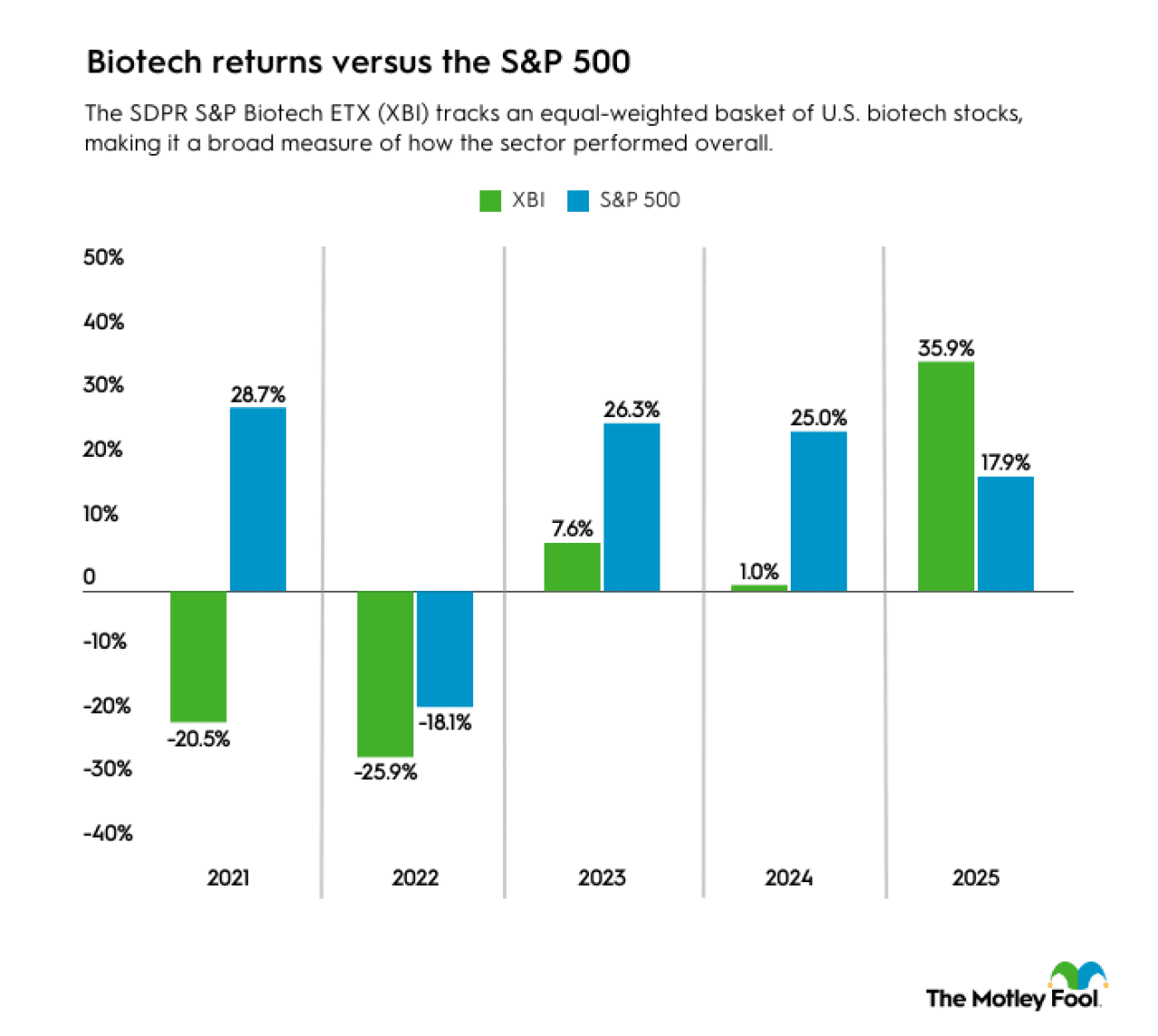
Biotech stocks were genuinely cheap coming into 2025 after three consecutive down years. Recoveries from that starting point, with strong underlying trends, have the potential to last longer than hype-driven rallies.
Which Parts of Biotech Had the Best 2025 for Investors?
Broad biotech funds only tell part of the story. Beyond the headline returns, different parts of the sector performed very differently in 2025.
The differences show where individual investors might see the most compelling long-term cases.
The following returns reflect year-to-date performance in 2025 for thematic ETFs, used as subindustry proxies.
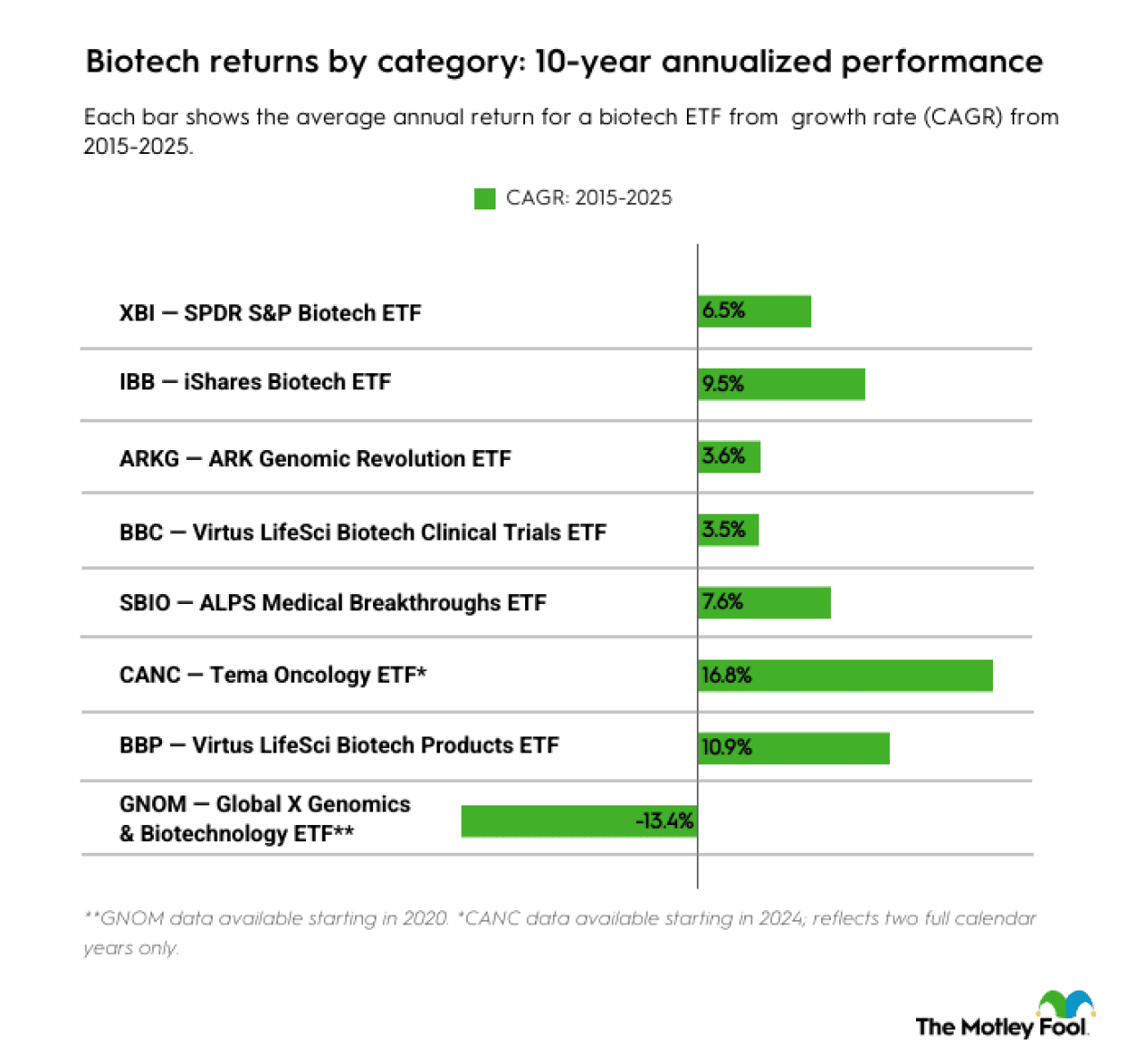
Ten-year compound annual growth rates (CAGR), which are the average annual returns over a 10-year period, reflect each fund’s full available history.
- Clinical-stage biotech was the biggest winner in 2025. The Virtus LifeSci Biotech Clinical Trials ETF (NYSE: BBC) returned 63.7 percent, nearly double the broad XBI, as smaller biotech companies with drugs still in trials got a major boost from stronger FDA approval rates and aggressive acquisition activity from big pharma. The ALPS Medical Breakthroughs ETF (NYSE: SBIO), which holds similar companies, gained 55.1 percent.
- Oncology and genomics also outperformed. The Tema Oncology ETF (NASDAQ: CANC) gained 42.9 percent in 2025. The ARK Genomic Revolution ETF (CBOE: ARKG), focused on gene editing and genomic medicine, returned 23.0 percent after a steep 28.2 percent decline in 2024. The Global X Genomics and Biotechnology ETF (NASDAQ: GNOM) gained 18.7 percent.
- Over a decade, the gap between commercial-stage and clinical-stage biotech is stark. Clinical-stage companies are still testing their drugs in human trials and have no products on the market yet. The Virtus LifeSci Biotech Products ETF (NYSE: BBP), which holds commercial-stage companies—those with at least one FDA-approved drug on the market—returned 10.85 percent annualized over 11 years. XBI, the broad equal-weighted biotech index, returned 6.46 percent annually over the same period. Genomics-focused ARKG returned just 3.60 percent annualized despite some explosive individual years, a reminder that early-stage science can be a bumpy ride even when the long-term thesis is compelling.
Smaller biotech companies with drugs still in clinical trials are what big pharma is trying to buy, with acquisition offers coming in above 60 percent to 120 percent of the stock prices, even though companies don’t have drugs on the shelves, according to Vision Life Sciences.
For investors who held shares in those acquired companies, that has meant seeing their stock jump by more than half overnight.
There is no guarantee future deals will look the same, but the pace of acquisitions in 2025 suggests large pharma's appetite for biotech pipelines is not slowing down.
Longevity Investment: Where Science and Capital Are Going
Longevity is an investment category forming around the science of aging, and private capital, research, and the FDA are moving quickly.
- Private investment in longevity science more than doubled in a single year. Global investment in longevity science reached $8.49 billion across 325 deals in 2024, up from $3.82 billion in 2023, according to Longevity. Investment.
- GLP-1 drugs are expanding from weight loss into longevity territory. GLP-1s are a class of drugs that includes semaglutide, sold as Wegovy and Ozempic, and tirzepatide, sold as Zepbound and Mounjaro. Originally approved for diabetes and obesity, they have since received FDA approval for cardiovascular risk reduction, obstructive sleep apnea, fatty liver disease, and oral obesity treatment. A Swiss Re model estimates that GLP-1 drugs could reduce all-cause U.S. mortality by 6.4 percent by 2045, making it the first drug class with implications at that scale. The GLP-1 market alone is projected to grow from $55 billion today to $150 billion by 2030, according to JPMorgan.
- The FDA formally recognized lifespan extension as a valid clinical goal for the first time. In February 2025, Loyal's LOY-002, a drug for aging dogs, became the first treatment to clear that regulatory bar, marking a milestone for the longevity field's credibility with regulators.
The drugs making some of the most money in biotech right now, like GLP-1s, cancer immunotherapies, and gene medicines, are the same ones showing early signs of potentially extending healthy life.
Longevity investing used to mean putting capital behind unproven science.
Increasingly, it means owning companies that are already generating revenue, like Novo Nordisk(NYSE: NVO), whose GLP-1 drug Wegovy is already one of the bestselling drugs in the world, according to industry publication Drug Discovery and Development.
What Investors Tracking Biotech and Longevity Should Watch
Biotech stocks enter 2026 with real momentum. The industry is still recovering from a brutal three-year run leading into 2025, big pharma is paying a significant premium to acquire pipeline companies, which are companies with drugs under development, and the FDA is approving new drugs at near-record rates.
The sector is grappling with patent expirations as longevity science is gaining traction.
Demographics create a demand floor that isn’t a forecast—the population data is set and is difficult to ignore.
Adults 65 and older represent 17 percent of the U.S. population but make up 37 percent of all healthcare spending, according to the Centers for Medicare and Medicaid Services.
Individuals aged both 60+ and 80+ will make up a growing share of the global population in the coming decades, according to the UN.
That means each passing year brings a larger, older cohort of patients who need treatment for chronic conditions that affect 95 percent of adults over 60, as well as greater demand for longevity drugs.
For individual investors tracking the intersection of biotech stocks and longevity, the data points in the same direction across many angles: drug performance, new-drug pipelines, private capital, government support, and demographics.
The question is no longer whether longevity is a viable investment theme but how much of the opportunity is already priced in and how much is still ahead.
FAQs
What Are Biotech Stocks?
Biotech stocks are companies that use biological science to develop products, most commonly drugs and medical treatments.
They range from small companies with a single drug in clinical trials to large commercial businesses with multiple approved products on the market.
What Is Longevity Investing?
Longevity investing involves investing in companies developing treatments, therapies, and technologies to extend healthy human life.
The category increasingly overlaps with mainstream biotech, as drugs originally developed for diabetes, obesity, and cancer begin showing evidence of broader life-extension effects.
Why Did Biotech Stocks Perform Well in 2025?
After three years of underperformance that left the sector trading at historically cheap valuations, biotech stocks rebounded in 2025 on the back of near-record FDA drug approvals, a surge in acquisition activity from large pharma companies racing to replace revenue before key patents expire, and growing investor interest in longevity science.
This story was produced by The Motley Fool and reviewed and distributed by Stacker.
View 0 Comments
Submit Correction
View Editorial & AI Guidelines