
...

By Hugh Cameron
Reporter
0
Share
Newsweek is a Trust Project member
See more of our trusted coverage when you search.Prefer Newsweek on Googleto see more of our trusted coverage when you search.
Data for Thanksgiving weekend shows consumers shopped at encouraging levels, but underlying details about spending patterns suggest this may not have been the economic boon the administration believes.
According to Adobe Analytics, U.S. consumers spent $6.4 billion on Thanksgiving Day and $11.8 billion online on Black Friday, both record highs and up significantly compared to last year. But Salesforce data, cited by Forbes, found that order volume fell by about 1 percent year over year, while average selling prices were up 7 percent—indicating that much of the growth was caused by inflation rather than any uptick in shopping enthusiasm.
Why It Matters
Consumer spending accounts for about two-thirds of economic activity, and the holiday season has been considered a particularly important barometer of how financially stressed shoppers are navigating the current economic climate.
Read More on U.S.
The White House has already pointed to Black Friday sales figures as demonstrating that the American consumer is in good health in late 2025, but others see signs that weak consumer confidence and a collection of financial headwinds are taking their toll despite an overall jump in spending.
...
What To Know
Pre-Black Friday forecasts were mixed, with some projecting record-high spending and others, such as Deloitte, anticipating a decline as "cost pressures and financial constraints" weighed on shopping behavior. Deloitte’s October survey revealed widespread reticence going into the shopping period, with both the lowest- and highest-income categories indicating that they would cut back on purchases this year.
Neil Saunders, the managing director of GlobalData Retail, told Newsweek that a lot of this year's increase was "due to higher prices with soft underlying volume growth."
"From our data, Black Friday spending grew by around 3.1 percent, with volumes rising by around 0.2 percent," he said. "Consumers dug deep on Black Friday, but they were selective in their spending and largely stuck to budgets. The new reality is that dollars stretch less far than they once did, and consumers have adjusted to that."
Nevertheless, the 9 percent jump in Black Friday e-commerce charted by Adobe, according to Forrester retail analyst Sucharita Kodali, will quell some of the fears that consumer spending has been dampened by prevalent economic anxieties.
“The U.S. inflation rate is nowhere close to 9 percent. It’s closer to 3 percent,” Kodali told Newsweek. “There was definitely lift in spend and the 9 percent exceeded Adobe’s own estimates.”
“I do think that many people are looking for deals which is why the numbers during a holiday sale date would be particularly high,” she added.
Overall, November spending has risen 7.1 percent year over year, per Adobe’s study, with sales up across all three leading product categories—electronics, apparel, and furniture/home goods. A separate analysis by Mastercard found that Black Friday sales—both in-store and online—were together up 4.1 percent compared to 2024.
Inflation-induced or not, the annual increase in spending is expected to have carried beyond Thanksgiving weekend. Last year’s Cyber Monday spending totaled $13.3 billion, and according to data shared with Newsweek. New data showed buy now, pay later usage reached a record high and drove over $1 billion in online spending on Cyber Monday.
Adobe and Salesforce noted the effects of artificial intelligence and buy now, pay later (BNPL) options in driving spending this year. Salesforce estimated that AI agents drove about $3 billion in online sales on Black Friday, while Adobe reported an 805 percent increase in AI-driven traffic to U.S. retail sites.
Meanwhile, Adobe forecast $761.8 million in BNPL spending on Black Friday, adding that $20.2 billion would be spent through the payment method in November and December, up 11 percent year over year.
Tracy Schuchart, a senior economist at NinjaTrader, called BNPL the "elephant in the room" of consumer spending, noting high levels of usage among high earners for discretionary purchases and among lower-income groups for essential items.
"The demographics explain why spending hit records while unit volumes declined," she wrote on X on Saturday. "Younger shoppers financing purchases on mobile devices drove transaction counts. High earners financing luxury goods on BNPL drove dollar amounts. Lower income shoppers financing necessities kept participation rates high even as they bought fewer actual items."
Ted Rossman, senior industry analyst at Bankrate, similarly noted the outsized role higher-income shoppers were playing in keeping consumer spending afloat—seen by many as symptomatic of the economy's increasingly clear “k-shape.”
An October survey from Bankrate found that 30 percent of consumers planned to spend less on holiday season than last year, with 43 percent spending around the same. Rossman told Newsweek that these figures could only be reconciled with the increase in total spending if one considers the disproportionate impact of America’s affluent consumers, as well as the fact that “a clear majority of holiday sales growth can be attributed directly to higher prices.”
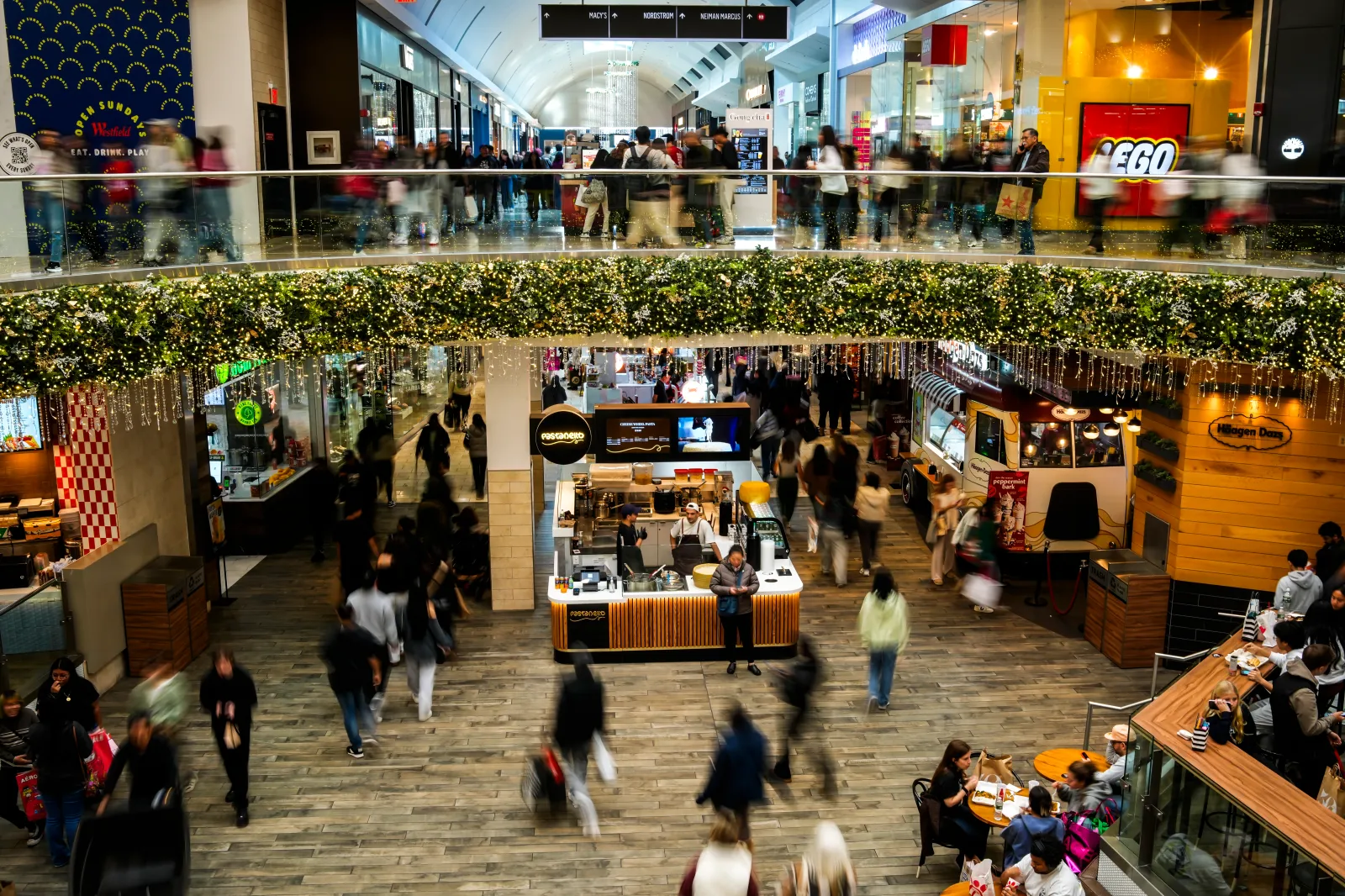
And despite higher online sales, retail analytics provider RetailNext charted a 5.3 percent year-over-year decline for in-store traffic on Friday and Saturday.
"Shoppers showed they're done with the impulse-driven, one-day frenzy," wrote Joe Shasteen, the global head of advanced analytics at RetailNext. "Prices, tariffs, and tighter budgets pushed people to shop with discipline, not adrenaline, and they responded by turning Black Friday into a value calculation."
What People Are Saying
White House economic adviser Kevin Hassett, the director of the National Economic Council, told CBS News: "We now have hard data for Black Friday and even for Saturday, and the online sales were up almost 10 percent, in-store sales were up 4 percent. It was really a blockbuster weekend after Thanksgiving. And so, I think that the folks who were saying, 'Wow, maybe people are going to be anxious about, you know, going back and getting presents for the kids and so on,' they've been disproven."
Retail analyst Neil Saunders told Newsweek: "The increased level of spending tells us that the consumer is not hibernating and that the retail economy is not in recession. However, it does reveal some underlying cracks. Growth is mostly being driven by middle- and higher-income households and is not a broad brush. Consumers are also cautions and are very deliberate and thoughtful about their spending. They're not just dashing out and buying loads on impulse. Muted volume growth creates polarization between winners and losers and there is not enough growth to satisfy all retailers."
Sucharita Kodali, retail industry analyst at Forrester, told Newsweek: “We may see smaller growth figures in the weeks to come if shoppers pulled spending forward. And stores may not have done as well as online. We have limited data points so the full story won't emerge for a few weeks but so far the outlook appears strong. I suspect that even consumers who are most vulnerable are still finding good deals at Walmart, Amazon, TJMaxx and other value retailers.”
Joanne Hsu, research associate professor and director of consumer surveys at the University of Michigan, told Newsweek: “Consumers broadly feel less confident about the economy than they did at the start of the year, due to two main factors: frustration over the persistence of high prices, and concerns that labor markets and income prospects are weakening. Accordingly, consumers have expressed that it is an unfavorable time to make major purchases. They may still be willing to spend on smaller purchases, but given their concerns about the economy they are likely to prioritize value and to be choosy about how they spend their money.”
“Note that the lion's share of aggregate spending is generated by high-income, high-wealth consumers,” she added. “These consumers are supported by strong stock markets and may be more willing to spend, even as lower-income, lower-wealth consumers tend to pull back.”
Caila Schwartz, the director of consumer insights at Salesforce, told Forbes: "Black Friday delivered an important signal for the U.S. economy. On the surface, sales were strong, hitting $18 billion, a 3 percent jump year over year. But with the average selling price for goods climbing 7 percent, U.S. shoppers continued to feel the bite of inflation."
What Happens Next
Black Friday is considered an early indication of consumers' holiday season behavior—the "anchor of the holiday shopping season," according to RetailNext's Shasteen—and both retailers and analysts must wait till beyond Christmas for firmer indications of how economic headwinds are altering Americans' spending patterns.
Adobe is projecting a total of $253.4 billion in holiday spending this year, up from $241.1 billion in 2024, while the National Retail Federation expects sales across November and December to surpass $1 trillion for the first time ever.
Mastercard, meanwhile, has forecast a 7.9 percent increase in e-commerce sales and a 2.3 percent rise in in-store sales. However, it added in its report that "inflation is expected to be a larger contributor to sales growth, as opposed to actual sales volume compared to last year."
Update 12/01/25 10:03 a.m. ET: This article was updated with additional comment and context.
View 0 Comments
Submit Correction
View Editorial & AI Guidelines