
...

By Tom Howarth
Science Reporter (Nature)
0
Share
Newsweek is a Trust Project member
See more of our trusted coverage when you search.Prefer Newsweek on Googleto see more of our trusted coverage when you search.
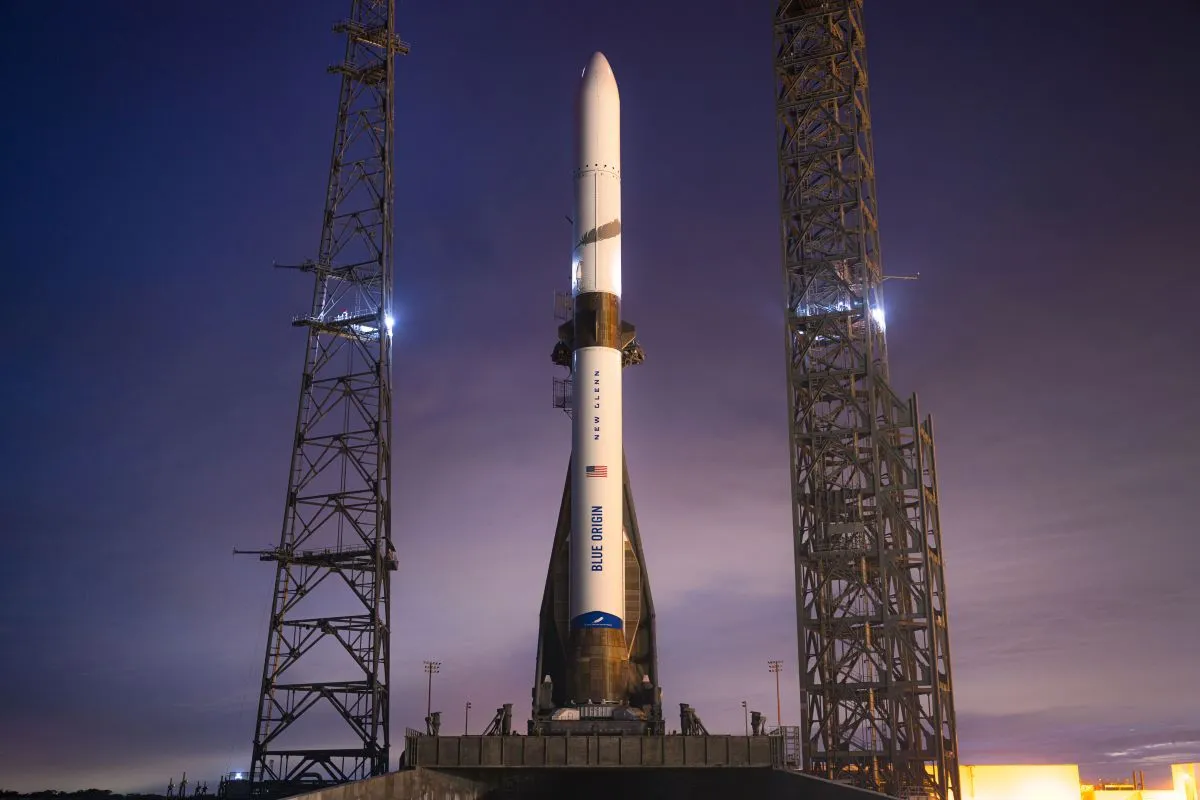
Blue Origin, Jeff Bezos' space exploration company, was forced to cancel the highly anticipated debut launch of its New Glenn rocket early Monday due to a technical issue.
The 320-foot orbital-class rocket was set to launch a prototype satellite from Cape Canaveral Space Force Station in Florida, but an unspecified problem halted the countdown in its final minutes. Blue Origin has not yet announced a new launch date.
This delay adds to a string of setbacks for New Glenn, which has been in development for a decade. The mission was initially delayed from January 10 due to rough seas that could have jeopardized the planned recovery of the rocket's first-stage booster.
Read More on Science
...
Why Was the Blue Origin Launch Aborted Today?
Launch controllers discovered a technical issue with one of the rocket's subsystems shortly before liftoff.
"We're standing down on today's launch attempt to troubleshoot a vehicle subsystem issue that will take us beyond our launch window," Blue Origin announced in a post on X (formerly Twitter). "We're reviewing opportunities for our next launch attempt."
Prior to the launch attempt, in another post on X, the company said its "key objective today is to reach orbit safely. Anything beyond that is icing on the cake."
It added, "No matter what happens, we'll learn, refine and apply that knowledge to our next launch."
How Does Blue Origin's Rocket Differ From SpaceX's Rocket?
The New Glenn rocket dwarfs SpaceX's Falcon 9, standing 320 feet tall compared to Falcon 9's 230 feet. It also boasts a higher payload capacity, capable of lifting up to 45 tons into space, nearly double Falcon 9's 23-ton capacity.
Like Falcon 9, New Glenn features a reusable first stage designed to land on a sea-based platform, aiming to cut launch costs and improve sustainability.
However, SpaceX has a significant head start. With hundreds of successful Falcon 9 launches and a demonstrated reusability record, SpaceX has set the standard for cost-effective space exploration.
SpaceX's Starship, currently the world's most powerful launch vehicle at 403 feet tall, further expands the company's technological edge.
The next Starship test flight, scheduled for January 15, will include a series of advanced maneuvers such as deploying Starlink satellite simulators and performing complex reentry experiments.
SpaceX will also attempt to catch its booster once again—a feat first achieved before the eyes of the world in October 2024. During Starship's last test flight in November, the maneuver was aborted.
Could the Blue Origin Rocket Rival SpaceX?
New Glenn's capabilities suggest that it could eventually become a formidable competitor to Falcon 9 and even Starship in the commercial and national security sectors.
Its large payload capacity, coupled with its reusability, aligns with the growing demand for heavy-lift rockets.
However, SpaceX's established reliability, innovative design and unmatched launch cadence will be hard to surpass.
While Blue Origin is still in the testing phase with New Glenn, SpaceX is already executing complex missions, including satellite deployment and booster recovery, with remarkable consistency.
...
What Does This Failure Mean for the Rivalry?
The canceled launch underscores the challenges Blue Origin faces in catching up with SpaceX. Although New Glenn's eventual success is almost certain, the delay highlights the difficulty of competing with a company that has already mastered reusable rocket technology.
For now, SpaceX maintains its lead in the private space race, with Starship's upcoming test flight poised to reinforce its dominance.
Still, the relationship between the two billionaires at the head of the race remains cordial.
After Bezos posted a video of the New Glenn rocket on X ahead of the launch last week, Musk wished him luck, replying, "Godspeed!"
Do you have a tip on a science story that Newsweek should be covering? Do you have a question about Blue Origin? Let us know via science@newsweek.com.
View 0 Comments
Submit Correction
View Editorial & AI Guidelines