...

By Jack Beresford
Senior Reporter
0
Share
Newsweek is a Trust Project member
See more of our trusted coverage when you search.Prefer Newsweek on Googleto see more of our trusted coverage when you search.
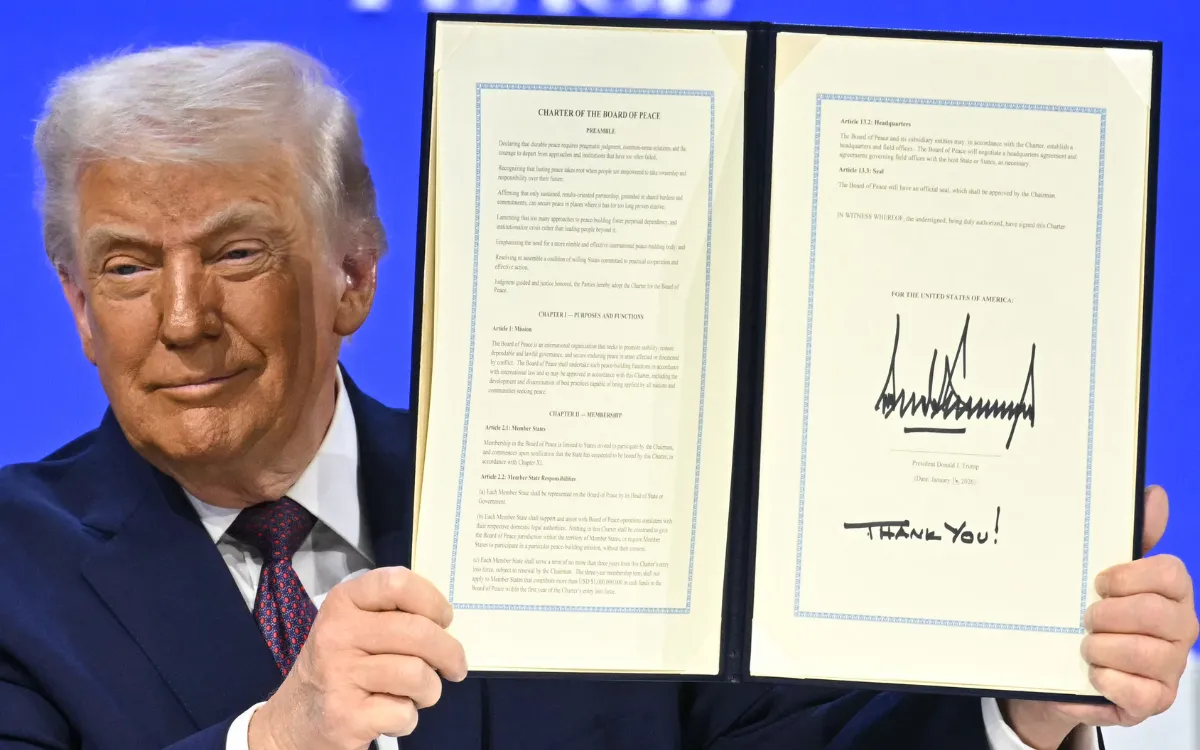
President Donald Trump’s proposed “Board of Peace” is beginning to take shape—but a potential roadblock lies ahead.
Trump launched the “Board of Peace” at the World Economic Forum in Davos, Switzerland, to assist Gaza’s transition out of war,. Somewhere in the region of 60 different nations have been invited to join the Board of Peace. They will be required to pay $1 billion each if they wish to become permanent members. Otherwise they will serve a three-year term on the board.
So far some 35 nations have agreed to join, according to the Trump administration. France, Norway and Sweden have all declined or deferred their invitations, while Trump personally withdrew Canada’s in a post shared to Truth Social.
Read More on World
Elsewhere, Slovenia declined the invite, with Prime Minister Robert Golob warning the board "dangerously interferes with the broader international order." Though Trump said Russian President Vladimir Putin had accepted an invitation to join the initiative, he has yet to confirm this and previously said they were still weighing up the invitation.
As bold as Trump's proposals may be, the potential fly in the ointment lies in the fact several of these new members are either facing U.S. sanctions or visa barriers.
Why It Matters
Any sanctions or barriers to entry to the U.S. could potentially hinder the work of the "Board of Peace." There has already been an example of the potential issues that lie ahead.
Writing on Threads under the handle @pattyemiller32, Patricia Miller, a vocal critic of Trump on social media, went viral after claiming the leaders of two countries signed up to the "Board of Peace" could not attend the signing ceremony in Davos "because they would have been arrested for war crimes.”
Miller appears to be referencing Israeli Prime Minister Benjamin Netanyahu and Russian President Vladimir Putin, both of whom are under an ICC arrest warrant for alleged war crimes. Putin has yet to confirm Russia's involvement in the initiative. In any case, Miller's post has been viewed over 130,000 times on the platform, earning over 18,000 likes and highlighting just one aspect of the issues that lie ahead.
The other concerns those who have accepted invitation to the "Board of Peace" despite U.S. visa processing having been frozen by the Trump administration. This may mean members from these states are unable to travel to the U.S**.** to participate in board activities. With permanent members expected to pay $1 billion to join, that may not sit well with those nations impacted.
That could create a two-tier system within the "Board of Peace" that includes countries that can fully participate and countries that are symbolically included but practically constrained. The inclusion of alleged war criminals in a "Board of Peace" may also impact its legitimacy both domestically and internationally, with the U.K. among those to express reservations about Russia's involvement.
Furthermore, it is likely to be a source of tension for those nations facing visa restrictions who may perceive them as a demonstration of how the U.S. may actually view each member state.
Newsweek has contacted the White House for comment on how these issues will be addressed.
...
What To Know
Argentina, Albania, Armenia, Azerbaijan, Bahrain, Belarus, Bulgaria, Egypt, Hungary, Israel, Indonesia, Jordan, Kazakhstan, Kosovo, Morocco, Mongolia, Pakistan, Qatar, Saudi Arabia, Turkey, United Arab Emirates, Uzbekistan and Vietnam have all accepted an invitation to join the "Board of Peace."
Of those potential members, Armenia, Azerbaijan, Belarus, Egypt, Kazakhstan and Kosovo are among the 75 countries where U.S. visa processing was frozen by the Trump administration. Russia was also among those countries impacted.
What People Are Saying
President Donald Trump speaking at Davos: “We have a lot of great people that want to join. It’s going to be the most prestigious board ever formed…I have some controversial people…But these are people that get the job done. These are people that have tremendous influence.”
U.K. Foreign Secretary Yvette Cooper: "We won't be one of the signatories today because this is a legal treaty that raises much broader issues. And we do also have concerns about President Putin being part of something that's talking about peace when we've still not seen any signs from Putin that there will be commitment to peace in Ukraine."
In a polarized era, the center is dismissed as bland. At Newsweek, ours is different: The Courageous Center—it's not "both sides," it's sharp, challenging and alive with ideas. We follow facts, not factions. If that sounds like the kind of journalism you want to see thrive, we need you.
When you become a Newsweek Member, you support a mission to keep the center strong and vibrant. Members enjoy: Ad-free browsing, exclusive content and editor conversations. Help keep the center courageous. Join today.


View 0 Comments
Submit Correction
View Editorial & AI Guidelines