10
Loading video...

By Jordan King
Reporter
0
Share
Newsweek is a Trust Project member
See more of our trusted coverage when you search.Prefer Newsweek on Googleto see more of our trusted coverage when you search.
A scientific journal has retracted a study that claimed satellite radar could reveal hidden structures inside the Great Pyramid of Giza, finding “serious methodological flaws and statistical errors” that undermined its conclusions.
The retraction matters because the paper provided a scientific foundation for increasingly extraordinary claims about what may lie beneath one of the world’s most famous archaeological sites.
The Original Claim
The 2022 paper by Italian researchers Filippo Biondi and Corrado Malanga was published in Remote Sensing, a peer-reviewed scientific journal that covers satellite imaging, radar and other technologies used to study Earth and the environment.
Read More on Science
The researchers used a radar-based imaging technique called synthetic aperture radar Doppler tomography, which they said could analyze tiny changes in radar signals to create a picture of structures hidden inside the Pyramid of Khufu, named after the Egyptian pharaoh who ordered its construction as his royal tomb, also called the Great Pyramid of Giza.
They argued that satellite data could be used to map previously unknown rooms, corridors and other features without physically entering the pyramid.
The Investigation
Remote Sensing said it opened an investigation after a reader raised concerns about the study’s methodology and later retracted the article on August 10.
Biondi, Malanga and other researchers later said scans indicated vast shafts, chambers and tunnels beneath the nearby Pyramid of Khafre—claims widely described online as evidence of an “underground city.”
Related Story
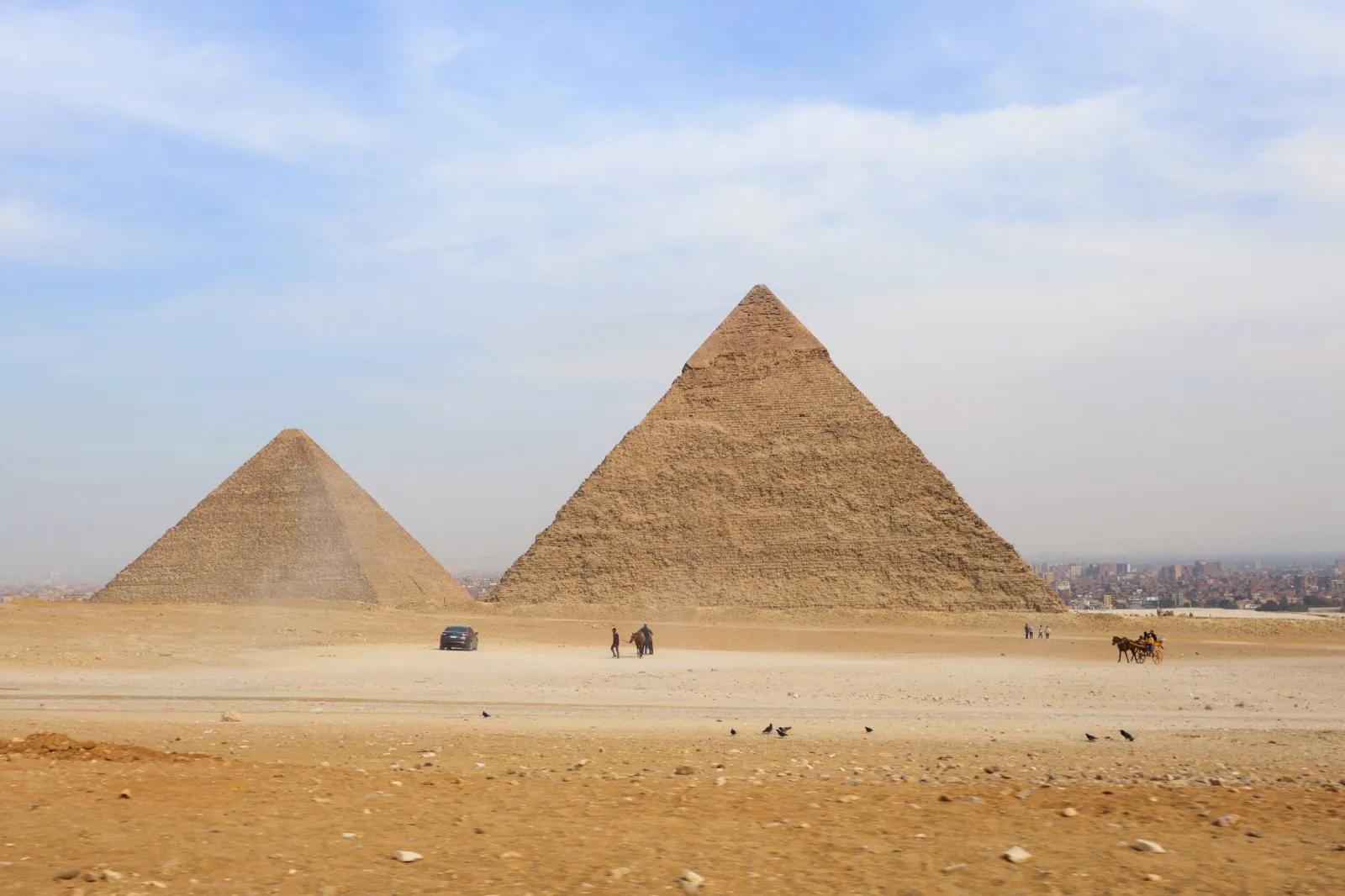
Giza Pyramid Mystery Addressed by Former Egyptian Official
The controversy drew international attention and interest from the YouTube creator known as MrBeast, who offered to help explore the pyramids after the claims went viral. Speculation has since expanded to include an alleged second Sphinx beneath the Giza Plateau, though no such discovery has been confirmed.
Biondi and Malanga disagreed with the decision to retract their paper, according to the journal’s notice. Retraction Watch, a nonprofit publication that reports on scientific retractions, research misconduct and related issues, said the researchers did not respond to multiple requests for comment. Newsweek contacted the authors via email on Monday for comment.
...
How the Pyramid Claims Became a Global Sensation
The paper claimed to have identified 20 hidden features inside and beneath the Great Pyramid, including corridors, rooms and ramps. The researchers also said their method detected the “Big Void,” a large cavity previously found using cosmic-ray scans.
The researchers used satellite radar to study tiny movements in the pyramid caused by factors such as wind, earthquakes and activity around the site. They said those movements allowed them to create a detailed picture of structures hidden inside the pyramid.
The researchers said the method “allows us to see the pyramid as if it were transparent like a crystal,” while noting that “only an on-site investigation can confirm” the structures identified by the analysis.
Public interest surged in March 2025, when the researchers and their collaborators applied the method to the Pyramid of Khafre and announced results at a news conference. They claimed to have identified five connected structures near its base and eight cylindrical shafts descending roughly 648 meters, surrounded by spiral pathways and leading toward two large cube-shaped structures. The presentation also discussed possible parallels with the Duat and Amenti, concepts associated with the ancient Egyptian underworld, helping fuel online descriptions of the purported structures as an “underground city.”
Why the Pyramid Claims Became Controversial
The scale of the Khafre claims quickly drew scrutiny from archaeologists and radar specialists. The findings had not been published in a peer-reviewed journal or independently verified, and the researchers had not conducted fieldwork to confirm the purported structures. The Remote Sensing paper covered their earlier analysis of the Great Pyramid, not the later claims involving shafts and chambers beneath Khafre. Critics therefore questioned whether minute surface movements detected by satellite could support such detailed conclusions about structures hundreds of meters underground.
Zahi Hawass, an Egyptologist and former Egyptian antiquities minister, rejected the announcement days after it began circulating. He said the researchers had not received permission from the Supreme Council of Antiquities to work inside the Pyramid of Khafre and that there was “no scientific evidence” supporting the alleged structures.
The researchers did not claim that ordinary radar signals traveled through hundreds of meters of stone. Their paper acknowledged that the “poor penetrating action of electromagnetic waves inside solid bodies” ordinarily prevents SAR from imaging their interiors. Instead, they argued that satellite data captured minute surface vibrations generated by seismic activity and other sources, from which hidden structures could be reconstructed.
Lawrence Conyers, a University of Denver professor emeritus who specializes in radar applications in archaeology, rejected that explanation. He told Retraction Watch that a radar sensor can measure only what it directly “sees” and argued that the purported vibrations would be too small for a satellite to detect.
The researchers themselves acknowledged that “only by confirmation on the field” could their hypothesis be validated. No excavation or independent survey had confirmed the sharply defined corridors, shafts and chambers shown in their reconstructions. Hawass said the Supreme Council of Antiquities had not granted the team permission to work inside the Pyramid of Khafre and that there was “no scientific evidence” supporting the alleged structures.
The contrast between the images’ apparent precision and the lack of physical verification became a central criticism of the project.
Why the Journal Retracted the Study
Nearly four years after the paper was published, Remote Sensing said a reader alerted its editorial office to concerns about the research methods. The journal said it investigated the complaint and “confirmed serious methodological flaws and statistical errors” that undermined the paper’s scientific conclusions.
The notice did not identify the reader or detail the alleged errors individually. Instead, it said the journal’s investigation had “confirmed serious methodological flaws and statistical errors” and that “the findings and conclusions presented in this article are not reliable.” The notice did not allege that Biondi or Malanga had fabricated data or committed research misconduct.
The decision applies to the 2022 paper about the Pyramid of Khufu. It does not constitute a separate review of the team’s later claims about the Pyramid of Khafre or the wider Giza Plateau, which were not published in that article.
The journal said that “the authors disagree with the retraction," but did not include their reasons for opposing the decision.
Biondi has continued sharing material about the wider project without publicly addressing the journal’s findings. On August 25, he posted a History Channel segment from The UnXplained about alleged structures beneath the pyramids.
He also shared a Khafre Project video saying technical plans for noninvasive field measurements and applications for excavation permits had been submitted to Egypt’s Ministry of Tourism and Antiquities on August 22. The announcement did not say permission had been granted, and neither video addressed the retraction’s findings.
Contact Newsweek editors on this story: Matthew Cannon and Gray R. Thomas
View 0 Comments
Submit Correction
View Editorial & AI Guidelines