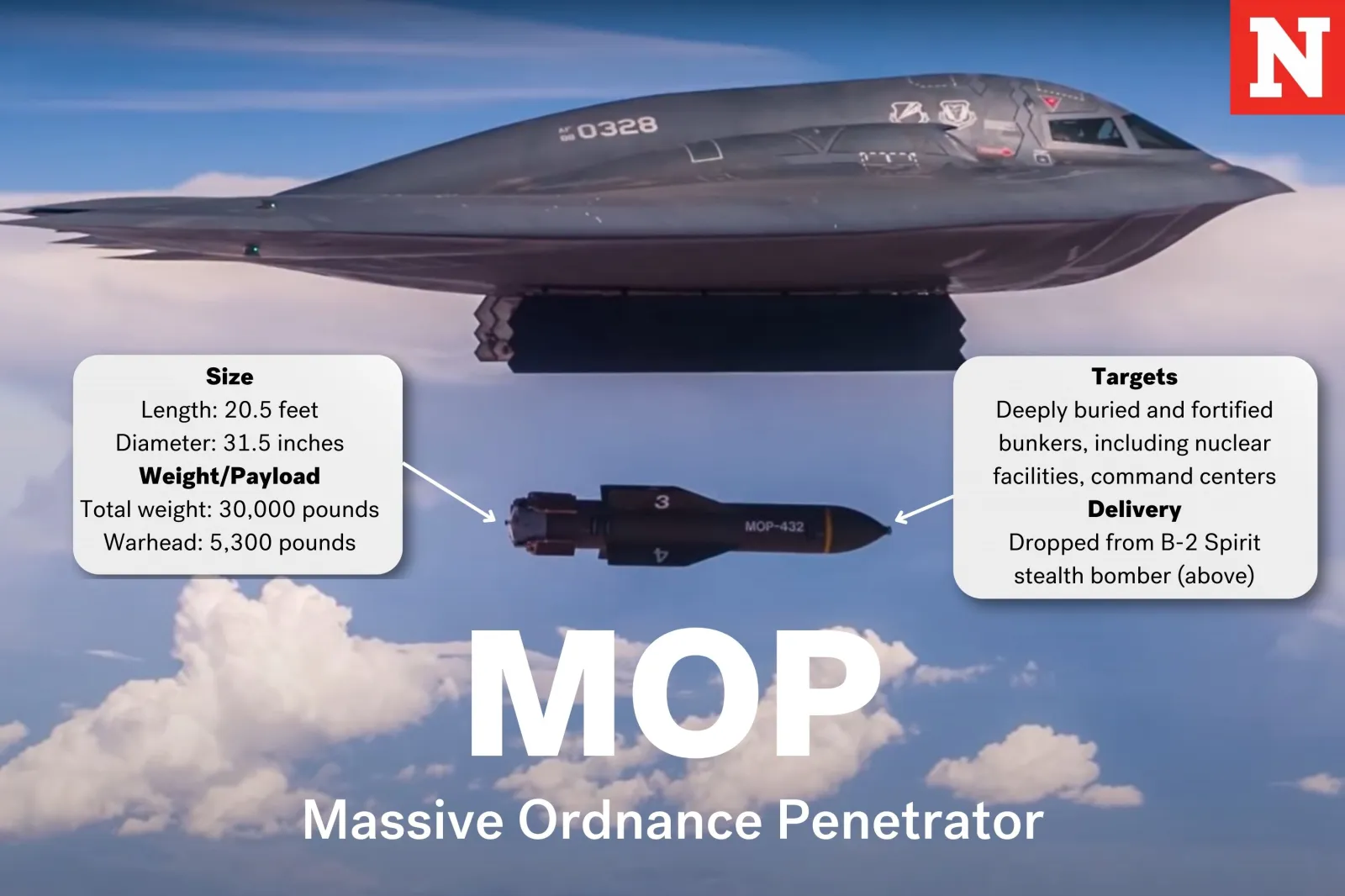
Newsweek illustration/USAF/Graphic of Massive Ordnance Penetrator

By Joe Edwards
Reporter
0
Share
Newsweek is a Trust Project member
See more of our trusted coverage when you search.Prefer Newsweek on Googleto see more of our trusted coverage when you search.
A U.S. Army plant in Oklahoma is being upgraded to triple monthly production of the U.S.'s largest non-nuclear bomb, informally known as the "bunker buster," reported Bloomberg Tuesday.
First conceived during World War II, these types of ordinances have since been deployed in numerous conflicts across the globe including in Korea and Iraq.
How "Bunker Busters" Work
The Massive Ordnance Penetrator (MOP), known as the GBU-57A/B, is a precision-guided, 30,000-pound bomb utilized by the U.S. Air Force.
Read More
Japan Scrambled Jets 41 Times Against Chinese and Russian Planes3 min read

China Responds to US and Taiwan’s Secret Naval Training in Pacific3 min read

The below illustration details some of the key features of the "bunker buster."
...
Engineered by Boeing, this "bunker buster" bomb has been specifically designed to penetrate deep into earth and concrete before detonating, making it ideal for destroying fortified bunkers and underground facilities which house sensitive military hardware or command centers.
The bomb measures 20.5 feet in length and 31.5 inches in diameter, equipped with a GPS guidance system to enhance its accuracy. It carries approximately 5,300 pounds of explosives and can breach up to 200 feet of earth or 60 feet of concrete before detonation, according to official specifications.
How They're Used
The primary use of the MOP is in strategic military operations where deeply buried targets must be neutralized without the use of nuclear weapons. This includes command centers, nuclear facilities, or munitions depots located underground.
The MOP can only be deployed from the B-2 Spirit bomber due to its massive size and weight.
The bomb has been considered crucial in scenarios involving potential conflicts with nations like Iran or North Korea, where underground facilities might be used to shield critical infrastructure or military assets from conventional attacks.
The Wall Street Journal reported in December that the U.S. provided bunker buster-type bombs to Israel for its war against Hamas in Gaza.
Some weapons experts and former government officials the Journal spoke to expressed concern that such weapons would put residents of Gaza at risk.
Countering "Bunker Busters"
Countering such deep-penetrating bombs is complex and often involves multiple layers of defense and engineering. Potential adversaries may use reinforced concrete with significant depth, layout complexity, and redundancy in their design of critical infrastructure to mitigate the effects of "bunker buster" bombs like the Massive Ordinance Penetrator.
The use of decoy sites and the dispersal of critical assets across multiple locations can also reduce the efficacy of a concentrated strike from a MOP.
Countries potentially at risk from a MOP could also invest in underground facility resilience and surrounding the facility with surface-to-air missiles, anti-aircraft guns, and interceptive aircraft to enhance defense by potentially shooting down or intercepting incoming munitions.
View 0 Comments
Submit Correction
View Editorial & AI Guidelines