
By Aristos Georgiou
Science and Health Reporter
0
Share
Newsweek is a Trust Project member
See more of our trusted coverage when you search.Prefer Newsweek on Googleto see more of our trusted coverage when you search.
A particle physicist has created an online tool which enables you to calculate what would happen if the Earth or any other astronomical object was sucked into a black hole.
The tool—developed by Álvaro Diez from the University of Warsaw in Poland—shows you various parameters, such as the amount of energy that would be produced by collisions with different-sized objects.
For example, the calculator shows that the energy generated by a collision between an object with the same mass as the Earth and a black hole with about four million solar masses—like Sagittarius A*, which lies at the center of the Milky Way—would be roughly 32,200,000,000,000,000,000,000,000,000,000,000 megajoules.
Read More
The Center of the Milky Way Exploded 3.5 Million Years Ago, Shooting Radiation 200,000 Light-Years Into Space4 min read

NASA Visualization Reveals How a Black Hole Warps Its Surroundings Like a Carnival Mirror5 min read

Planet Nine Mystery Could Be Caused by a Black Hole, and Dark Matter ‘Annihilation Signals’ May Help Find It: Scientists3 min read

"These events are so huge we couldn't even begin to comprehend the size," Diez told Newsweek. "There's not really much more context for such a huge amount. Black holes are so compact and, hence, have such strong gravity around them that the speeds, forces and energies related to anything that gets close to them are just out of our imagination."
Diez said he created the calculator because he was inspired by several black hole discoveries which have been announced recently.
"This year has been undeniably the black hole year, from the data collected by Nobel Prize-winning collaboration LIGO, to the first-ever picture of a black hole, to NASA publishing a collision between a black hole and a neutron star not two weeks ago, it seems like we can't go for a month without one or more breakthroughs in our understanding of black holes," he said.
"In particular, this last story was an inspiration for me to create a more complete version of a black hole calculator that can show people not only what black holes are and how they interact, but also the consequences of those interactions and collisions on the black hole itself," he said.
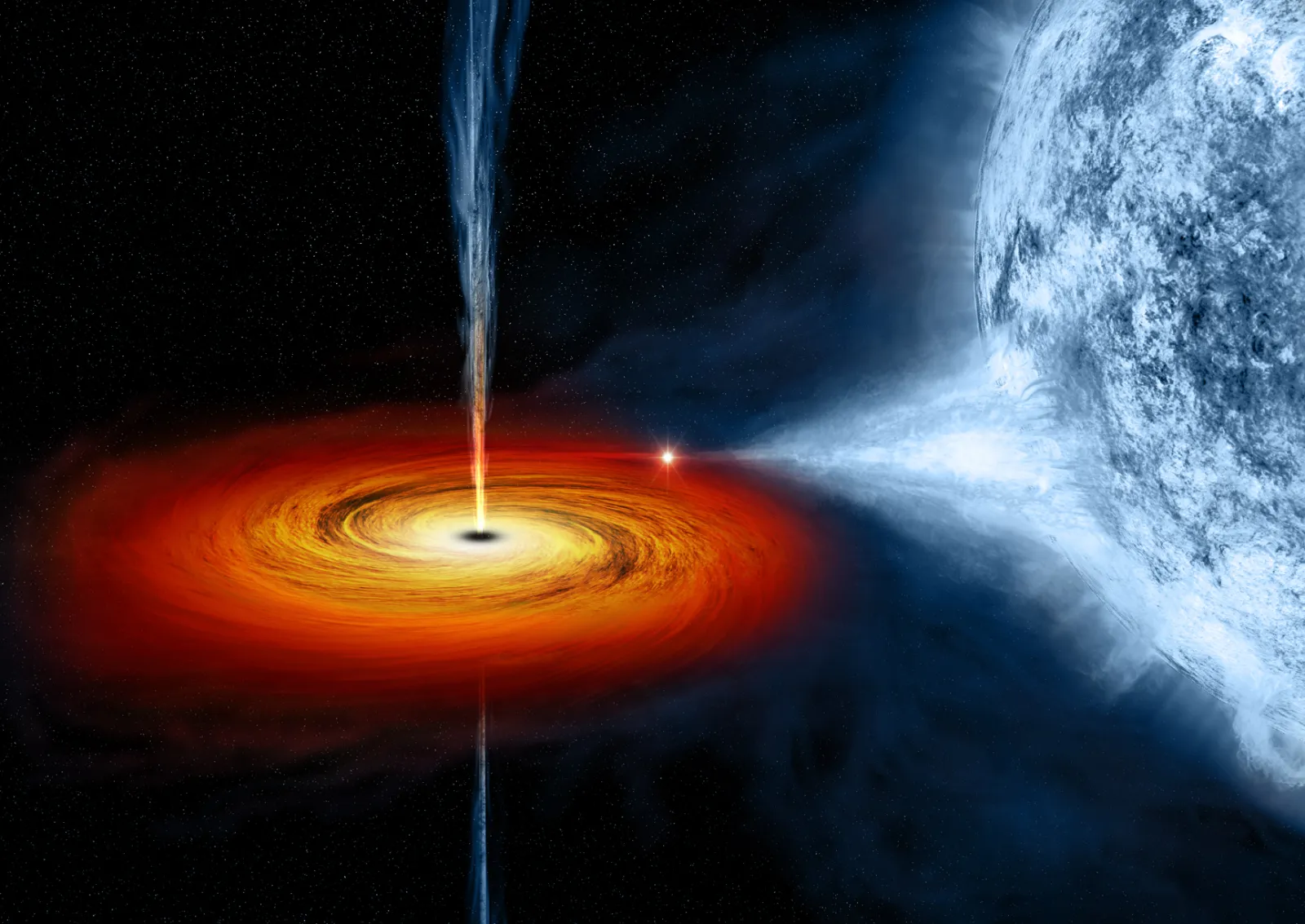
In simple terms, black holes are dead stars that, after exploding as supernovae, have so much mass that nothing can hold them together anymore.
These dead stars eventually collapse in on themselves into a single point of infinite density, known as a singularity—where gravity is predicted to be infinite and the laws of physics as we know them break down. The singularity is surrounded by the event horizon—the boundary beyond which nothing can escape due to the extreme gravitational pull.
"A black hole is defined by its mass or its Schwarzschild Radius, which is the surface that marks the 'point of no return,' anything that gets closer than that distance cannot escape the black hole, not even light—which is why they are called black holes," Diez said.
According to the physicist, there are two main types of interactions between black holes and other objects which help alert us to their existence: destructive and non-destructive.
In the non-destructive interactions, astronomers observe astronomical objects—most of which are stars—orbiting around what appears to be a non-existent object with an extremely strong gravitational pull.
After ruling all other options out, astronomers may conclude that this signifies the existence of a black hole, even if they can't see the object directly.
The more violent encounters involve objects getting too close to the black hole and being swallowed by it. These events are not as common, however, when objects like stars fall into black holes, the collisions produce vast amounts of energy—which we can detect on Earth using infrared and gamma ray detectors, even if they take place in other galaxies, millions of light-years away.
Sometimes stars get too close to the black hole and are ripped apart by what's known as "tidal disruption." This process describes how different parts of the star are pulled into the black hole at different speeds, eventually leading to its demise. Once the black hole has eaten, the event horizon grows, as the calculator reveals.
Recently, NASA released a visualization of a simulated black hole which demonstrates how the extreme gravitational forces produced by such objects distorts the light around them like a carnival mirror.
...
View 0 Comments
Submit Correction
View Editorial & AI Guidelines