...

By Ian Randall
Deputy Science Editor
0
Share
Newsweek is a Trust Project member
See more of our trusted coverage when you search.Prefer Newsweek on Googleto see more of our trusted coverage when you search.
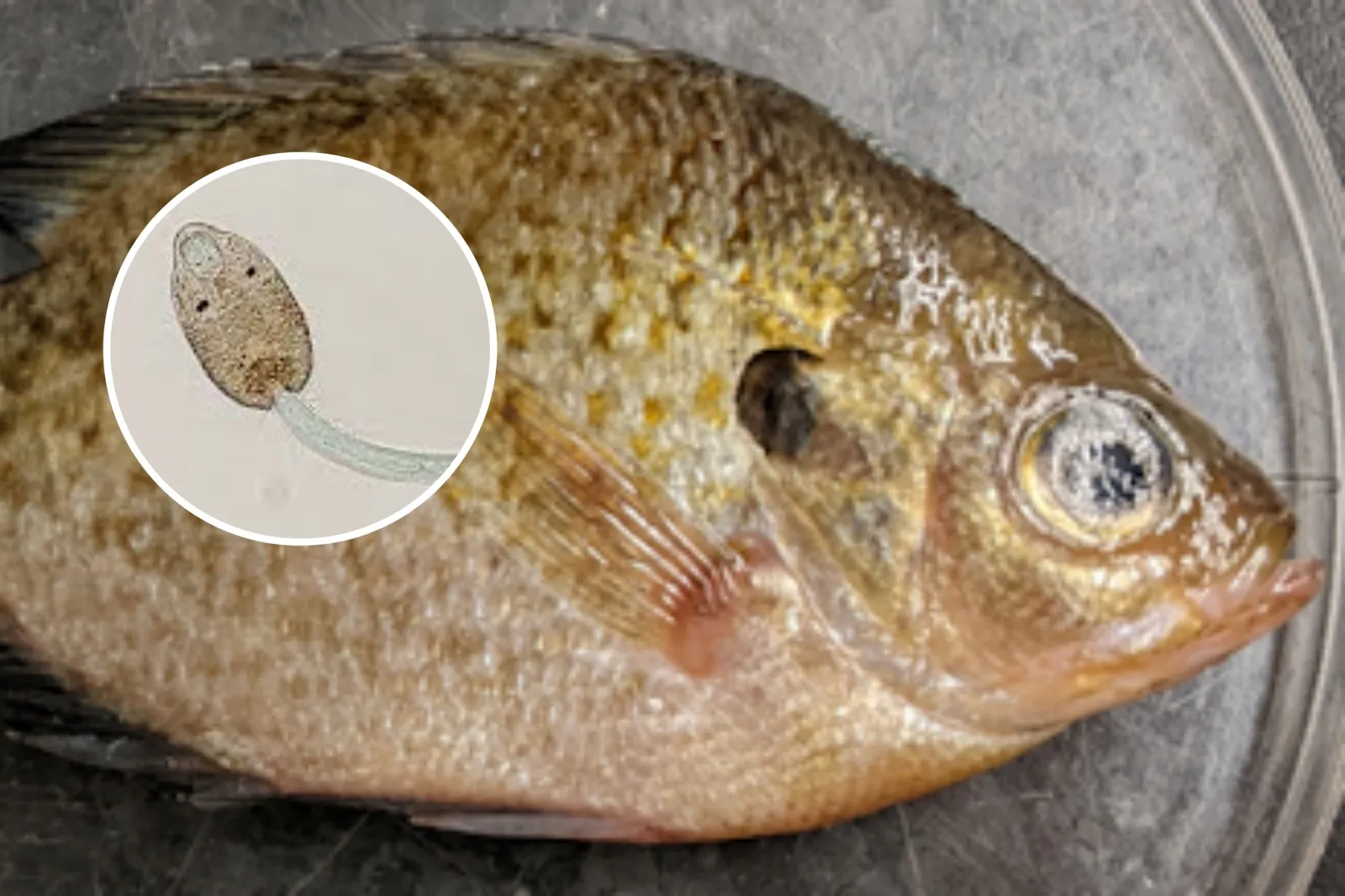
Southern Californians have been warned that more than 90 percent of popular game fish have been found to contain invasive, parasitic worms that can infect humans.
Two species of the parasitic flatworms known as "trematodes" were found infecting five species of freshwater fish from San Diego County in a study by researchers from University of California, San Diego's Scripps Institution of Oceanography.
Infection with the worms typically causes gastrointestinal problems, lethargy and weight loss in humans—but severe cases have even been known to cause heart attack and strokes.
Read More
Humans Give Off a Light That Is Extinguished in Death, Study Reveals3 min read

New Combination of Drugs Could Drastically Change How We Age: Scientists3 min read

Deadly Hospital Superbug Could Eat Patients’ Dressings, Implants and Sutures3 min read

"Americans don't usually think about parasites when they eat freshwater fish because it hasn't historically been an issue here," said paper author and ecologist Ryan Hechinger in a statement.
However, he added: "These parasites are here in the U.S., and they're infecting fish that people are eating.
"We hope this study can help make public health officials, doctors and the public more aware."
...
In their study, the researchers sampled 84 fish—representing seven species, including largemouth bass and bluegill—from five popular fishing spots around San Diego County.
The team identified two species of invasive trematode in the fish: Haplorchis pumilio and Centrocestus formosanus.
H. pumilio was found in 93 percent of all fish sampled—with some individual fish harboring thousands of the parasitic worms. C. formosanus, meanwhile, occurred in 91 percent of the fish from two of the locations.
Both worms are believed to have arrived in the U.S. from Southeast Asia more than a decade ago, traveling inside the bodies of one of their hosts—an invasive aquatic species known as the Malaysian trumpet snail (Melanoides tuberculata.)
Today, M. tuberculata can be found in 17 states, as well as Puerto Rico—and both it and its parasites are widespread in California.
The worms have a life cycle that involves living inside three hosts: first, the trumpet snail; then, a fish; and finally a warm-blooded vertebrate like birds or humans that are unlucky enough to eat the infected fish.
Hechinger said there is "no need to panic," as the risk from the parasites can be neutralized by either cooking the fish or, if planning to consume them raw, freezing for at least one week beforehand.
A survey of social-media videos conducted by the team alongside their field work, however, revealed that some Americans are consuming freshwater fish raw without these precautions—putting them at risk of infections.
"Nearly 5 million views shows there is widespread interest and possibly a widespread practice of folks eating freshwater fish raw," said paper author and marine scientist Emma Palmer of the Smithsonian Environmental Research Center in a statement.
Palmer conducted the research into the parasites while undertaking her graduate studies at the Scripps Institution of Oceanography.

...
It is unclear what impact the invasive worms might be having on the fish connoisseurs of Southern California, the researchers said.
"There haven't been any reported cases of these parasites infecting Americans, but nobody is looking for cases, and doctors aren't required to report them," said Hechinger.
He added: "This kind of research is so important to identifying new public health threats."
Based on their findings, to better track the parasites, the researchers have recommended that these fish-borne worm infections be added to the list of diseases that doctors are required to report to public-health officials.
Do you have a tip on a science story that Newsweek should be covering? Do you have a question about parasites? Let us know via science@newsweek.com.
Reference
Palmer, E. M., Metz, D.C.G., & Hechinger, R. F. (2025). Further Evidence for Plausible Transmission of Fishborne Trematodiases in the United States: Game Fish Carry Human-Infectious Trematodes and Are Eaten Raw. The Journal of Infectious Diseases. https://doi.org/10.1093/infdis/jiaf180
View 0 Comments
Submit Correction
View Editorial & AI Guidelines