...


By Kate Plummer and Sam Stevenson
0
Share
Newsweek is a Trust Project member
See more of our trusted coverage when you search.Prefer Newsweek on Googleto see more of our trusted coverage when you search.
Billionaire environmental activist Tom Steyer remains among the leading contenders in California's gubernatorial race after a series of high-profile debates, but new polling suggests the contest is tightening and remains highly volatile.
California, the nation's most populous state, is reliably Democratic. It backed then-Vice President Kamala Harris by 20 points in the 2024 presidential election and has not supported a Republican governor since reelecting Arnold Schwarzenegger, who served from 2003 to 2011, in 2006.
But the race was upended when U.S. Representative Eric Swalwell, a front-runner in the open primary to replace term-limited Democratic Governor Gavin Newsom, left the race on April 12 after sexual assault allegations surfaced. Swalwell, who later resigned from Congress, has denied the allegations. His would-be voters must now choose another candidate to support, which may risk splintering the Democratic field and boosting the Republican Party's chances of success.
Read More on Politics
The state uses a jungle primary system, in which all candidates, regardless of party, run on a single ballot. The two candidates with the most votes advance to the general election.
Will Tom Steyer win the California Governor Election in 2026?
Yes 41% · No 59%
View full market & trade on Polymarket
A SurveyUSA poll conducted April 28 to May 1, following the first televised gubernatorial debate, showed Republican Steve Hilton, whom President Donald Trump has endorsed, moving into first place with 20 percent support, putting him 2 points ahead of Steyer's 18 percent.
Hilton's rise marks a shift from earlier April polling that showed Steyer leading, highlighting how quickly the race has been reshaped by debates and candidate exits.
The California primary is set to be held on June 2, with the top two finishers advancing to the general election regardless of party under the state's "top two" system.
"Steve Hilton is leading the field because Californians are ready for real change," Hector Barajas, the communications director for Hilton's campaign, told Newsweek.
"People are tired of the same failed politicians and the same failed excuses, while costs keep rising and families are being pushed out of the state. Steve's Califordable agenda to lower costs, make communities safer, and build a government that actually works for working people is clearly resonating with voters across California."
Newsweek has contacted Steyer's campaign for comment via email.
What Are the California Governor Race Polls Showing?
Recent polling shows a tightly contested and volatile race, with multiple candidates clustered within the margin of error.
A KGTV-TV/SurveyUSA poll conducted April 28 to May 1 among 991 likely primary voters found Hilton leading with 20 percent, followed by Steyer with 18 percent. The survey drew from a wider sample of 1,415 adults statewide using an online nonprobability panel and reported a margin of error of plus or minus 4.2 percentage points for likely voters.
That result marks a notable shift from the same pollster's April 8 to 10 survey, in which Steyer held a 3-point lead—amounting to a 5-point swing toward Hilton in less than three weeks following the first televised debate.
An Emerson College poll conducted April 14 to 15 among 1,000 likely voters also showed a fragmented field, with Hilton at 17 percent and both Steyer and Republican Sheriff Chad Bianco tied at 14 percent. That poll used a mixed-mode methodology combining voter file contacts and online panels and reported a margin of error of plus or minus 3 percentage points.
A CBS News/YouGov survey conducted April 23 to 27 among 1,479 registered California voters similarly found a narrow race, with Hilton at 16 percent, Steyer at 15 percent and Xavier Becerra, who served as U.S. secretary of health and human services in the Biden administration, at 13 percent. The poll reported a margin of error of plus or minus 4.1 percentage points.
Taken together, the data points to a race defined less by a clear front-runner than by small, debate-driven swings, with multiple candidates still within range of securing one of the two spots in the general election.
...
What Happened at the California Governor Debate? Key Takeaways
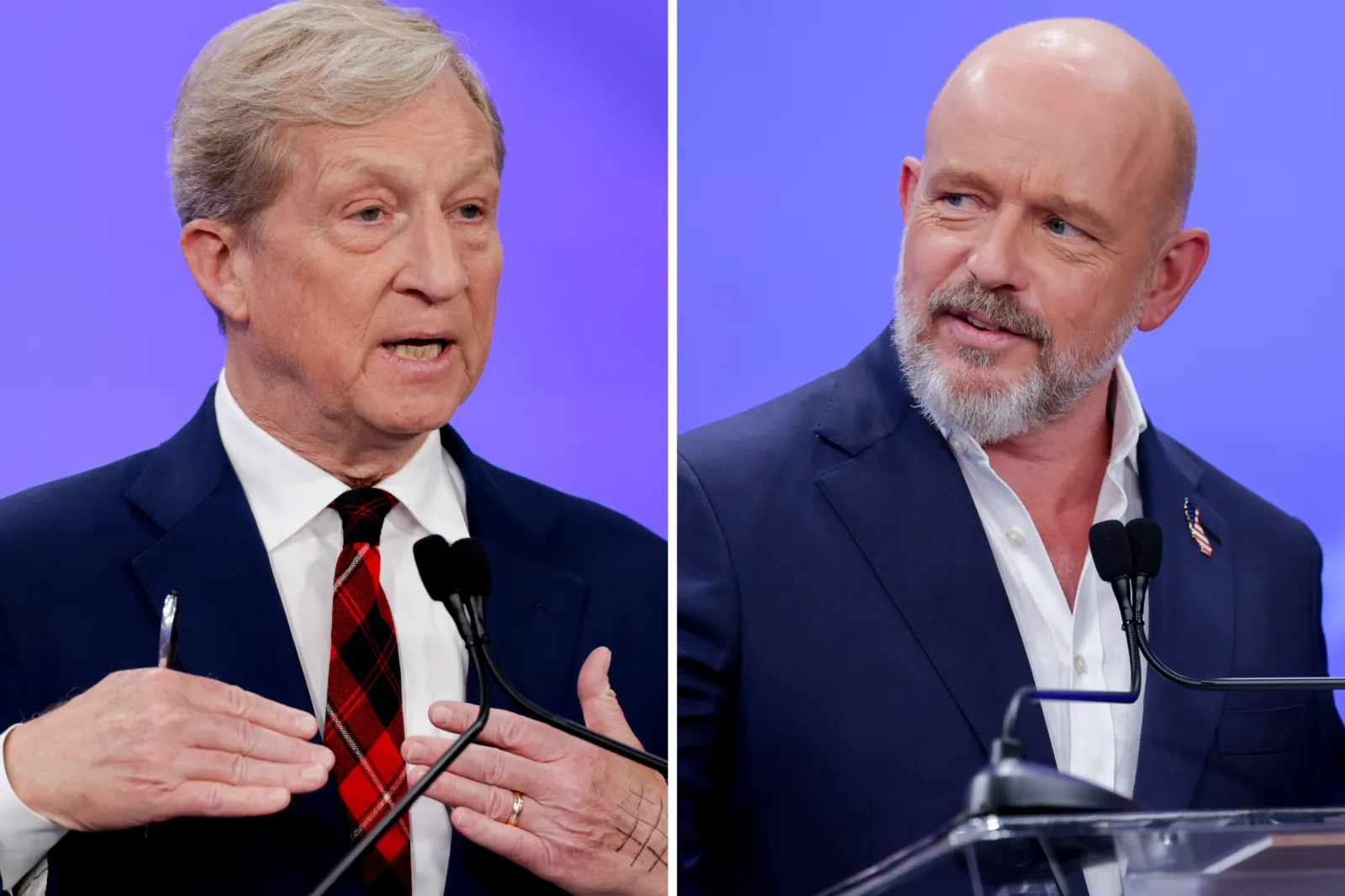
The latest gubernatorial debate, held on May 5, brought together seven of the top candidates and underscored how fluid the race remains less than a month before voting concludes.
The exchange was often combative, with candidates clashing over affordability, immigration and health care while repeatedly interrupting one another.
Becerra—who has surged in some polls following Swalwell's exit—emerged as a central target, drawing criticism from multiple rivals over his record as health and human services secretary, per NBC Los Angeles.
Health care proved one of the defining issues of the night, particularly around proposals for a single-payer system, as candidates pressed each other on whether they supported a government-run model.
The debate also highlighted divisions among Democrats, with Steyer defending his progressive platform while facing criticism over his wealth and past business record and intraparty disagreements playing out onstage.
With ballots already being mailed to voters, the debate was one of the final major opportunities for candidates to shift momentum before the June 2 primary.
What Is Single-Payer Health Care?
At its simplest, single-payer health care is a model in which a single public or government-backed agency pays for health care for all residents, replacing the mix of private insurance providers.
The topic emerged as a major flash point in the latest California gubernatorial debate, with candidates repeatedly clashing over whether the state should adopt a government-run system.
Candidates pressed each other to take clear positions on proposals often described as "Medicare for All" at the state level, exposing divisions, particularly among Democratic candidates, over how far to go in overhauling the current system.
Under single-payer health care, funding typically comes from taxes, and the public body reimburses doctors, hospitals and other providers directly, rather than patients navigating multiple insurance plans.
Supporters argue it could expand coverage and reduce administrative costs, while critics warn it could require significant tax increases and be difficult to implement at the state level.
In the context of the California race, the debate highlighted how the policy has become both a defining ideological dividing line and a key test of how candidates plan to tackle the state's rising health care costs.
Who Are the Candidates?
The May 5 debate featured seven leading candidates competing in the crowded primary field:
- Republicans: Steve Hilton and Chad Bianco
- Democrats: Tom Steyer, Xavier Becerra, Katie Porter, Matt Mahan and Antonio Villaraigosa
These candidates represent the top tier of a much larger field, with more than 60 names originally on the ballot—though only a handful are polling competitively.
The debate reinforced how divided the Democratic vote remains, while Republicans have largely consolidated behind Hilton and Bianco.
Betty Yee, a former state controller, suspended her campaign last month over fundraising concerns. She was vying to be the first woman to hold the state's highest office.
"It was becoming clear that the donors were not going to be there. Even some of my former supporters just felt like they needed to move on," Yee said in an online news conference.

...
Why Did Swalwell Exit the Race?
Swalwell resigned after the San Francisco Chronicle reported that a former staffer alleged that the congressman sexually assaulted her in 2019, when she worked for him, and again in 2024 at a charity gala. CNN reported that three additional women accused Swalwell of misconduct, including unsolicited explicit messages and inappropriate physical contact.
A fifth woman, Lonna Drewes, accused Swalwell of drugging and raping her during a 2018 encounter in Los Angeles. Swalwell, who denied the previous allegations, declined to comment on the latest allegation when reached via phone. "I have no comment on anything—period—and I'm going to hang up now," he previously told Newsweek.
When Is the Election?
California's open primary is scheduled for June 2. Regardless of party, the two candidates who receive the most votes advance to the general election, which is scheduled to take place on November 3.
Update 5/7/26, 5:27 a.m. ET. This article has been updated with additional information.
Update 4/28/26, 3:19 a.m. ET: This article has been updated with additional information.
Update 4/29/26, 6:43 a.m. ET: This article has been updated with additional information.
View 0 Comments
Submit Correction
View Editorial & AI Guidelines