
...

By Jasmine Laws
Reporter
0
Share
Newsweek is a Trust Project member
See more of our trusted coverage when you search.Prefer Newsweek on Googleto see more of our trusted coverage when you search.
Two decades after voters approved the plan, California's high-speed rail project now looks markedly different from the one put forward in 2008.
The project, still officially aimed at connecting San Francisco and Los Angeles with electric trains capable of reaching 220 mph, is now less a single, publicly funded mega-project and more a phased infrastructure program built around private investment.
Proposition 1A authorized a bond issue of $9.95 billion to help establish a high-speed train service linking California's two largest cities via the Central Valley, as well as several other smaller areas that have historically not benefited from transport infrastructure, with public and private matching funds expected to cover the rest.
Read More on U.S.
Triple the Cost, Recast the Project

...
Today, after years of delays, a soaring price tag (which has now hit $100 billion, triple the original cost estimate) and growing backlash, state officials are increasingly recasting the project in order to speed up progress and delivery of the long-awaited transportation link. Completion is currently expected to be 2038.
President Donald Trump has been a longtime critic of the project, branding it a "waste" and a "green disaster." Transportation Secretary Sean Duffy has echoed similar skepticism over the cost and timeline of the project, meanwhile, California gubernatorial candidate Xavier Becerra has vowed he will ensure the project is finished on time if elected.
The California High-Speed Rail Authority (CHSRA) denies that the project has fundamentally changed, saying it "continues to be delivered in accordance with state law."
"While a phased delivery strategy has been implemented in response to inflation, engineering maturity, statutory constraints, and real‑world funding conditions, the core project approved in 2008 remains unchanged," the authority said.
It also said the original $45 billion estimate from 2008 "did not account for inflation (which has nearly doubled since then), nor the full engineering and delivery complexity of a statewide system, evolving scope, or a completed design/alignment through the Central Valley."
"The initial timeline also assumed full funding up front. As with other major infrastructure programs, phasing helps manage both cost and complexity," CHSRA continued.
It added, "Our focus remains the same: delivering a statewide high-speed rail system from San Francisco to Los Angeles while positioning the project to connect California's major regions as efficiently and cost‑effectively as possible."
...
From Public Funding to Private Investment
When voters approved Proposition 1A in November 2008, the measure was framed around state bond funding, federal support and required matching dollars from public and private sources.
The official ballot summary said the bond issue would provide $9.95 billion, with at least 90 percent spent on specific construction projects and matching funds required from sources including federal, revenue bond and local funds.
That model has since evolved. In December 2025, CHSRA launched a formal process to attract private investors and developers to help deliver the project “faster, smarter, and more economically.”
By June 2026, that effort had advanced into a co-development agreement with Momentum Alliance Partners, a global consortium of high-speed rail firms including Plenary Americas, CDPQ Infra, Keolis, SNCF Voyageurs, Jacobs, Sener, SYSTRA, Setec, Arup and Steer.
...
From Fixed Plans to Flexible Design
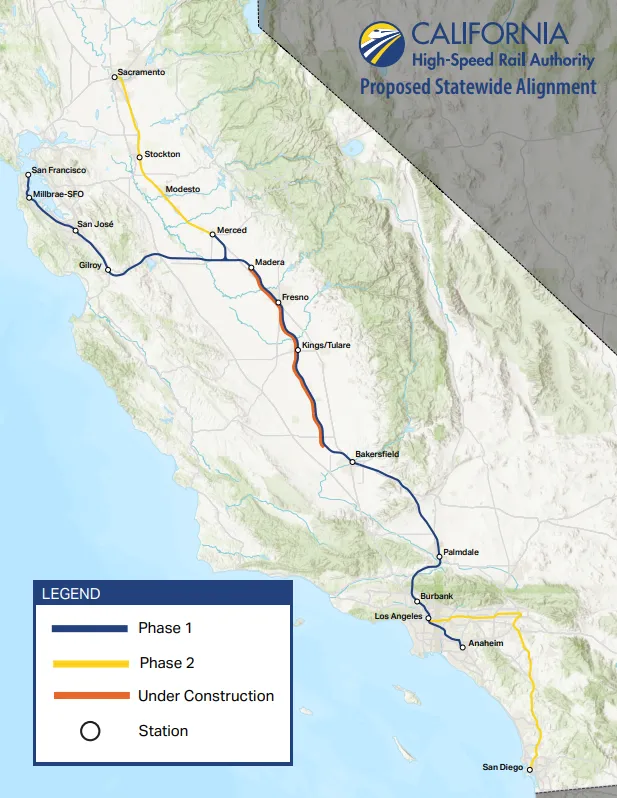
The original voter-approved vision was centered on a statewide system linking major population centers, including San Francisco, Sacramento, the Central Valley, Los Angeles, Orange County, the Inland Empire and San Diego.
However, the project has been increasingly shaped by cost and delivery constraints. Recent reporting said officials are considering excluding a Bakersfield station, and instead building a temporary station north of 7th Standard Road several miles from the planned downtown station near F Street and Golden State Avenue.
CHSRA CEO Ian Choudri told local news outlet The Fresno Bee, “It’s never about changing anything just because we want to," adding that "funding is the constraint."

...
From One Mega-Project to Phased Delivery
The project voters approved was sold around the eventual promise of fast statewide travel, particularly between Northern and Southern California, but today, the emphasis is on delivering segments in phases.
The authority’s 2024 business plan said it was advancing construction and early operations work in the Central Valley, with the Merced-to-Bakersfield corridor serving as the initial operating segment.
In 2025, a three-phased plan was proposed, dividing the delivery into three segments: the Merced-Bakersfield segment, the San Francisco-Gilroy-Bakersfield segment, and the Gilroy–Palmdale Segment.
From Building Railways to Building Revenue
The authority is no longer talking only about laying tracks and building stations. Its new strategy puts significant emphasis on revenue generation, commercial development and long-term financial sustainability.
When it launched a process to draw in private investors in December 2025, CHSRA said a private partner would evaluate help commercialization of station facilities, track access, fiber, power, real estate and other project assets at the earliest possible opportunity.
The June 2026 co-development agreement also said that long-term infrastructure commercialization opportunities would be tied to future expansion.
From a Statewide Vision to a Central Valley First Strategy
The long-term goal is still a San Francisco-to-Los Angeles high-speed rail line, with later extensions envisioned to Sacramento and San Diego, but the working strategy today is much narrower: complete and operate the Central Valley segment first, then use that foundation to extend toward the Bay Area and Southern California.
In a 2023 fact sheet, CHSRA said that the Merced to Bakersfield line was "the first building block of the statewide system."
Each of these developments mean the high-speed rail project is now no longer the vision voters approved in 2008. It is now a recalibrated infrastructure program, still statewide in ambition, but with a Central Valley-first in execution. It is also still publicly backed, but becoming increasingly dependent on private capital.
Update 6/29/26, 5:34 a.m. ET: This article has been updated with comment from the California High-Speed Rail Authority.
View 0 Comments
Submit Correction
View Editorial & AI Guidelines