10
Loading video...

By Alyce Collins
Senior Reporter
0
Share
Newsweek is a Trust Project member
See more of our trusted coverage when you search.Prefer Newsweek on Googleto see more of our trusted coverage when you search.
A four-time cancer survivor who had her tongue reconstructed using her tattooed skin from her arm has told Newsweek why she wears it like "a badge of honor."
In August 2009, Jennifer Alexander from Marietta, Georgia, developed a two-centimeter tumor on her tongue and also noticed substantial weight loss. They felt like major warning signs at the time that led her to get checked out. Shortly after, she was diagnosed with tongue cancer.
Alexander, 53, had the tumor removed and she hoped that would be the end of her cancer journey. However, her tongue cancer recurred in 2017, 2019, and in 2020.
Read More on Wellness & Fitness
By the end of 2019, she "was done with having surgeries" and wanted to find a resolution. That's when she came across the head and neck center at Emory University Hospital and discussed the possibility of tongue reconstruction.
"I wanted it to be over, so I did my research and knew reconstruction was a thing, so I told them I needed it," she said. "Three days later, I was sitting in their office with a plan. You must be your own advocate because only you are in charge of your health."
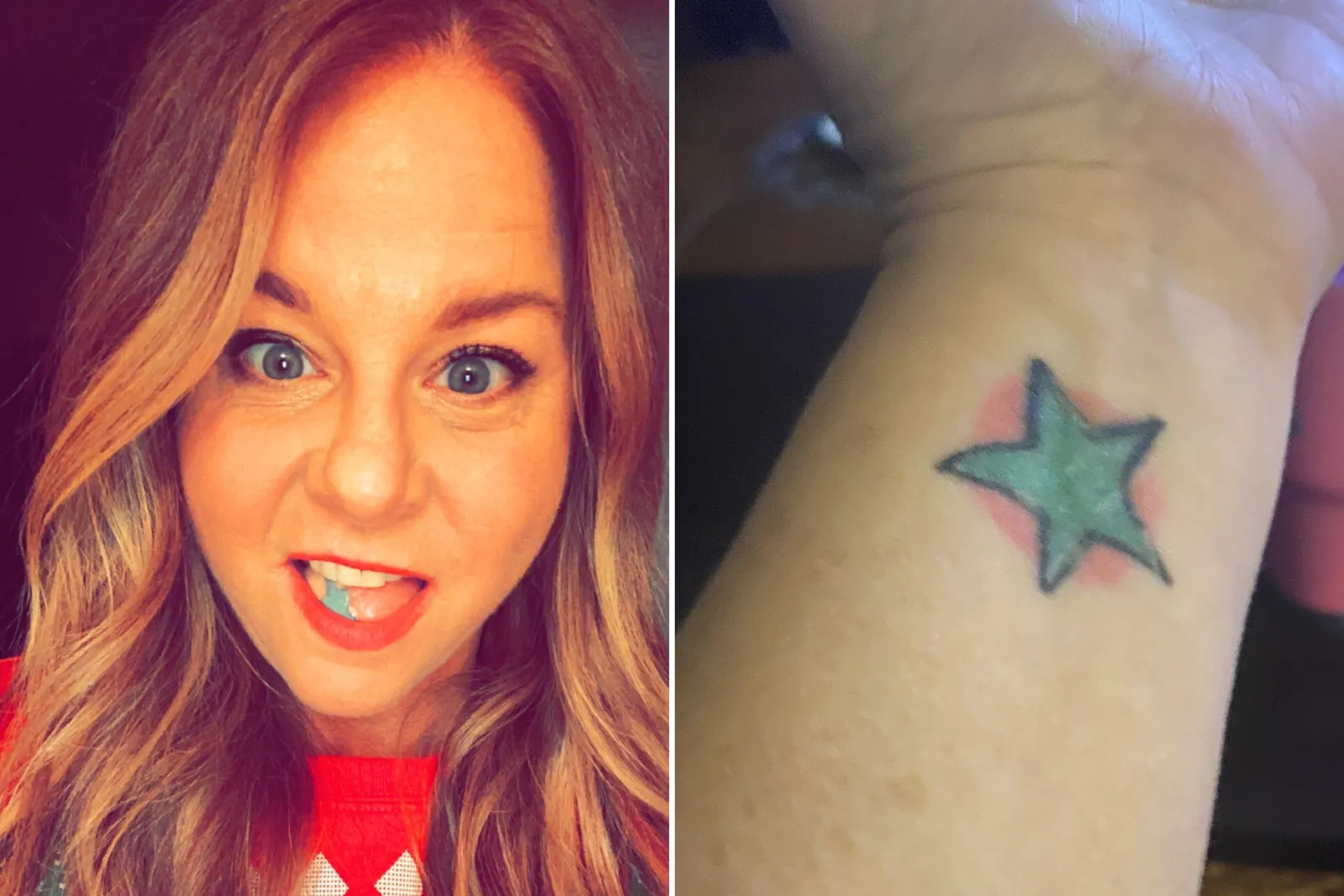
More than a decade after her diagnosis, Alexander was finally to undergo tongue reconstruction surgery. She wanted to rid her body of cancer once and for all with the procedure that involves taking skin from the thinnest part of the body, which is the wrist.
...
There was only one problem—the wrist tattoo of a green star tattoo that Alexander got in 2010.
"I found out when I met the plastic surgeon, who said 'oh boy' when he saw my wrist. It was so funny, but I didn't know the tattoo would be front and center until after surgery," she told Newsweek. "The wrist is the thinnest skin and when you roll it up to make a tongue, it's not too fat in your mouth once the swelling goes away. So, they used the left wrist because I'm right-handed and didn't want to take any chances that I wouldn't be able to write."
During the surgery, Alexander also had skin taken from her left thigh and placed on her left wrist.
Aside from the reconstruction surgery, which lasted more than nine hours, Alexander has also gone through a tracheotomy and speech therapy. She experiences lymphedema in her face due to the loss of lymph nodes.
She was released from hospital a week after surgery and was able to heal at home during the COVID-19 lockdown.

...
"I'm a very social person and it would have been harder for me to miss out on life," she said. "I couldn't talk at all, so communication was extremely frustrating. I couldn't eat for three months, and it's just been in the last year that I'm back to normal with everything."
Alexander added: "There was very little pain as none of the skin has feeling so it didn't hurt. My sense of taste is different, but I can eat a raw jalapeno with no issues. I've had to deal with some teeth issues due to dry mouth, and my face swells, which can affect my self-esteem. Overall, I couldn't be happier with the way things have turned out."
It was certainly a surprise to see the green star tattoo on her tongue for the first time, but now Alexander feels so proud every time she sees it. It serves as a reminder that she survived, and she "wears all [her] scars as a badge of honor."
When it comes to reconstructing the tongue, facial plastic surgeon Dr. Donald B. Yoo tells Newsweek that skin cannot just be harvested from anywhere on the body as "only vascularized flaps" will work.
Dr. Yoo explained that the skin must be carefully taken from the area so that the artery and vein can be preserved. Skin can be taken from the anterior thigh, but this creates "a much bulkier flap," he says.
"Reconstruction of the tongue after surgical resection allows for better function in terms of speech and swallowing," he said. "The radial forearm freeflap has become one of the workhorses of head and neck reconstruction as it provides thin, pliable soft tissue. Interestingly, the skin paddle of the forearm free flap gradually becomes mucosalized like the rest of the mouth over time, so that tattoo will disappear."
Overcoming Cancer and Raising Awareness
Alexander gets asked what is on her tongue every day now, especially on social media. She often talks about her experience on TikTok (@2ofacrime) and jokes that people are "braver online" so they don't care about asking.
Thankfully, she doesn't mind and is more than happy to raise awareness.
One video about her tattooed tongue has amassed over 337,700 views and 16,800 likes on TikTok so far.
"The reaction is always positive, and strangers say the nicest things to me," Alexander told Newsweek. "They see me as a brave warrior and this is the path God chose for me. I want people to see that cancer doesn't mean the end and it doesn't have to ruin your life. The key is early detection."
Overcoming cancer also inspired Alexander to go back to college and finish her business degree. She graduated in May 2024 and felt motivated to finally chase her dreams.
She's always been fascinated by true crime, so she started creating content and sharing it on TikTok, as well as working on a documentary. She's keeping the promise she made to herself after her diagnosis to always do what makes her happy.

...
Alexander hopes to get the all clear next month and be told she's cancer free (after five years with no recurrence). But she will continue to share her story and educate people about tongue cancer.
Her key advice for anyone is to never skip a doctor's appointment as she highlights the vital importance of detecting cancer early.
"Cancer changed me in ways that I can't even describe, for the better. During the moments of silence when I couldn't talk, I decided that I would make God proud and do whatever came my way to raise awareness for my disease," she said.
Is there a health issue that's worrying you? Let us know via health@newsweek.com. We can ask experts for advice, and your story could be featured on Newsweek.
View 0 Comments
Submit Correction
View Editorial & AI Guidelines