...

By Jesus Mesa
Reporter
0
Share
Newsweek is a Trust Project member
See more of our trusted coverage when you search.Prefer Newsweek on Googleto see more of our trusted coverage when you search.
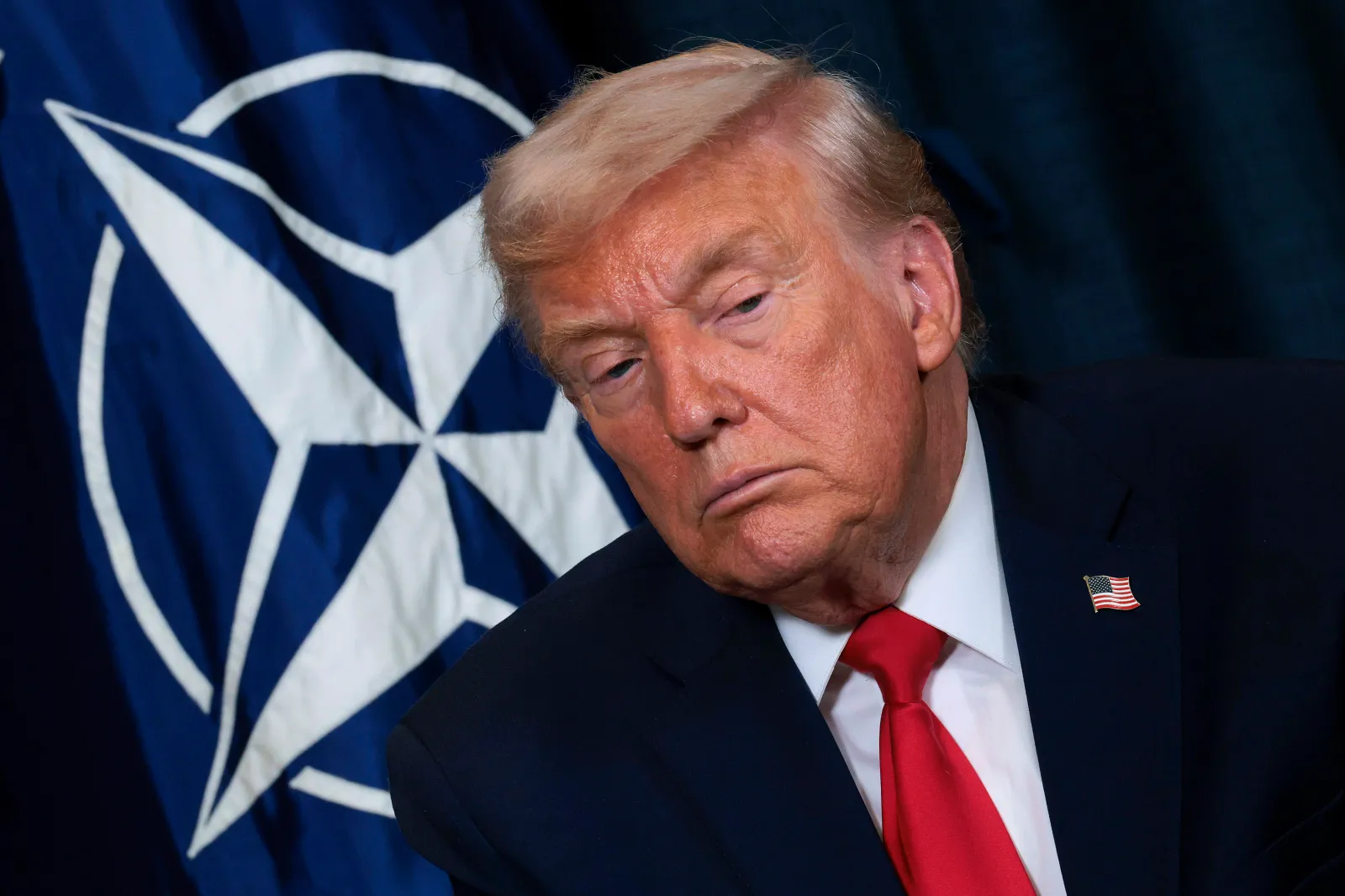
Odds of a U.S. withdrawal from NATO have jumped according to a leading prediction market, as President Donald Trump escalates pressure on allied nations for refusing to join the American military campaign against Iran.
Trump said Tuesday he is considering pulling the United States out of the NATO alliance, citing frustration with allies over their refusal to join the U.S. military campaign against Iran. "Oh yes, I would say [it's] beyond reconsideration. I was never swayed by NATO," Trump said when asked if he wanted to pull the U.S. out of the military bloc.
According to prediction market Polymarket, odds of withdrawal now sit at 15 percent, up 5 percentage points.
Read More on Politics
Why It Matters
For years, Trump has berated America's European allies, urging them to assume greater responsibility for their own security and spend more on defense. He has argued that the U.S. has done more for them than the other way around.
Long-simmering tensions within the alliance have bubbled up again over the Iran war. As energy prices have spiked, Trump has been desperate to get countries to send their ships to the Strait. He’s called his NATO allies “cowards,” pulling at any rhetorical lever he can to get help with the fallout of a war that no ally was consulted on or asked to take part in.
What To Know
The spike in withdrawal odds reflects deepening divisions between Washington and European partners. In mid-March, Trump warned NATO allies of a "very bad" future should they not help secure the Strait of Hormuz. European countries responded to Trump with caution and resistance, declining to send warships to the vital trade waterway.
On Truth Social on Tuesday, Trump lashed out at countries "like the United Kingdom, which refused to get involved in the decapitation of Iran," and suggested they buy U.S. oil or go to the Strait of Hormuz themselves, "and just take it."
Will US withdraw from NATO before 2027?
Yes 15% · No 85%
View full market & trade on Polymarket
The prediction market tells the story in numbers. Odds spiked sharply in mid-December 2025, reaching roughly 20 percent, before settling to around 8 percent by late January. In mid-January, as tensions over Greenland mounted, Trump posted on Truth Social, "NATO: Tell Denmark to get them out of here, NOW!"
A second spike pushed odds toward 16 percent before Trump reversed course at Davos in late January. But the most recent and steepest climb began in late March 2026, driven by Trump's escalating frustration over NATO allies' refusal to support the Iran campaign. Odds now sit at 15 percent.
NATO Won't Join Trump's Iran War
NATO is built on Article 5 of its founding treaty, which pledges that an attack on any one member will be met with a response from them all. As the Iran war has spread, missiles and drones have been fired toward NATO member Turkey and a British military base on Cyprus, fueling speculation about whether the alliance might invoke its collective security guarantee.
The alliance has not intervened or signaled any plan to do so. Secretary-General Mark Rutte, who has voiced support for Trump and America's role in the alliance, has been focusing mostly on Russia's war against Ukraine, which borders four NATO countries. NATO operates uniquely by consensus.

...
All 32 countries must agree for it to make decisions, so political priorities play a role. Even invoking Article 5 requires agreement among the allies. Turkey or the U.K. cannot trigger it alone.
A U.S. pullout would essentially spell the end of NATO, but even as Trump signals his appetite for withdrawing, any actual exit faces formidable legal and procedural obstacles. Legislation passed under the Biden administration in December 2023 prevents any president from withdrawing the United States from NATO without two-thirds approval from the Senate or an Act of Congress.
The measure was led by Virginia Democratic Senator Tim Kaine and, now, Florida Republican Secretary of State Marco Rubio, and was included in the annual National Defense Authorization Act.
Where The Public Stands
American public opinion on NATO remains fractured along stark partisan lines, though overall support remains substantial. 68 percent of Americans now report a favorable view of NATO, the highest percentage since the survey began in 2018, according to the Ronald Reagan Institute's latest annual National Defense Survey.
The survey was conducted between October 23 and November 3, 2025, with 2,507 respondents.
A combined three in four Americans (74 percent) favor maintaining (48 percent) or increasing (25 percent) US support for NATO. Support splits sharply along party lines. Democrats support maintaining or increasing the US commitment at 91 percent, while Republicans are at 59 percent.
Additionally, a majority of Americans believe cooperation between North American and European NATO members makes the United States safer (57 percent, up from 52 percent in 2024).
What People Are Saying
Trump posted on Truth Social on Tuesday: "All of those countries that can't get jet fuel because of the Strait of Hormuz, like the United Kingdom, which refused to get involved in the decapitation of Iran, I have a suggestion for you: Number 1, buy from the U.S., we have plenty, and Number 2, build up some delayed courage, go to the Strait, and just TAKE IT."
British Prime Minister Keir Starmer said when asked about Trump's comment: "Whatever the pressure on me and others, whatever the noise, I am going to act in the British national interest in all the decisions I make."
Spain's Defense Minister Margarita Robles told lawmakers in Madrid on Tuesday: "Two countries went to war and expected us to join them. Our position is supported by the majority of people, and not just Spanish but European."
What Happens Next
European leaders have called for the war to stop and want the United States and Iran to return to negotiations over Tehran's nuclear program, which America and Israel see as a threat.
In a polarized era, the center is dismissed as bland. At Newsweek, ours is different: The Courageous Center—it's not "both sides," it's sharp, challenging and alive with ideas. We follow facts, not factions. If that sounds like the kind of journalism you want to see thrive, we need you.
When you become a Newsweek Member, you support a mission to keep the center strong and vibrant. Members enjoy: Ad-free browsing, exclusive content and editor conversations. Help keep the center courageous. Join today.


View 0 Comments
Submit Correction
View Editorial & AI Guidelines