
...

By Micah McCartney
Reporter
0
Share
Newsweek is a Trust Project member
See more of our trusted coverage when you search.Prefer Newsweek on Googleto see more of our trusted coverage when you search.
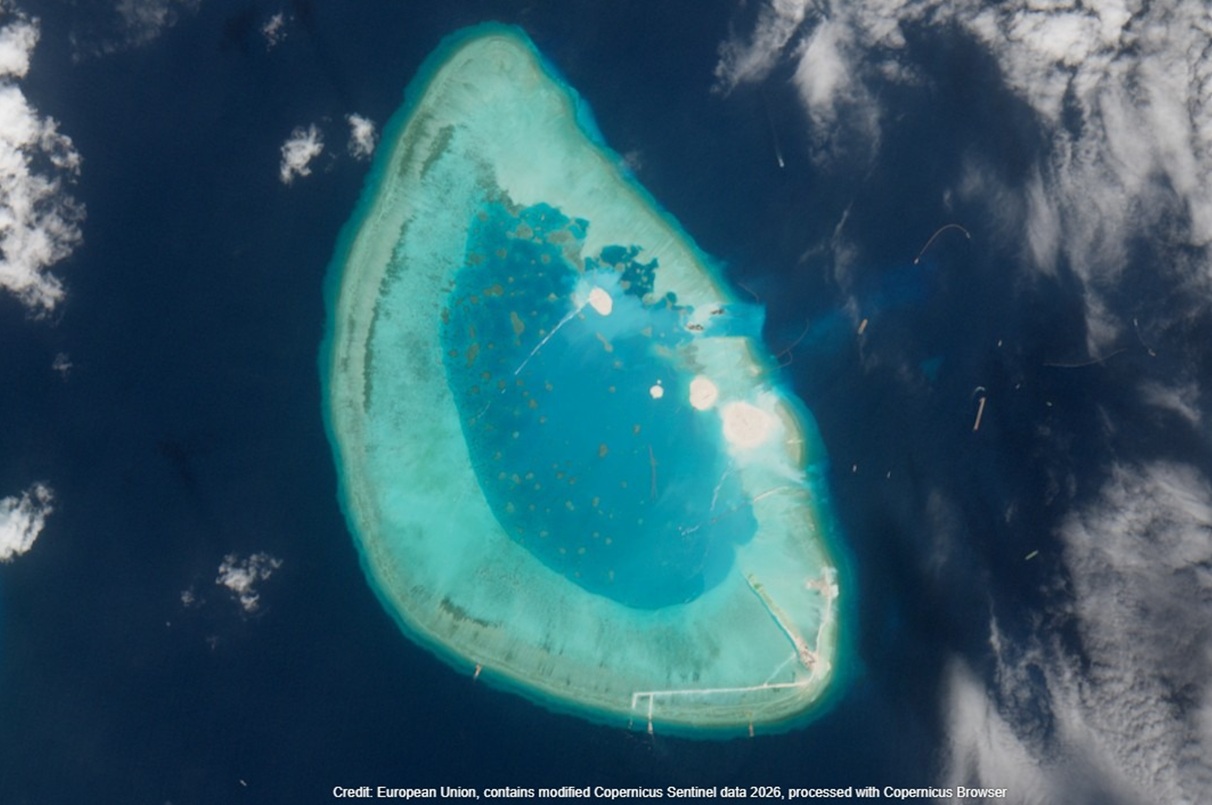
Satellites have revealed a flurry of new land reclamation activity at a disputed reef in the South China Sea’s Paracel Islands, suggesting China is expanding an outpost there.
Why It Matters
China claims sovereignty over more than 80 percent of the South China Sea, a strategic waterway that serves as a conduit for up to one-third of global maritime trade.
Read More on World
This includes the Paracels, where Beijing’s claims overlap with those of Taiwan and Vietnam. Since 2013, China has carried out land reclamation on an unprecedented scale, building out 20 outposts in the Paracels and seven in the Spratlys to the south—some of them militarized—contributing to regional tensions and causing significant damage to marine ecosystems.

What To Know
Satellite imagery from the European Space Agency’s Sentinel-2 satellites shows new sand dredging began sometime after October 15 at Antelope Reef, known as Linyang Jiao in Chinese and Da Hai Sam (" Sea Cucumber Rock") in Vietnamese.
Antelope Reef is a submerged coral formation in the Western Paracels, located about 250 miles east of the Vietnamese city of Hue and roughly 175 miles southeast of China’s Sanya naval base in Hainan province.
The dredging is concentrated along four sites on the eastern and southern sides of Antelope’s lagoon. Additional land appears to be reclaimed on either side of the current outpost and its adjoining port facility.
The move follows recent additions to China’s artificial islands, including upgrades completed in the early 2020s. These include new antenna arrays and units resembling mobile electronic warfare systems on China’s three fully militarized islands in the Spratlys. A December satellite analysis by the Asia Maritime Transparency Initiative (AMTI), a project of the Center for Strategic and International Studies (CSIS), found that the upgrades reflect continued strategic investment in the region.
Meanwhile, Vietnam has dramatically ramped up its own reclamation work on maritime features in the Spratlys under its control—prompting vocal protests from Beijing.
China has controlled the Paracel Islands since seizing them in a 1974 naval battle with then-South Vietnam.
What People Are Saying
AMTI wrote: "These upgrades underscore the fact that a major function of China’s bases is to provide unparalleled ISR [intelligence, surveillance, and reconnaissance] coverage of the South China Sea, supporting the operations of China’s coastguard and navy in peacetime and allowing Beijing to contest the use of the electromagnetic spectrum by others in the event of a conflict."
What Happens Next
It remains unclear whether Vietnam will issue a formal response to the latest dredging work. The dispute over the Paracels, alongside China's unilateral announcement of new territorial baselines in the Gulf of Tonkin, has triggered sharp rebukes from Hanoi in the past.
Still, Vietnam has calibrated these protests to maintain stable diplomatic ties with its powerful neighbor and major trade partner.
View 0 Comments
Submit Correction
View Editorial & AI Guidelines