...

By Brendan Cole
Senior Reporter
0
Share
Newsweek is a Trust Project member
See more of our trusted coverage when you search.Prefer Newsweek on Googleto see more of our trusted coverage when you search.
Chinese military forces conducted drills near U.K. Naval vessels, which were tracked in the Taiwan Strait and the South China Sea, in a sign of Beijing’s belligerence, it has been reported.
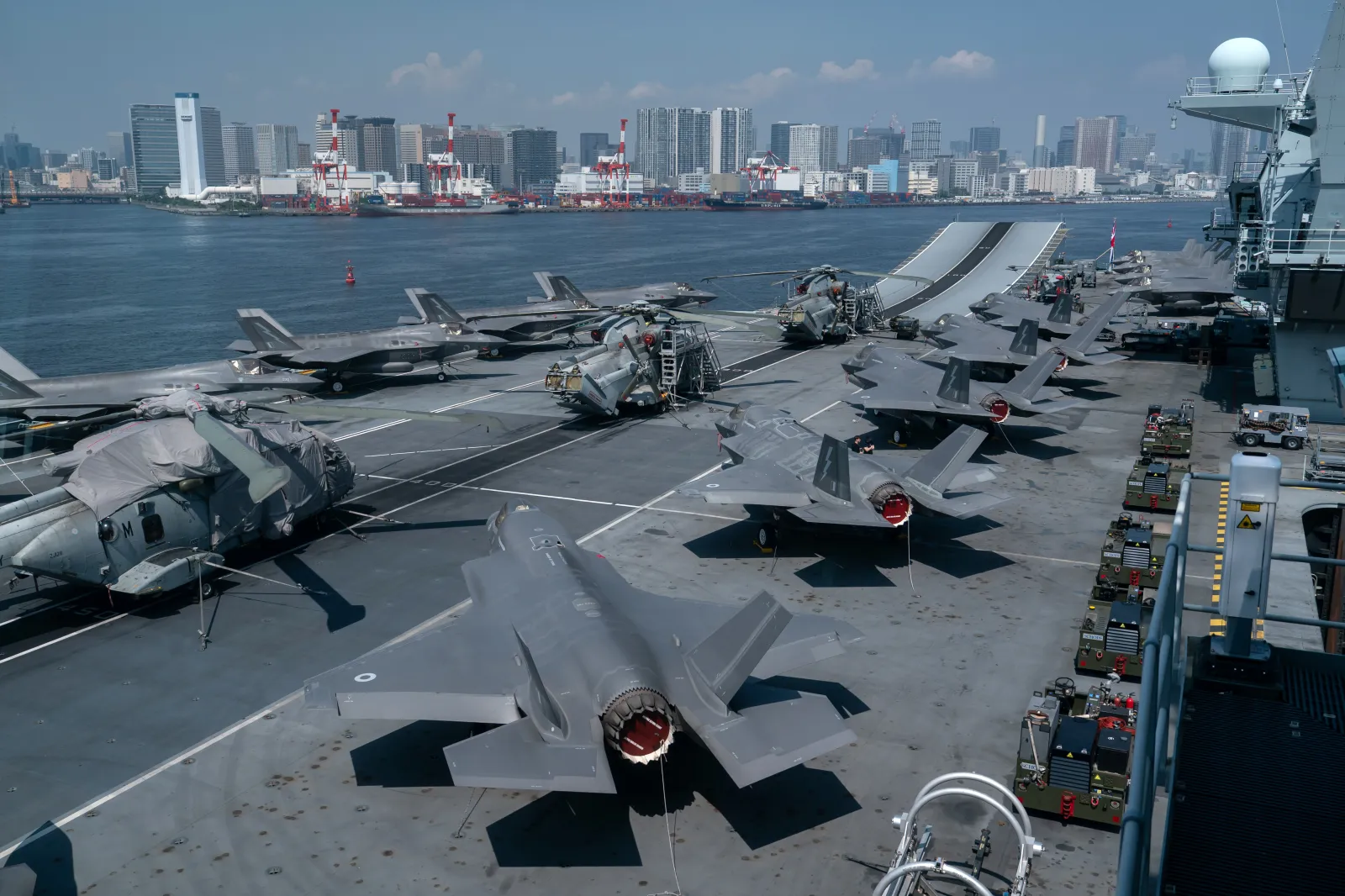
British newspaper The Times reported Chinese fighter jets performed simulated missile attacks on the warship HMS Richmond, and China’s warships also stalked the Royal Navy’s aircraft carrier HMS Prince of Wales.
It was part of a ploy by China to test the Royal Navy’s boundaries, sub-lieutenant Rohan Lewis, an officer on the Prince of Wales, told the paper.
Read More on World
A spokesperson for the U.K. Ministry of Defense told Newsweek that the Carrier Strike Group "experienced routine interactions with Chinese military in the Taiwan Strait and South China Sea," but no unusual or dangerous activity occurred.
Newsweek reached out to the Chinese Foreign Ministry for comment.
Why It Matters
China claims the self-ruling island of Taiwan as well as nearly all of the South China Sea. The incidents, as reported by The Times, highlight the rising tensions in the region amid a broader geopolitical contest over freedom of navigation and Beijing's territorial claims.

...
What To Know
The U.K. Ministry of Defense has not revealed details about the incident, but citing Royal Navy officers, The Times reported that HMS Prince of Wales, at the helm of the UK Carrier Strike Group (UKCSG), was followed by Beijing military forces in the South China Sea.
The paper provided an account of the passage through the Taiwan Strait of HMS Richmond, which was subject to what are known as “constructive kills,” in which a fighter jet performs maneuvers to launch an attack without firing a missile.
The carrier group was tracked by Chinese ships as it sailed through the disputed Spratly Islands, where a British and a Norwegian ship—the Royal Fleet Auxiliary ship Tidespring and the Roald Amundsen—sailed close to in a freedom of navigation exercise.
The Richmond’s Merlin MK2 helicopter was shadowed by a Chinese counterpart, the Changhe Z-10 and Beijing’s fighter jets launched “constructive kills," or dummy attacks that serve as a warning, the paper said.
There was no expectation that the Chinese would open fire, and they remained at a safe distance, but Lewis, who was on the Prince of Wales, said that the Chinese “were trying to harass us.”
An unnamed officer on the Prince of Wales described it as China “pretending to kill us.” The carrier group also participated in Exercise Bersama Lima, a joint training exercise with Malaysia, Singapore, Australia, and New Zealand.
A spokesperson for the U.K. Ministry of Defense told Newsweek that the U.K. Carrier Strike Group "experienced routine interactions" with the Chinese military in the Taiwan Strait and South China Sea, but there was no dangerous activity.
What People Are Saying
Royal Navy sub-lieutenant Rohan Lewis, an officer on the Prince of Wales, told The Times: “The Chinese were trying to harass us, four or five of them trying to get close. They tried to push us a little bit to see how far they can go."
Chinese state newspaper Global Times said: “For a country that once took pride in colonising many countries and regions and projecting power across the seas, flaunting [Britain’s] aircraft carriers in the Pacific and hyping up militarism over the Taiwan Straits is little more than self-indulgent nostalgia.”
U.K. Ministry of Defence in a statement: “As anticipated, elements of the Carrier Strike Group experienced routine interactions with Chinese military in the Taiwan Strait and South China Sea. No unusual or dangerous activity has occurred."
The statement added: “Wherever the Carrier Strike Group operates, it does so in full compliance with international law and norms.”
What Happens Next
The Royal Navy’s Operation Highmast is due to return to Portsmouth in early December at the end of an eight-month deployment. In the meantime, China will likely face further scrutiny over its military actions in the South China Sea.
Update 09/30/25, 5:32 p.m. ET: This article was updated with a statement by the U.K. Ministry of Defense
View 0 Comments
Submit Correction
View Editorial & AI Guidelines