...

By Micah McCartney
Reporter
0
Share
Newsweek is a Trust Project member
See more of our trusted coverage when you search.Prefer Newsweek on Googleto see more of our trusted coverage when you search.
China has converted scores of obsolete fighter jets into drones and positioned many at forward air bases opposite Taiwan, raising concerns they could be used to help overwhelm the island’s defenses in a conflict.
Decades-old Shenyang J-6 aircraft are visible across at least six air bases near the Taiwan Strait—five in Fujian province and one in neighboring Guangdong—according to satellite imagery published by the Washington-based aerospace think tank the Mitchell Institute.
China’s investments in drones, missile forces and fifth-generation aircraft such as the J-20 have widened the air power gap with Taiwan, prompting Taipei to increase spending on layered air defenses and longer-range strike capabilities in recent years.
Read More on World
The People’s Liberation Army has also stepped up pressure on Taipei through large-scale exercises and near-daily sorties across the median line of the Taiwan Strait.
...
Newsweek reached out to the Chinese Foreign Ministry and Taiwan’s Defense Ministry with requests for comment.
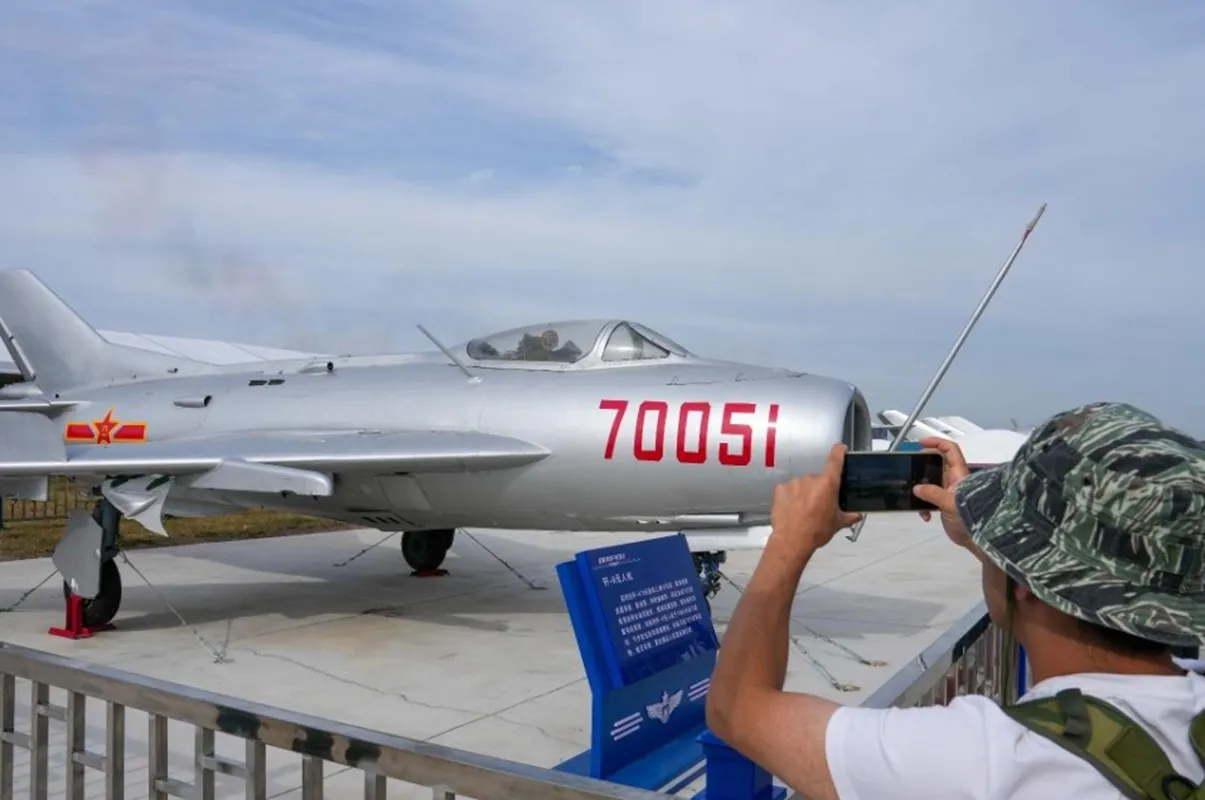
The supersonic, twin-engine J-6—derived from the Soviet MiG-19—entered service in the early 1960s. The last airframes were retired from active service in 2010, though the venerable fighter has continued to be used for training.
China is known to have begun converting these aircraft into unmanned platforms around 2013, and the fighters-turned-drones, dubbed J-6Ws, were on display during last year's Changchun Air Show in Jilin Province. Out of an estimated more than 500 converted airframes, at least 200 are now positioned at bases near the Taiwan Strait, Reuters cited Mitchell Institute analyst Michael Dahm as saying.
Less sophisticated than purpose-built unmanned systems, the J-6 drones could still pose a threat if launched en masse as part of a broader saturation attack, analysts warn.
"Large numbers of these coming across the Strait in conjunction with other strike aircraft or cruise missiles could help in overwhelming Taiwanese—and potentially U.S. and Japanese defenses," Tom Shugart, founder of Archer Strategic Consulting and adjunct senior fellow at the Center for a New American Security, told Newsweek.
Satellite imagery indicates the aircraft are deployed at air bases in Fuzhou, Hui’an, Longtian, Yixu and Liancheng in Fujian province, as well as Xingning in Guangdong.
There is no obvious reason for the J-6s to be forward-deployed alongside more advanced platforms, wrote Moriki Aita, a research fellow at Japan’s National Institute for Defense Studies, in a recent report. "Rather, it suggests that they may be assigned different missions."
"Assuming that an unmanned J-6 is designed for one-way suicide attack operations, it could serve as a means of directly attacking air defense radar sites, surface-to-air missile batteries, airfield facilities, or critical infrastructure," he wrote. "This concept would impose a significant burden on air defense systems, forcing repeated engagements while enabling a portion of these platforms to penetrate even robust defenses."
Aita warned this concept could easily extend beyond the J-6 to include other retired aircraft such as the J-7 and J-8.
"What is needed going forward is not merely the enhancement of our intercept capabilities," he said. "We must re-evaluate our air defense posture from the perspective of how long we can sustain interception operations and whether our ammunition reserves and personnel systems can withstand long-term strain."
China considers Taiwan a breakaway province that must eventually be brought under Beijing’s control, by force if necessary. Taiwan operates as a self-governing democracy with its own military and elected leadership, and President Lai Ching-te has said the island is already independent.
U.S. defense officials have warned Chinese President Xi Jinping has ordered the People's Liberation Army to be capable of taking Taiwan by 2027. However, the Department of National Intelligence assessed in a report earlier this month that progress is steady but uneven and that there likely isn't a fixed timeline for this goal.
While the U.S. is Taiwan's main arms supplier, Washington has for decades maintained a policy of "strategic ambiguity," leaving it unclear whether it would come to Taiwan's direct defense in the event of a Chinese attack.
Japanese Prime Minister Sanae Takaichi sparked a diplomatic firestorm in November when she suggested a Chinese blockade of Taiwan could constitute a "survival threatening situation" and warrant an intervention alongside allied U.S. forces.
Taiwan is expected to feature in upcoming talks between President Donald Trump and Chinese President Xi Jinping, now scheduled for mid-May after being postponed from late March.
View 0 Comments
Submit Correction
View Editorial & AI Guidelines