...

By Micah McCartney
Reporter
0
Share
Newsweek is a Trust Project member
See more of our trusted coverage when you search.Prefer Newsweek on Googleto see more of our trusted coverage when you search.
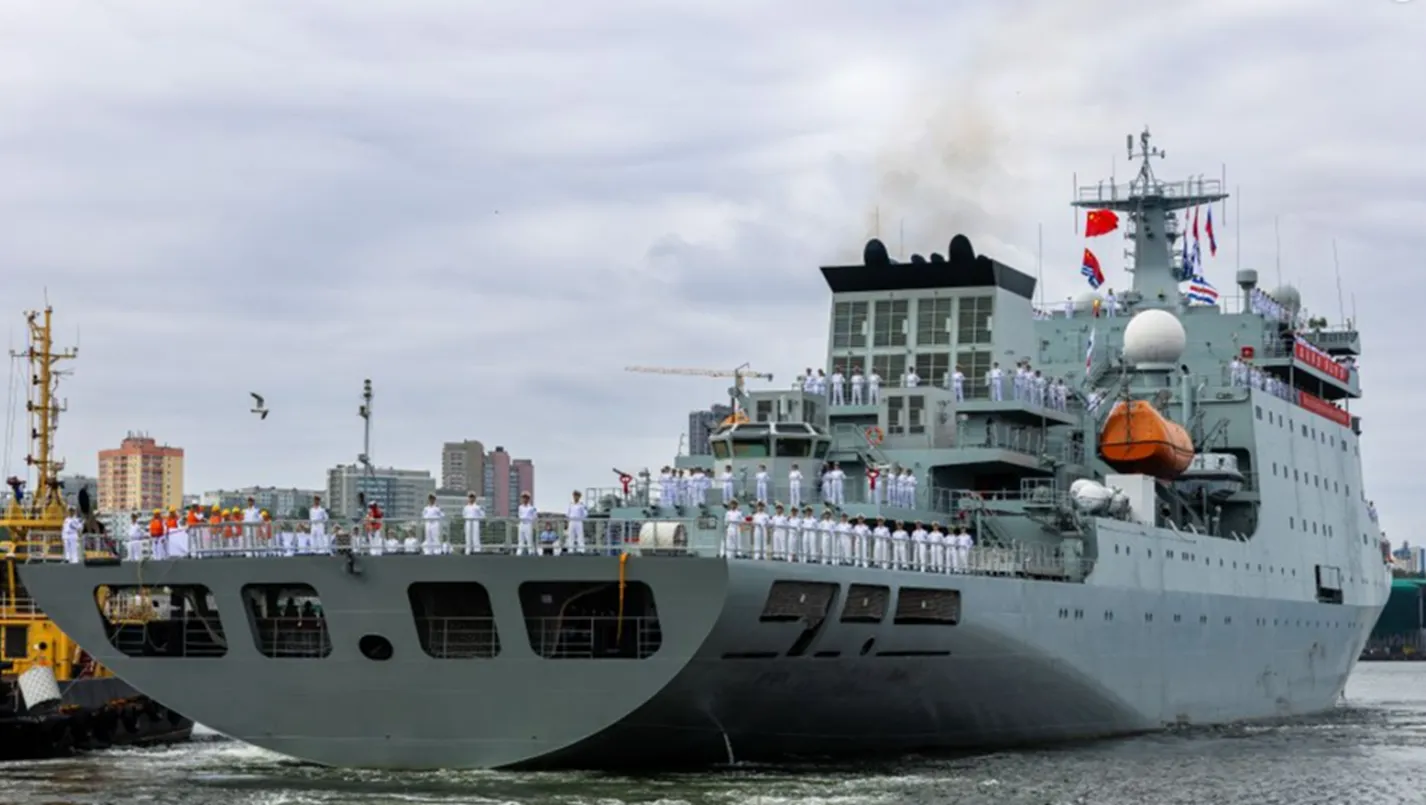
A Chinese naval flotilla arrived in Russia's far eastern port of Vladivostok on Tuesday for four days of training and exchanges, underscoring deepening military ties between Beijing and Moscow amid rising tensions with the United States and its allies in the Western Pacific.
The People's Liberation Army Navy's Task Force 83, composed of the training ship Qi Jiguang and the amphibious dock landing ship Kunlunshan, arrived in Vladivostok—the headquarters of Russia's Pacific Fleet—at the invitation of the Russian Navy. The vessels were greeted by flag-waving spectators gathered along the waterfront, as shown in images published by the Chinese state media outlet Xinhua.
While China has continued to present itself as neutral on Russia's war in Ukraine, it has also helped support Russia's sanctions-strained economy through booming cross-border trade, including dual-use exports and increased purchases of heavily discounted Russian oil and gas.
Read More on World
The United States and its European allies have repeatedly described China as a "decisive enabler" of Russian President Vladimir Putin's ongoing war effort.
...
Putin and Chinese leader Xi Jinping reaffirmed their strategic partnership during the Russian leader's visit to Beijing last month, with both sides pledging to deepen cooperation across defense, energy, and technology sectors.
"The Chinese and Russian militaries will earnestly implement the consensus reached by the two heads of state and continue to expand practical cooperation in various fields," China's Defense Ministry said in a statement released Monday ahead of Qi Jiguang and Kunlunshan's arrival in Vladivostok.
Newsweek reached out to the Russian Foreign Ministry and the Pentagon via email for comment.
Naval Cooperation
The deployment is a "long-distance sea internship" that will see Chinese sailors exchange with Russian naval officers during their stay, the Chinese Defense Ministry said.
The two neighbors have steadily strengthened security ties in recent years by stepping up joint air and naval exercises. While 2025 marked a five-year low in the number of joint drills—six, compared with a peak of 14 in 2024—the countries notably conducted their first joint submarine exercise, according to the Center for Strategic and International Studies.
"Russia views its navy as central to its great power aspirations, both globally and in the Asia-Pacific region," the Congressional Research Service wrote in a June analysis.
"The importance of Russia's navy may be one reason why Russia-PRC naval exercises and patrols have been more extensive than comparable ground military exercises, and may indicate a greater level kof familiarity and trust between naval partners."
US and Allied Concerns
The U.S. Coast Guard has expressed concern about an uptick in Chinese and Russian patrols near U.S. territory, particularly around Alaska.
Chinese and Russian military operations, both independently and in coordination, have also raised concerns in Japan and South Korea, Washington's two Northeast Asian treaty allies.
In December, Chinese and Russian bombers conducted a joint air patrol over the Sea of Japan and international waters between the Japanese islands of Okinawa and Miyako, prompting Japan's Air Self-Defense Force to scramble fighter jets.
Japanese Defense Minister Shinjiro Koizumi said the operation was "clearly intended as a show of force against our nation, which is a serious concern for our national security."
Although Beijing and Moscow are not bound by a formal military alliance, both countries are aligned in challenging long-standing U.S. military dominance and promoting what they describe as a more multipolar international order.
Contact Newsweek editors on this story: Frances Mao and Sam Wilson.
View 0 Comments
Submit Correction
View Editorial & AI Guidelines