10
Loading video...

By Ryan Chan
China News Reporter
0
Share
Newsweek is a Trust Project member
See more of our trusted coverage when you search.Prefer Newsweek on Googleto see more of our trusted coverage when you search.
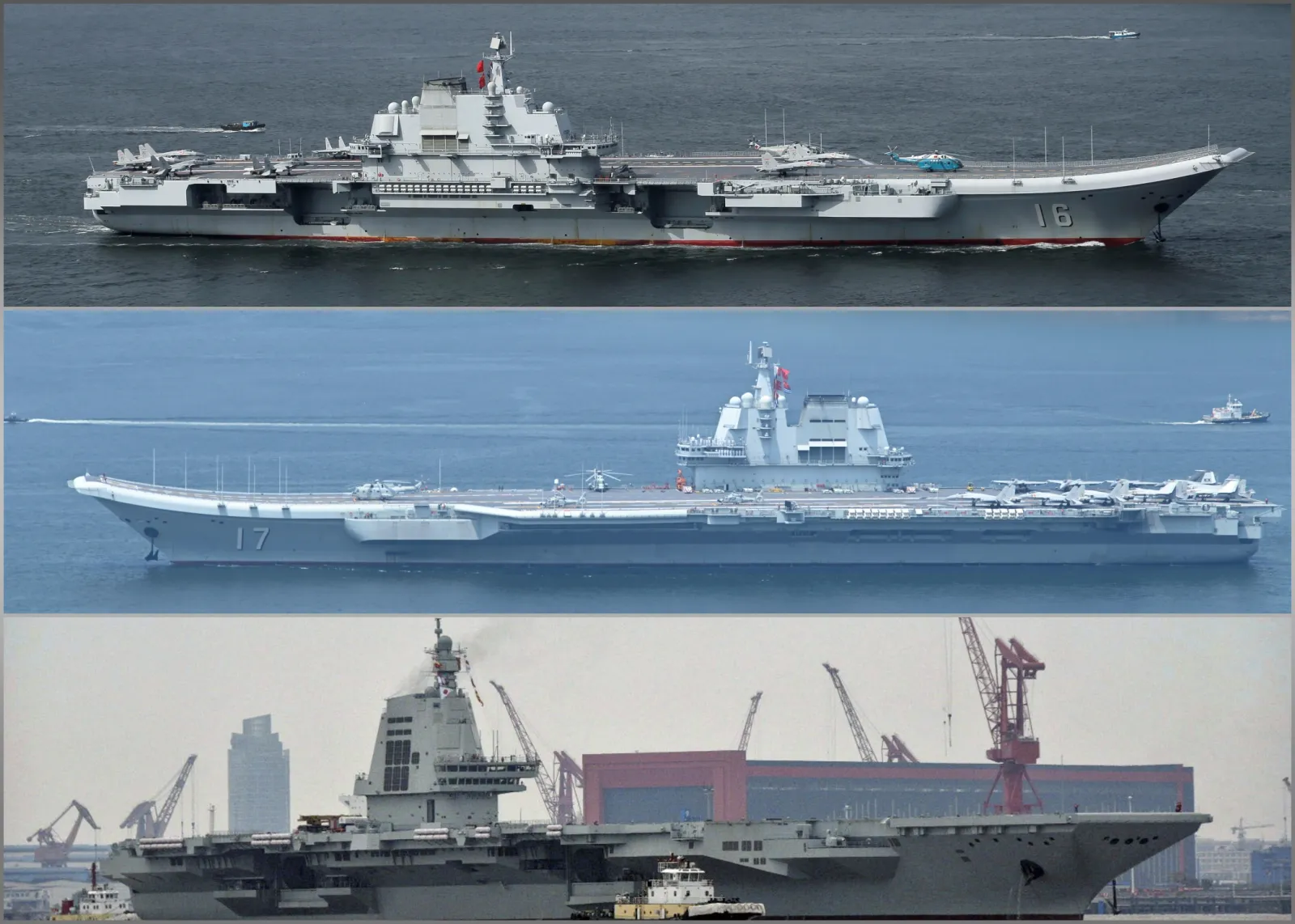
The Chinese military said its fast-growing navy has entered a "three-carrier era" following the commissioning of its most advanced aircraft carrier, CNS Fujian, last week.
"The navy's ongoing transformation and development demonstrates its confidence in safeguarding peace and embracing the world as a major power," the People's Liberation Army Daily, the official newspaper of the Chinese military, commented on Thursday.
Newsweek has contacted the Chinese Foreign Ministry for further comment via email.
Read More on World
Why It Matters
China is undergoing military modernization under President Xi Jinping, who has sought to challenge the United States' military supremacy with the goal of Beijing's armed forces being "world-class" by 2049. This has resulted in the building of the world's largest navy, with over 370 vessels, including the aircraft carriers CNS Liaoning, CNS Shandong and the Fujian.
China is expanding its military reach beyond East Asia through naval deployments, including a dual aircraft carrier mission in the Western Pacific earlier this year. While the U.S. Navy maintains the world's largest aircraft carrier fleet with 11 vessels, recent imagery suggests China is likely working on its first nuclear-powered aircraft carrier.
...
What To Know
The Chinese military newspaper said in an article that an aircraft carrier represents "a sense of security, self-confidence and a source of motivation" for the Chinese people.
The commissioning of the Liaoning, the Shandong and the Fujian marked what the newspaper called "three leaps" in China's aircraft carrier program, beginning with the Liaoning, which was extensively modernized from a vessel built by the Soviet Union.
Following the Liaoning's commissioning in 2012, China launched its first domestically built aircraft carrier, the Shandong, in 2017, representing another leap in the program. The vessel, also equipped with a ski-jump flight deck, was put into service in 2019.
The final leap is the Fujian, China's first non-ski-jump style aircraft carrier, which is equipped with electromagnetic catapults and a straight, full-length flight deck, the article said.
The newspaper also revealed operational details of the three aircraft carriers, citing officers from each vessel. The Liaoning reportedly covered nearly 34,000 miles during its voyages last year, including an operation with the Shandong in the South China Sea.
The number of aircraft sorties launched by the Shandong in the past two years is "several times" the total of the previous four years. During their first mission aboard the Fujian, aircraft completed dozens of successful launches at the first attempt.
The article confirmed the existence of two aircraft carrier bases—Yuchi in northeastern China and Yulin on the South China Sea—while land-based home stations and training sites for carrier-based aircraft have been put into operation "one after another."
What People Are Saying
The People's Liberation Army Daily commented on Thursday: "For the international community, an aircraft carrier is no longer merely a naval force, but a symbol of a nation's comprehensive strength and international status, a reliable guarantee that a nation's voice is respected, and a backing to safeguard its sovereignty, security, and development interests."
Jiang Bin, spokesperson for China's Ministry of National Defense, said on Friday: "China adheres to the path of peaceful development and follows a national defense policy that is defensive in nature…[People's Liberation Army Navy] vessels will sail to wherever necessary for the protection of China's national interests."
What Happens Next
With three aircraft carriers in service, it remains to be seen when the Chinese military will conduct another dual-aircraft carrier—or its first tri-aircraft carrier—deployment.
View 0 Comments
Submit Correction
View Editorial & AI Guidelines