...

By Micah McCartney
Reporter
0
Share
Newsweek is a Trust Project member
See more of our trusted coverage when you search.Prefer Newsweek on Googleto see more of our trusted coverage when you search.
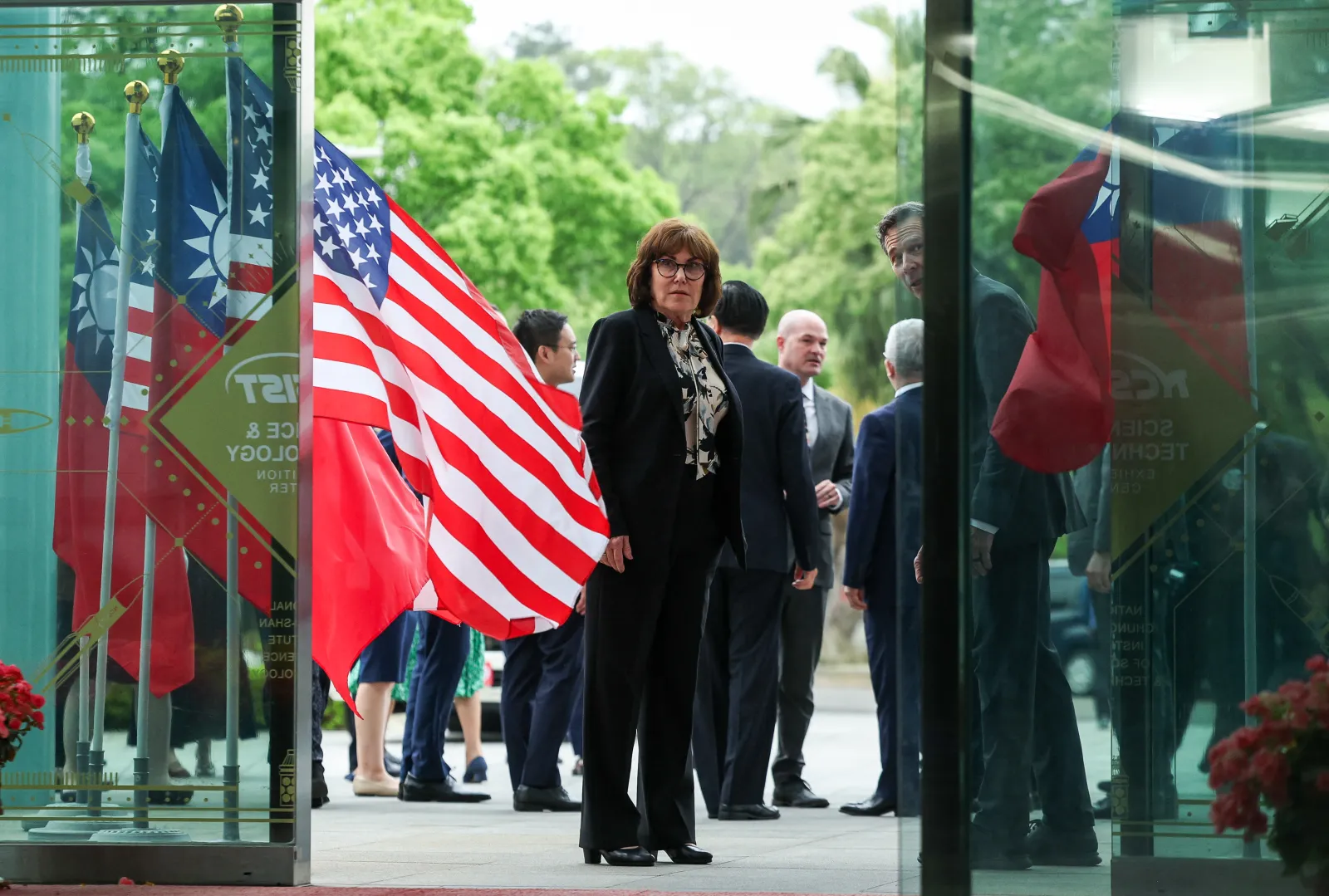
A bipartisan U.S. Senate delegation has drawn a protest from Beijing after it arrived in Taiwan to press lawmakers to boost defense spending amid a widening military gap across the Taiwan Strait.
“Taiwan firmly opposes official interactions between the U.S. and the Taiwan region and has lodged serious representations with the U.S. side,” Chinese Foreign Ministry spokesperson Mao Ning said during Monday’s regular press briefing.
While the U.S., like most countries, switched diplomatic recognition to Beijing, Washington maintains robust unofficial ties with Taipei and supplies it with arms under the 1979 Taiwan Relations Act. A special defense budget requested by President Lai Ching-te, however, has for months been in a state of limbo in Taiwan’s opposition-controlled legislature, which favors closer ties with Beijing and has raised concerns over oversight and spending details.
Read More on World
...
China considers self-ruled Taiwan part of its territory and a core interest, and routinely condemns U.S. arms sales to the island. The issue is expected to feature in upcoming talks between President Donald Trump and Chinese counterpart Xi Jinping in Beijing.
In December, the Trump administration approved a record $11-billion arms package for Taiwan. Continued delays in passing the special budget could complicate follow-on acquisitions, including additional HIMARS rocket systems and other capabilities that would strengthen the island's defense capabilities.
Newsweek has reached out to Taiwan’s de facto embassy in Washington and to the Taiwanese opposition party Kuomintang for comment.
“The U.S. should adhere to the One China principle and the three China-U.S. joint communiqués, handle the Taiwan question with prudence, stop all forms of official interactions with the Taiwan region, and stop sending any wrong signals to Taiwan independence forces,” Mao said, adding that Beijing would take all necessary measures to safeguard its sovereignty and territorial integrity.
The U.S. has for decades followed a “one China” policy, acknowledging—but not endorsing—Beijing’s claim over Taiwan. The three joint communiqués, issued as Washington and Beijing normalized relations in the late 1970s and early 1980s, include a U.S. commitment to gradually reducing arms sales to Taiwan, without setting a timeline.
On the first day of their two-day visit to Taiwan, the senators stressed “peace through strength” during an event at Taiwan’s Presidential Office, urging the Legislative Yuan to pass the defense budget and reaffirming U.S. support, according to Taiwan’s Central News Agency.
“I’d like to personally endorse the special defense budget and tell you that, back in Washington, D.C., my colleagues are watching—this is important,” said Utah Republican John Curtis, who co-led the delegation with New Hampshire's Jeanne Shaheen, a Democrat. “We want to make sure that as we invest in this part of the world, you are also investing, and that we’re in this together.”
Joining them were Republican Thom Tillis of North Carolina and Jacky Rosen, a Nevada Democrat.
President Lai thanked the group for its support, pointing to polling cited by his Democratic Progressive Party (DPP) showing roughly two-thirds of the public backing the budget, which he said has been delayed by domestic political disputes, according to a statement released by his office.
The visit comes just over a week before Cheng Li-wun, a senior figure in Taiwan’s main opposition Kuomintang leads a delegation on a multi-city trip to China at the invitation of Xi—a plan that has drawn criticism from Lai's DPP.
Since taking up her role in November, Cheng has advocated for more stable cross-strait ties and expanded dialogue with Beijing, arguing engagement can reduce tensions and improve economic and political relations.
China views Taiwan as a breakaway province to be brought under its control, by force if necessary. Taiwan’s government rejects that claim, maintaining it is a sovereign entity with its own constitution, military and democratically elected leadership.
In a polarized era, the center is dismissed as bland. At Newsweek, ours is different: The Courageous Center—it's not "both sides," it's sharp, challenging and alive with ideas. We follow facts, not factions. If that sounds like the kind of journalism you want to see thrive, we need you.
When you become a Newsweek Member, you support a mission to keep the center strong and vibrant. Members enjoy: Ad-free browsing, exclusive content and editor conversations. Help keep the center courageous. Join today.


View 0 Comments
Submit Correction
View Editorial & AI Guidelines