
...

By Jesus Mesa
Reporter
0
Share
Newsweek is a Trust Project member
See more of our trusted coverage when you search.Prefer Newsweek on Googleto see more of our trusted coverage when you search.
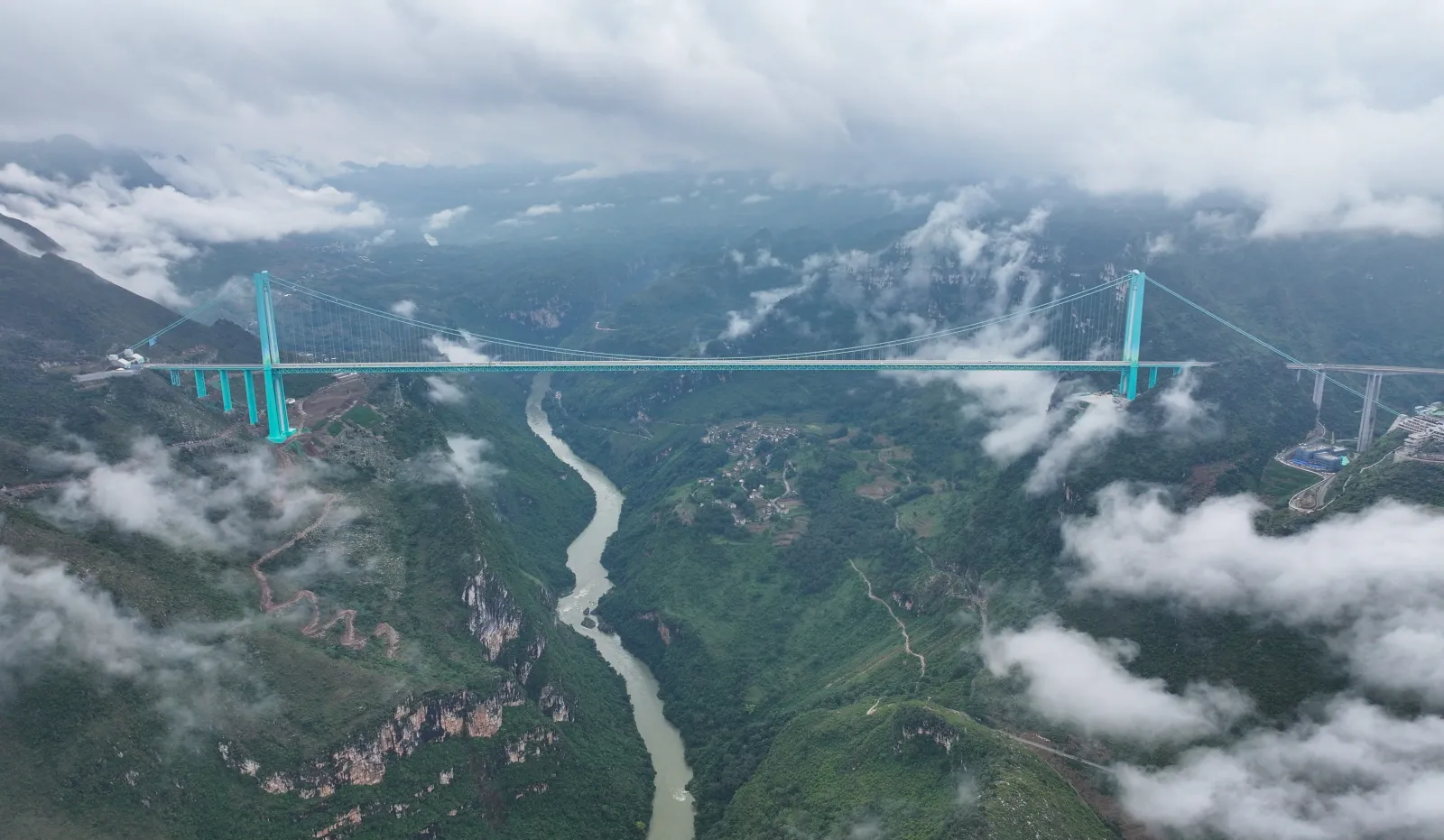
A new bridge in southern China has become the tallest in the world, opening to traffic over the weekend in Guizhou province and connecting two remote areas across a deep canyon in just over a minute of travel time.
The Huajiang Grand Canyon Bridge rises 2,051 feet (625 meters) above the Beipan River—almost 600 feet taller than the Empire State Building (at 1,454 feet)—and spans 9,482 feet (2,890 meters) in total length. Its main span alone measures 4,659 feet (1,420 meters), surpassing the previous record holder, the Duge Bridge, which is also located in Guizhou.

...
Read More on News
Travel across the Huajiang Canyon previously took more than an hour by road. With the bridge now open, that same route takes just over a minute by vehicle.
“By then, this super project that spans the 'Earth crack' will be the world's first in both directions. It will become another landmark project to demonstrate China's infrastructure strength,” Zhang Shenglin, chief engineer of Guizhou Highway Group, told China Daily earlier this year, when the bridge was 95 percent complete.
...
A Dual Role
The bridge includes a high-speed glass elevator that transports visitors to a café located 2,600 feet (792 meters) above the river. A 1,900-foot-high (579-meter) glass walkway and bungee platform have also been built at the site as part of a wider tourism initiative.
Project manager Wu Zhaoming of Guizhou Transportation Investment Group said the team had to address several technical challenges during construction, including stabilizing steep slopes, managing strong winds, and controlling concrete temperatures. Despite those difficulties, the project was completed ahead of schedule.
“This bridge is the result of everyone’s hard work,” said Tian Hongrui, a technician on the project, in an interview with CCTV (China Central Television, national television broadcaster of China). “Leaving now is bittersweet, but this isn’t the end. It’s the start of a new chapter.”
...
Construction began in January 2022 and concluded on September 28, 2025. The steel-truss suspension bridge carries the Guizhou S57 Liuzhi–Anlong Expressway and cost an estimated 2.1 billion yuan (about $295 million), based on government figures.
Safety testing was completed in August. Engineers used 96 trucks to simulate traffic loads while more than 400 sensors monitored the bridge's main cables, towers, and span for any structural movement. The tests were described as successful by project officials speaking to local outlet NDTV.
Guizhou province is now home to more than 32,000 bridges, up from fewer than 3,000 in the 1980s. Nearly half of the 100 tallest bridges in the world are located in the region.
Over ten years ago China launched its Belt and Road Initiative (BRI), leader Xi Jinping's signature infrastructure program which has seen $1 trillion worth of investments poured into projects in nearly every region of the globe. It was meant to place China firmly on center stage as an alternative financier—and therefore power center—to U.S.-led institutions.
View 0 Comments
Submit Correction
View Editorial & AI Guidelines