...

By Micah McCartney
Reporter
0
Share
Newsweek is a Trust Project member
See more of our trusted coverage when you search.Prefer Newsweek on Googleto see more of our trusted coverage when you search.
China rolled out the welcome wagon for U.S. President Donald Trump, who arrived Wednesday evening for high-profile talks with Chinese counterpart Xi Jinping—marking the first visit by an American president in almost a decade.
In the years since Trump's 2017 visit to Beijing, China has become Washington's peer in power and global influence, a change that Trump acknowledged last year when he dubbed the relationship the "G2."
The three-day summit is taking place against a backdrop of geopolitical tumult, including the U.S.-Israeli war against Iran—a Chinese partner—and the near-closure of the Strait of Hormuz, a critical route for one-fifth of the world's oil and about half of China's imports of crude.
Read More on World
Trump and Xi are expected to discuss Iran and other areas where their nations are deeply divided—including an ongoing trade war, artificial intelligence, human rights and Taiwan, the island China claims as its territory despite never having ruled there. Trump has said he will also discuss U.S. arms sales to Taiwan.
...
Trump Arrives in Beijing
Trump was greeted on the tarmac by Chinese Vice President Han Zheng after Air Force One touched down in Beijing.
The red-carpet welcome continued on Thursday morning with a ceremony outside the Great Hall of the People, a sprawling state building west of Tiananmen Square where China's rubber-stamp legislature convenes once a year.
On Truth Social, Trump shared a video that showed him saluting as a brass band played the American national anthem.
Progressing down the red carpet, the pair reviewed an honor guard and were greeted by a crowd of children waving the flags of both countries, who broke into a choreographed performance as the leaders walked past.
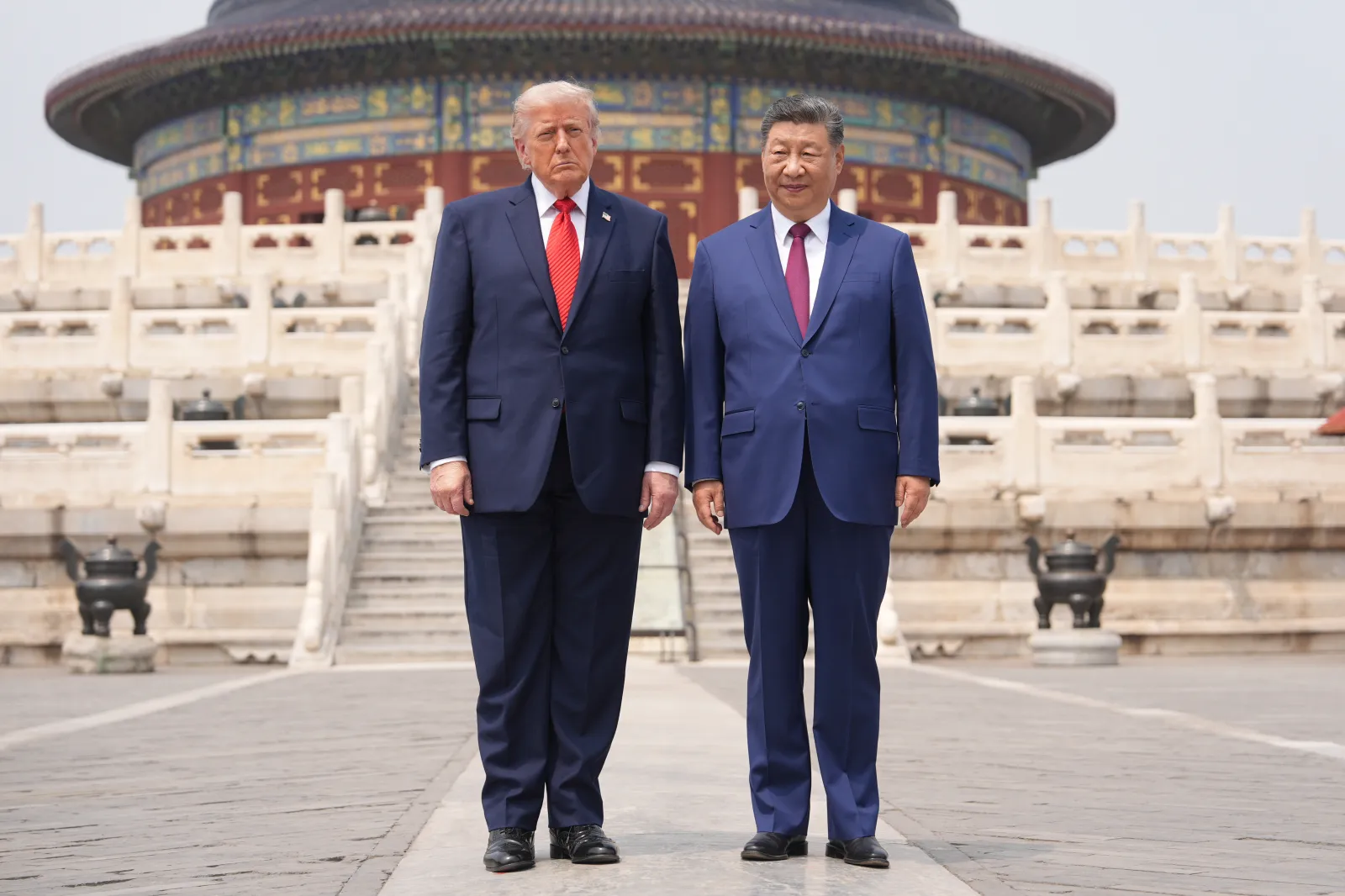
Shortly afterward, the pair stopped for a photo outside the Temple of Heaven, another Beijing landmark, state media reported. In centuries past, the site symbolized the connection between heaven and earth and was associated with "Heaven's mandate"—or the divine right to rule of emperors, who would pray at the temple for bountiful harvests.

...

...

...
1 of 3
Xi also greeted the entrepreneurs accompanying Trump on the trip, including Nvidia CEO Jensen Huang and Tesla CEO Elon Musk.
Trump was effusive in his initial remarks at the Great Hall of the People, calling Xi a "great leader" and saying it was a "great honor" to be back in China. He also characterized U.S.-China ties as "very good."
"I look forward to working with President Xi to strengthen communication and cooperation, properly resolve our differences, usher in the best U.S.-China relationship in history, and create a brighter future for both nations," Trump said, according to a readout from the Chinese Foreign Ministry.
Xi struck a more cautious tone in his remarks, pointing to Taiwan as the most important issue in China-U.S. relations.
"If it is handled properly, the relationship between the two countries will remain generally stable," he warned. "If it is not handled well, the two countries will collide or even conflict, pushing the entire Sino-U.S. relationship into a very dangerous situation."
The Banquet
On Thursday evening, Xi hosted a lavish banquet, during which he noted the start of China’s 15th Five-Year Plan for social development as well as the 250th anniversary of U.S. independence.
The U.S.-China relationship is the world’s most important bilateral relationship, Xi said, adding that both sides have a responsibility to steer it in the right direction, according to a Chinese Foreign Ministry readout of his toast.
Trump struck a similarly warm tone in his own remarks, saying friendship between the American and Chinese people stretched back decades and that the two nations shared mutual appreciation and respect.

...

...

...
1 of 3
Photos from the banquet showed members of the two delegations mingling. Musk drew particular attention, with video circulating of the SpaceX CEO being approached for selfies by Apple CEO Tim Cook and Lei Jun, chief executive of Chinese smartphone maker Xiaomi.
The menu blended Chinese cuisine with international fare, including several Western-style dishes more suited to Trump’s famously less adventurous palate. Offerings included salmon in mustard sauce, lobster in tomato soup, and stewed seasonal vegetables, The New York Times reported. Dessert included ice cream, fruit and tiramisu.
Reasons for China's Pomp and Pageantry
Trump received the "super VIP" treatment, Claus Soong, an analyst with the Mercator Institute for China Studies (MERICS), told Newsweek—warmer than the reception given to British Prime Minister Keir Starmer in January but cooler than the personal rapport Xi shows toward Russian President Vladimir Putin.
Soong said the carefully staged visit reflected Beijing’s growing confidence and its effort to position itself as a center of global diplomacy. Unlike Trump’s 2017 visit to the Forbidden City, which emphasized imperial grandeur, this year’s stop at the Temple of Heaven projected “calm confidence and ease,” he said.
The symbolism may also have carried a subtler message for the American president: “The Temple of Heaven was where the emperor reflected before Heaven and showed reverence for it,” Soong said. "The visit may also imply a virtue of leadership, and maybe for the reminder to Xi’s American guest if he could understand: humility."
Overall, the fanfare surrounding the state visit may have served a strategic purpose, Danny Russel, a former senior U.S. diplomat and analyst with the Asia Society Policy Institute, told The Associated Press.
Beijing understands Trump responds well to “flattery and spectacle,” he said. "The pomp and pageantry is designed both to flatter Trump and to pacify him, making him more amenable to Chinese asks and reducing the risk of an embarrassing public confrontation."
View 0 Comments
Submit Correction
View Editorial & AI Guidelines