10
Loading video...

By Brendan Cole
Senior Reporter
0
Share
Newsweek is a Trust Project member
See more of our trusted coverage when you search.Prefer Newsweek on Googleto see more of our trusted coverage when you search.
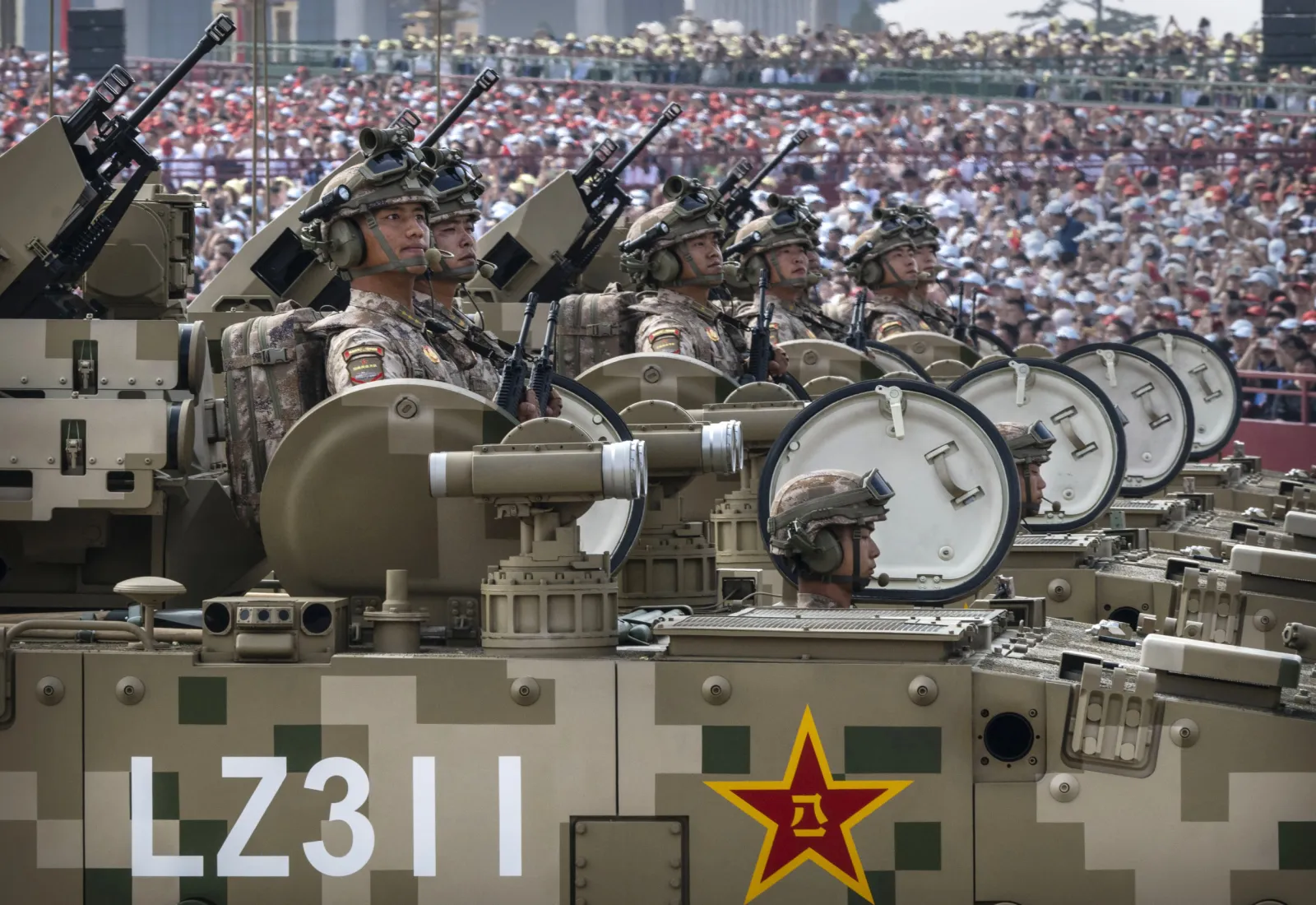
A new laser weapon and a nuclear intercontinental ballistic missile were among the weapons China revealed during a parade in Beijing, which demonstrated its military might and sent a statement of intent to the West.
Chinese President Xi Jinping was joined by around 20 world leaders, including Russia's Vladimir Putin and North Korea's Kim Jong Il, in Tiananmen Square to mark the 80th anniversary of Japan's surrender in World War II.
Among the hardware on show were the LY-1 shipborne laser weapon system and the DF-5C liquid-fueled intercontinental ballistic missile (ICBM).
Read More on World
Craig Singleton, a senior China fellow at the Foundation for Defense of Democracies (FDD), told Newsweek the event showcased China's growing convening power, its maturing military kit and signals its "tightening authoritarian alignment."
...
Why It Matters
The DF-5C is touted as a leap in Beijing's strategic nuclear deterrence capabilities, while the LY-1 showed China's intent to match or surpass U.S. naval laser capabilities.
Other weapons on show were innovative and diverse, particularly drones and missiles—demonstrating how advanced their defense-industrial complex has become and how quickly it can produce a diverse range of weapons.
What To Know
More than 50,000 people gathered at Beijing's Tiananmen Square on Wednesday to see the military parade to commemorate the end of World War II.
Leaders of democratic countries mostly stayed away, but the presence of Iran's president, Masoud Pezeshkian, and Myanmar's junta leader Min Aung Hlaing, as well as Kim and Putin, formed a roll call of U.S. adversaries challenging the U.S.-led world order.
U.S. President Donald Trump's comment that the presence of Kim and Putin at the parade showed they were working to "conspire against The United States of America" showed how the event was as much about sending a message to the U.S. and its allies as it was about hardware.
Dongfeng-5C ICBM
Among the weapons rolled out was the Dongfeng-5C (DF-5C), which is China's latest and most powerful liquid-fueled intercontinental ballistic missile (ICBM).
The missile combines the technologies of earlier versions, including the DF-5 and DF-41, and carries multiple independently targetable reentry vehicles (MIRVs) with nuclear or conventional warheads, according to the publication Defense Mirror.
It has a range of over 20,000 km (13,000 miles), meaning it can target any location in the world.
Hans Kristensen, director of the Nuclear Information Project at the Federation of American Scientists (FAS), told Newsweek that the DF-5C is possibly a replacement for the existing DF-5A, which also has a single multi-megaton warhead.
"As such we'll probably see the DF-5C go into the larger mountain-silos that have been under construction for several years," Kristensen said.
LY-1 Naval Laser System
China also unveiled the LY-1 naval laser system, which was rolled out on an eight-wheeled HZ141 vehicle.
The LY-1 is a shipborne laser weapon system that is part of a broader push by China's People's Liberation Army (PLA) Navy to integrate directed-energy weapons into its layered maritime defense architecture.
It can intercept drones, missiles and potentially hypersonic projectiles and can strike at the speed of light, minimizing the delay between target detection and interception.
It is intended to neutralize the optical sensors of enemy equipment, and Beijing has touted this weapon as one that alters the rules of naval warfare by adding a new layer of defense based on directed energy, the publication Army Recognition reported.
"LY-1 matters because China is signaling it will put lasers on warships to knock down drones and scorch the sensors on incoming missiles—at pennies a shot," Singleton told Newsweek.
"The message is simple—make ships harder to overwhelm and save expensive missiles for real threats. If LY-1 works at sea and scales across the fleet, it could shift the economics of naval defense," he said, "the proof will be sea trials and deployments, not the parade."
The parade also featured hypersonic anti-ship missiles that China has previously tested, including the Yingji-19, Yingji-17, and Yingji-20, Reuters reported.
Also on display were cruise missiles, including the Changjian-20A, Yingji-18C, Changjian-1000, and other hypersonic missiles, such as the Yingji-21, Dongfeng-17, and Dongfeng-26D.
A wide range of drones was on display, including some AI-powered models, such as the AJX-002 giant submarine drone and the GJ-11 stealth attack drone.
However, Singleton told Newsweek that parade pageantry won't solve the PLA's problems, including corruption, leadership purges, strained campaign logistics, and weak command and control.
What People Are Saying
Missile expert Yang Chengjun told China's Global Times the Dongfeng-5C's MIRVs: "could be equipped with nuclear or conventional warheads, or decoys. This can greatly increase the challenges for defense systems to intercept."
What Happens Next
Singleton said the key thing to watch out for is whether Beijing follows up with a post-parade live-fire or naval drill, because "hardware plus habits—not headlines—show where China's military is headed."
Update 9/3/25, 2:48 p.m. ET: This article was updated with additional comment from Craig Singleton.
View 0 Comments
Submit Correction
View Editorial & AI Guidelines