10
Loading video...

By Ryan Chan
China News Reporter
0
Share
Newsweek is a Trust Project member
See more of our trusted coverage when you search.Prefer Newsweek on Googleto see more of our trusted coverage when you search.
China has strengthened its long-range nuclear and conventional strike capabilities by increasing the number of missiles and launchers, according to a Pentagon assessment.
In its report on Chinese military power released on Tuesday, the Pentagon said China's historic military buildup has made the United States homeland increasingly vulnerable, with a large and growing arsenal capable of directly threatening Americans' security.
The Chinese Defense Ministry said on Thursday that China "firmly pursues a defensive national defense policy" while advancing military modernization with what it called "high quality" to safeguard national sovereignty, security and development interests.
Read More on World
Why It Matters
Missiles play a key role in China's strategy to counter U.S. intervention in the event of a conflict in the western Pacific, including around Taiwan—which it has threatened to seize by force—and in disputed South China Sea waters, aiming to deter and limit the ability of U.S. forces, particularly air force and naval vessels, to operate in the region.
China's continued expansion of its missile forces is part of an ambitious goal outlined by President Xi Jinping, who aims to build a "world-class" military by 2049. According to the Pentagon, the Chinese People's Liberation Army, or PLA, is a key component of the East Asian power's effort to displace the U.S. as the world's most powerful nation.
What To Know
The Pentagon detailed the PLA's missile order of battle in its report, listing the number of missiles and launchers for intercontinental ballistic missiles (ICBMs), intermediate-range ballistic missiles (IRBMs), medium-range ballistic missiles (MRBMs), short-range ballistic missiles (SRBMs) and ground-launched cruise missiles (GLCMs).
The Chinese ICBM force, which has an estimated range of more than 3,417 miles and primarily carries nuclear warheads but can also conduct conventional strikes, consists of 400 missiles and 550 launchers. While the number of missiles remains the same as in last year's Pentagon report, China has added 50 ICBM launchers in a year.
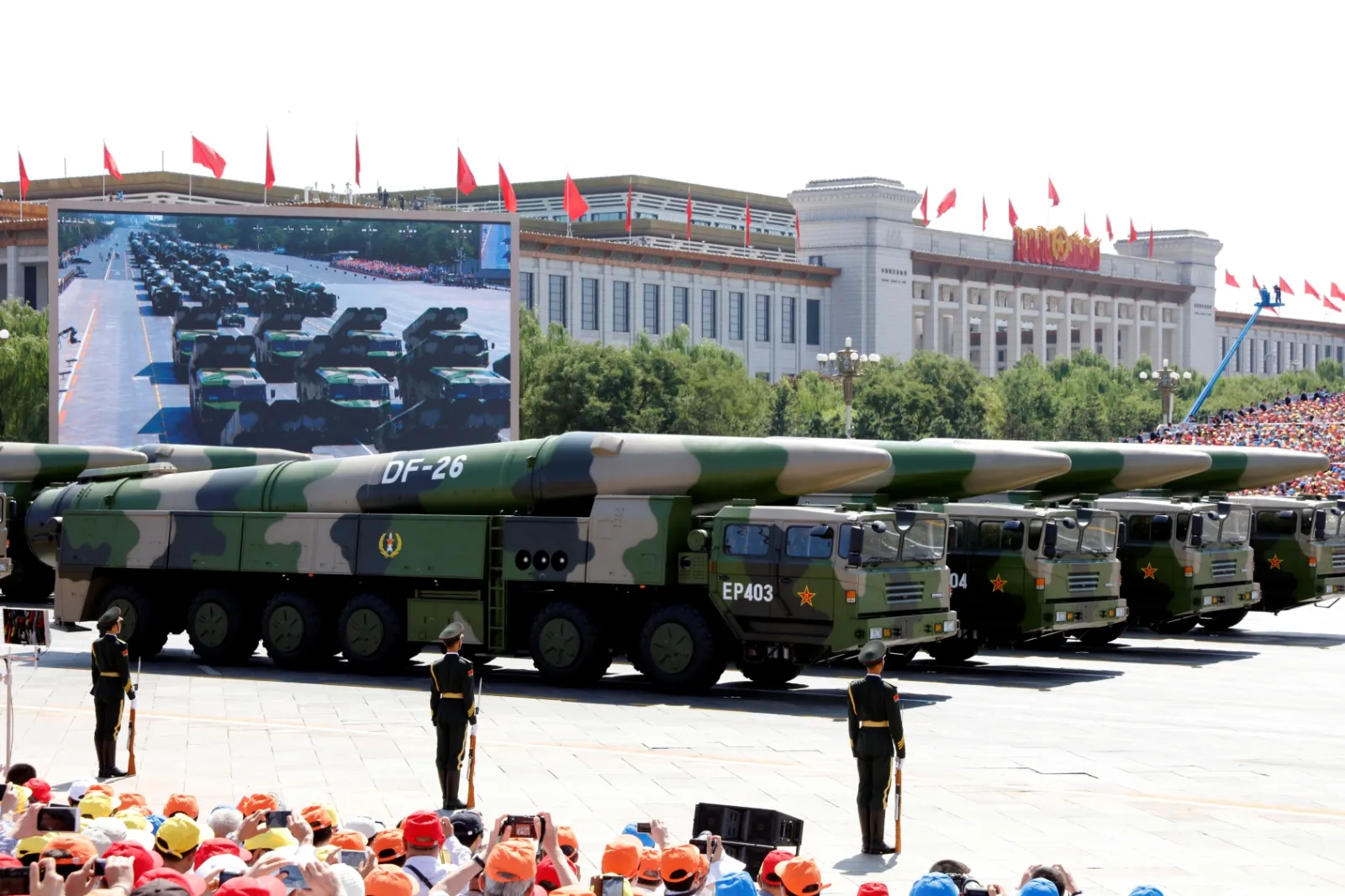
Meanwhile, China's IRBM fleet, capable of hitting targets between 1,864 and 3,417 miles, has added 50 missiles and 50 launchers, bringing the totals to 550 missiles and 300 launchers. Unlike its ICBMs, which have multiple types, China has fielded one IRBM, the CSS-18, known as the DF-26—a highly precise theater weapon.
The DF-26 is designed to "rapidly swap" conventional and nuclear warheads for precision land-attack and anti-ship strikes across the western Pacific, the Indian Ocean and the South China Sea from mainland China, the Pentagon said in last year's report.
This Chinese IRBM poses a significant threat to the U.S. military's ability to project power near China from Guam, a key military outpost. The DF-26 is the first Chinese conventional ballistic missile capable of striking the westernmost U.S. territory in the Pacific, the Center for Strategic and International Studies' Missile Defense Project said.
China's MRBM force—with a range of 621 to 1,864 miles—remains unchanged from the Pentagon's previous estimate, with 1,300 missiles and 300 launchers in operation.
...
As for China's SRBMs and GLCMs, which have ranges of 186 to 932 miles, the former has reduced its number of launchers from 300 to 250 while fielding 900 missiles. The latter's missile inventory dropped from 400 to 300, and it maintains 150 launchers.
"China produces a wide range of ballistic, cruise, air-to-air, air-to-surface and surface-to-air missiles, many comparable in quality to those of other international top-tier producers, for domestic use and export," the Pentagon said of China's missile industry.
What People Are Saying
The Pentagon's Chinese military power report read: "China's People's Liberation Army (PLA) has for decades marshaled resources, technology, and political will to achieve its vision of a world-class military. The PLA is a key component of China's ambition to displace the United States as the world's most powerful nation. The PLA measures its concepts and capabilities against the 'strong enemy' of the United States."
The Chinese Defense Ministry said: "The entire [Pentagon] report is filled with erroneous perceptions of China and geopolitical biases, and it hypes up the so-called 'Chinese military threat' to mislead the international community...We urge the U.S. side to adopt a correct understanding of China, view China and the development of the Chinese military objectively, stop fabricating false narratives, stop instigating confrontation and antagonism, and avoid leading bilateral and military relations astray."
What Happens Next
It remains to be seen how the U.S. military will bolster its missile defense capabilities amid China's growing threat, which could hinder its freedom of movement across the Pacific if it needs to come to the aid of Washington's allies and partners during a crisis.
View 0 Comments
Submit Correction
View Editorial & AI Guidelines