...

By Didi Kirsten Tatlow
Senior Correspondent, International Affairs
0
Share
Newsweek is a Trust Project member
See more of our trusted coverage when you search.Prefer Newsweek on Googleto see more of our trusted coverage when you search.
As the four-week mark of the Iran War approaches on Saturday, China is increasingly orchestrating efforts to negotiate a solution to the crisis that has spiked energy markets and spooked countries around the world.
It is facing its own hard-to-reconcile dilemma in the region.
Beijing has much to lose not just economically but strategically as it tries to support Tehran, stay on good terms with the Gulf states which Iran has attacked, and prevent the U.S. and Israel from seizing broad strategic control in the Middle East.
Read More on World
Pakistan's Prime Minister Shehbaz Sharif offered to hold talks in Islamabad, in a statement that was shared by President Donald J. Trump on Truth Social. Pakistan is one of China's closest allies, suggesting Beijing may be shadowing the situation carefully and would have a proxy seat at the table.
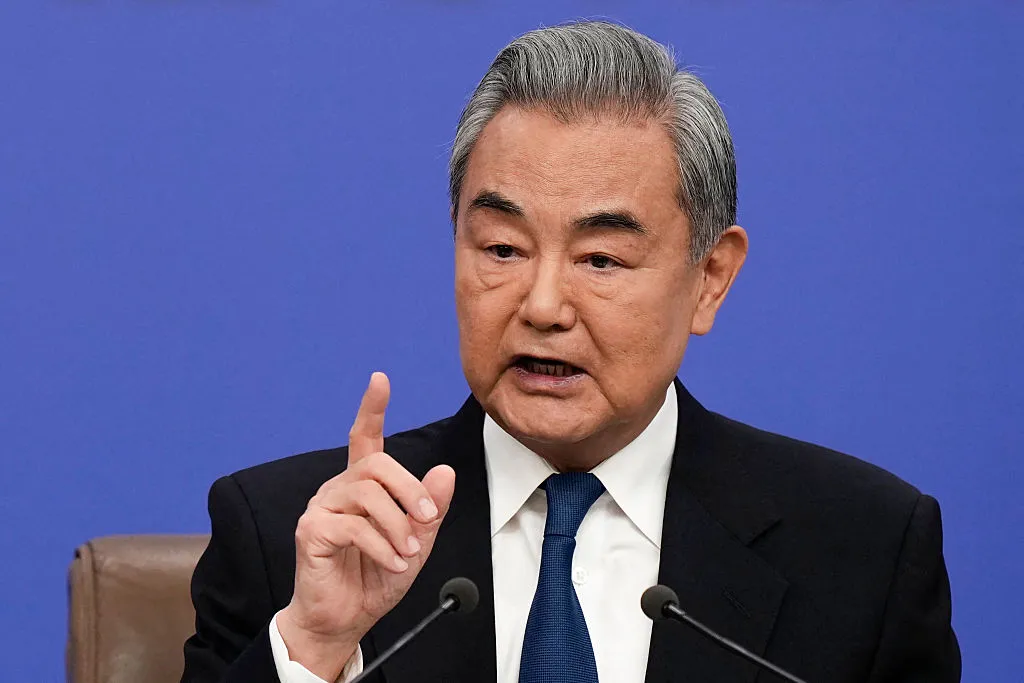
On Tuesday, China's Foreign Minister Wang Yi made a phone call to his reluctant Iranian counterpart to "urge" him to talk, Xinhua reported.
China has been sanctions-struck Iran's lifeline and strategic partner for years, supporting it economically, technologically and militarily. But it also wants good relations with Gulf nations such as Saudi Arabia and the United Arab Emirates—these supply half the oil and other vital goods China needs for its mighty industries. Those countries are also a major source of foreign direct investment for Beijing.
In turn, Beijing has invested billions in the region.
But the Gulf states are furious that Iran has attacked them with scores of drones and ballistic missiles, causing significant damage.
So as Beijing's crucial support for Tehran indirectly threatens those states, they may increasingly push China to choose between Iran and them, analysts said.
When Wang called the Iranian Foreign Minister Seyed Abbas Araghchi on Tuesday his message was clear: Talk, don't fight.
"All hotspot issues should be resolved through dialogue and negotiation, rather than through the use of force," in an "urge" to his counterpart, Xinhua reported.
“Ceasefire and peace talks are more important tasks at hand,” Foreign Ministry spokesman Lin Jian told reporters in Beijing on Wednesday, following up his minister's comments.
A Shifting Strategic Balance
The problem may not be so easily solved —even if the talks take place, which is unclear.
China does not want to see the Middle East shift strategically to become a U.S. and Israel-led region, Chinese analysts say. The fall of the Iranian theocracy would also mean the collapse of Iran's region-wide, ideological "Axis of Resistance," which includes key proxies such as Hezbollah, Hamas and the Houthis.
One "solution" to China's dilemma could look a little like "Ukraine-ization," or what Beijing is doing for Russia in its war on Ukraine by fueling Russia's military and technology while striving for maximum deniability, Tuvia Gering, an analyst at Israel-based Planet Nine, a cyber and technology company, and a researcher at the Institute for National Security Studies in Tel Aviv, Israel, told Newsweek.
But that still poses long-term challenges for broader Middle East relations for China: having been pummeled by Iranian weapons, the Gulf states may not like it.
"If there's going be one area of pressure point ... it's going to be about the Gulf states' autonomy themselves, and their level of anger right now, driving them to try to make China make a choice itself as well, as much as possible," said Jonathan Panikoff, director of the Scowcroft Middle East Security Initiative at the Washington, D.C.-based Atlantic Council.
Chinese leaders largely expect and want the Iranian regime to survive, even if in a degraded form.
At stake is nothing less than the regional security order, according to Tang Zhichao of the Chinese Academy of Social Sciences (CASS), writing in the authoritative Communist Party journal Qiushi.
China and Iran signed a 25-year "strategic cooperation partnership" in 2021.
"Iran holds immense geostrategic importance," Tang wrote. "It is often referred to as the "Eurasian Land Bridge" and the "East-West Air Corridor."
And now, "Geopolitically, Iran and the U.S. and Israel are vying for dominance in the Middle East order," Tang said.
"The reason for the U.S.-Israeli military action against Iran lies in the fact that Iran poses a significant challenge to U.S. hegemony in the Middle East and the U.S.-Israeli-led regional security order," said Tang, who is the director of the Institute of West Asian and African Studies at CASS.
A Complicated Ledger
That fight for dominance means that if the U.S. wins, China loses another global strategic foothold—after the January U.S. invasion of Venezuela and seizure of its leader Nicolas Maduro and the collapse of the Syrian government of China-friendly Bashar Al-Assad in 2024.
Said Gering: "The worst-case scenario for China is that Iran collapses because of the implications for the region and because of possibility that there would be a neutral or even a pro-U.S. administration in Iran."
"What can we expect from China? If this war ends tomorrow, then nothing much," said Gering.
"But if it does continue, there is a possibility of the Ukraine-ization of this war, meaning that the same way that China provides the economic lifeline and the industrial support for Russia's war machine in Ukraine, China could and probably will sustain Iran's regime just above the level of complete collapse," Gering said.
So unless peace talks take place and work, and remove the Iranian threat to Israel, China's support for Tehran will continue to destabilize the region—and that could lead to an ongoing "mow the grass" strategy by Israel whereby it launches regular attacks to degrade Iran's military including its nuclear capability, said Panikoff.
"That's the type of thing that I think will portend a pretty consistent level of kinetic engagement, especially by the Israelis. And then there's going to be this question of how destabilizing it is for the broader region, and that's what China needs to think about," said Panikoff.
View 0 Comments
Submit Correction
View Editorial & AI Guidelines