
...

By Gabe Whisnant
News Editor
0
Share
Newsweek is a Trust Project member
See more of our trusted coverage when you search.Prefer Newsweek on Googleto see more of our trusted coverage when you search.
Supreme Court Justice Clarence Thomas on Wednesday warned that progressivism threatens the nation’s founding principles, calling it “retrogressive” during a speech at the University of Texas at Austin marking the 250th anniversary of the Declaration of Independence.
His remarks come as ideological divisions on the Supreme Court have sharpened amid ongoing debates over executive power, immigration enforcement and the role of the administrative state.
Those disputes affect how federal authority is exercised and how the court’s 6-3 conservative majority interprets limits on government power.
Read More on Politics
Clarence Thomas' Texas Speech: What to Know
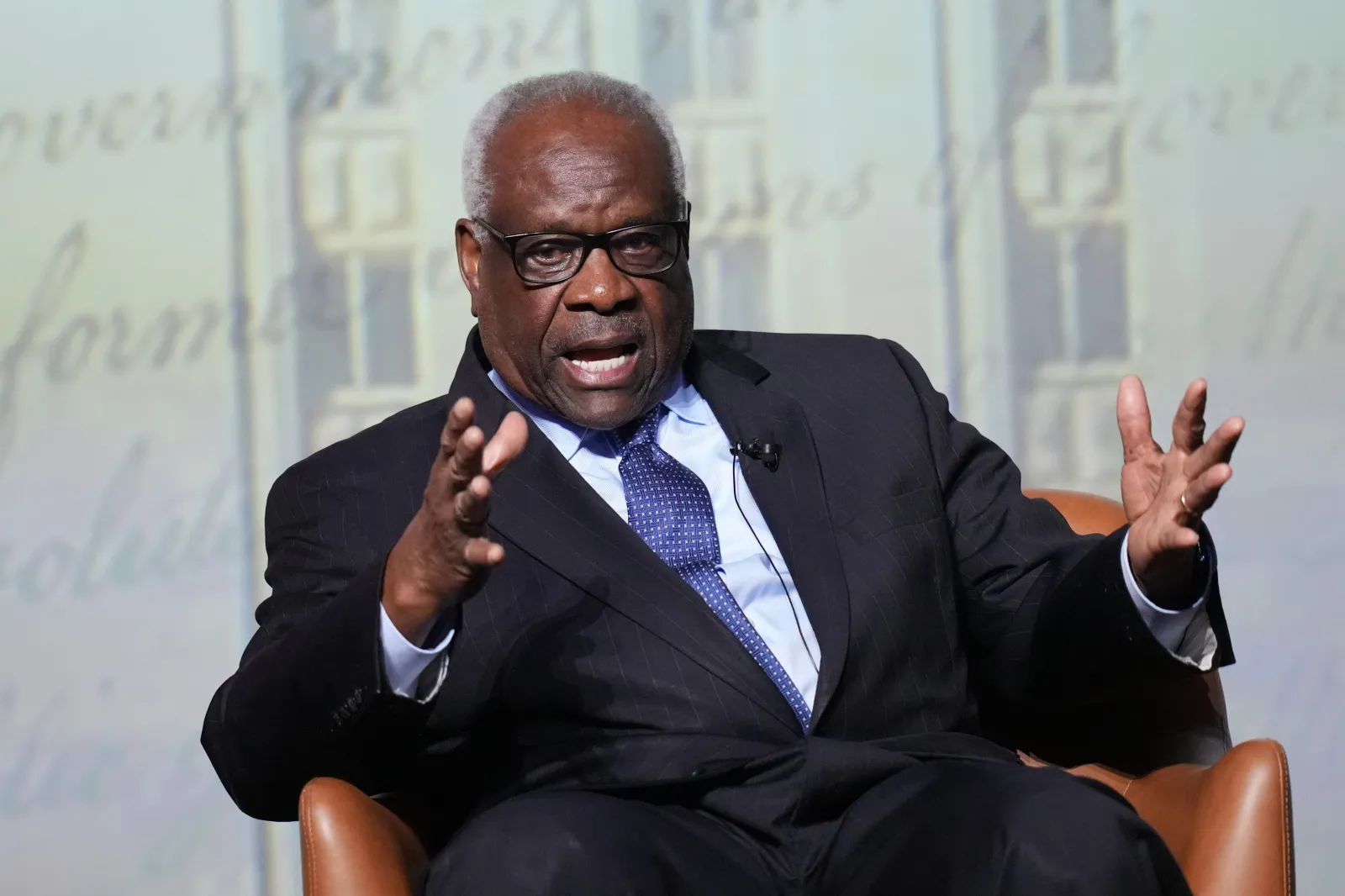
In a speech focused on constitutional first principles, Thomas argued that progressivism conflicts with the Declaration’s commitment to natural rights and limited government. He said the Declaration establishes the ends of government, while the Constitution provides the framework to protect liberty from concentrated authority and unchecked majority rule.
...
Thomas cited historian Alexis de Tocqueville’s Democracy in America, saying that the United States owed its success to rejecting centralized planning and administrative rule. “Progressivism, in other words, is retrogressive,” Thomas asserted, arguing that modern governance trends abandon those foundations rather than improve upon them.
He traced progressive political thought to early 20th‑century ideas associated with President Woodrow Wilson, whom Thomas said admired European systems built around centralized state power. According to Thomas, that philosophy treats liberty as something granted by government rather than as an inherent right that precedes it.
Thomas warned that replacing natural rights with evolving notions of historical progress has repeatedly enabled abuse, pointing to segregation, eugenics and other state‑sanctioned practices upheld in past Supreme Court rulings. He argued that reliance on administrative authority diminishes self-government and weakens constitutional protections, particularly for minorities.
Invoking figures from James Madison to Abraham Lincoln and Calvin Coolidge, Thomas urged renewed adherence to the Declaration’s principles.
"Progressivism seeks to replace the basic premises of the Declaration of Independence, and hence our form of government," the conservative justice said. "It holds that our rights and our dignities come not from God, but from the government. It requires of the people a subservience and weakness incompatible with a Constitution premised on the transcendent origin of our rights."
The conservative justice appointed by President George H.W. Bush also published an excerpt of his speech Wednesday in The Wall Street Journal.
A Supreme Court Shaped by the Trump Era
Thomas’ remarks reflect a broader ideological divide on the Supreme Court that sharpened during and after Donald Trump’s presidency, which reshaped the court with three conservative appointments, Neil Gorsuch, Brett Kavanaugh and Amy Coney Barrett. The resulting 6-3 conservative majority has repeatedly revisited long‑settled precedents and expanded executive authority, particularly through emergency orders that allow administrations to pursue contested policies while litigation continues.
That approach has drawn sustained criticism from the court’s liberal justices, who argue that expedited rulings often lack full briefing, detailed reasoning and sufficient consideration of how policies affect individuals. Immigration enforcement has emerged as a recurring flashpoint, with conservatives emphasizing deference to presidential authority and liberals warning of constitutional violations and real‑world harm.
Public Voices, Private Divides
Thomas’ appearance at the University of Texas fits within a broader trend of justices speaking more openly outside the courtroom, offering ideological context that traditionally appeared only in judicial opinions. Those public engagements have increased as the court faces heightened scrutiny and declining public confidence following several polarizing rulings.
While the justices continue to stress collegiality, Thomas’ warning this week underscored how sharply divided the court remains over the meaning of progress, the scope of government power and the relevance of America’s founding documents.
As the Supreme Court approaches the Declaration’s 250th anniversary, those philosophical clashes—sharpened in the Trump era—are expected to continue shaping decisions on immigration, administrative authority and executive power well beyond a single presidency.
This is a breaking news article. Updates to follow.
View 0 Comments
Submit Correction
View Editorial & AI Guidelines