
...

By Alexis Kayser
Healthcare Editor
0
Share
Newsweek is a Trust Project member
See more of our trusted coverage when you search.Prefer Newsweek on Googleto see more of our trusted coverage when you search.
When AI made its grand entrance into the health care industry, all eyes were on Cleveland Clinic. And for good reason.
The system is home to the best smart hospital in the world, according to Newsweek’s and Statista’s most recent ranking. In 2025, it exceeded its revenue goals, bringing home $18.3 billion with a five percent operating margin; meanwhile, many of its not-for-profit U.S. health system peers are struggling to stay in the black. Cleveland Clinic is growing at twice the rate of its U.S. peers, establishing an international footprint with facilities in Ontario, Abu Dhabi and London. More than 3.6 million unique patients visited the Clinic’s locations last year.
Cleveland Clinic is undoubtedly a leader in medicine, research and reputation. The same principles that made it aspirational in these areas are guiding its AI strategy, according to Dr. Tom Mihaljevic, the organization’s president, CEO and Morton L. Mandel CEO Chair.
Read More on Health Care
“We think of ourselves, rightly or wrongly, as the most corporate of all not-for-profits in health care,” Mihaljevic told Newsweek in an April meeting. “We take 'corporate' as a badge of honor, because we believe that a corporate discipline leads to the scalability of goods that we can deliver to our operations."

...
That “scalability” Mihaljevic mentioned is a pain point that spans business across all industries, not just health care. Ninety-five percent of generative AI pilots fail to scale at the deploying business, according to a 2025 MIT report. More companies are also abandoning their AI initiatives in the trial phase, per a recent S&P Global analysis: 42 percent left their plans on the cutting room floor last year, up from 17 percent the year prior.
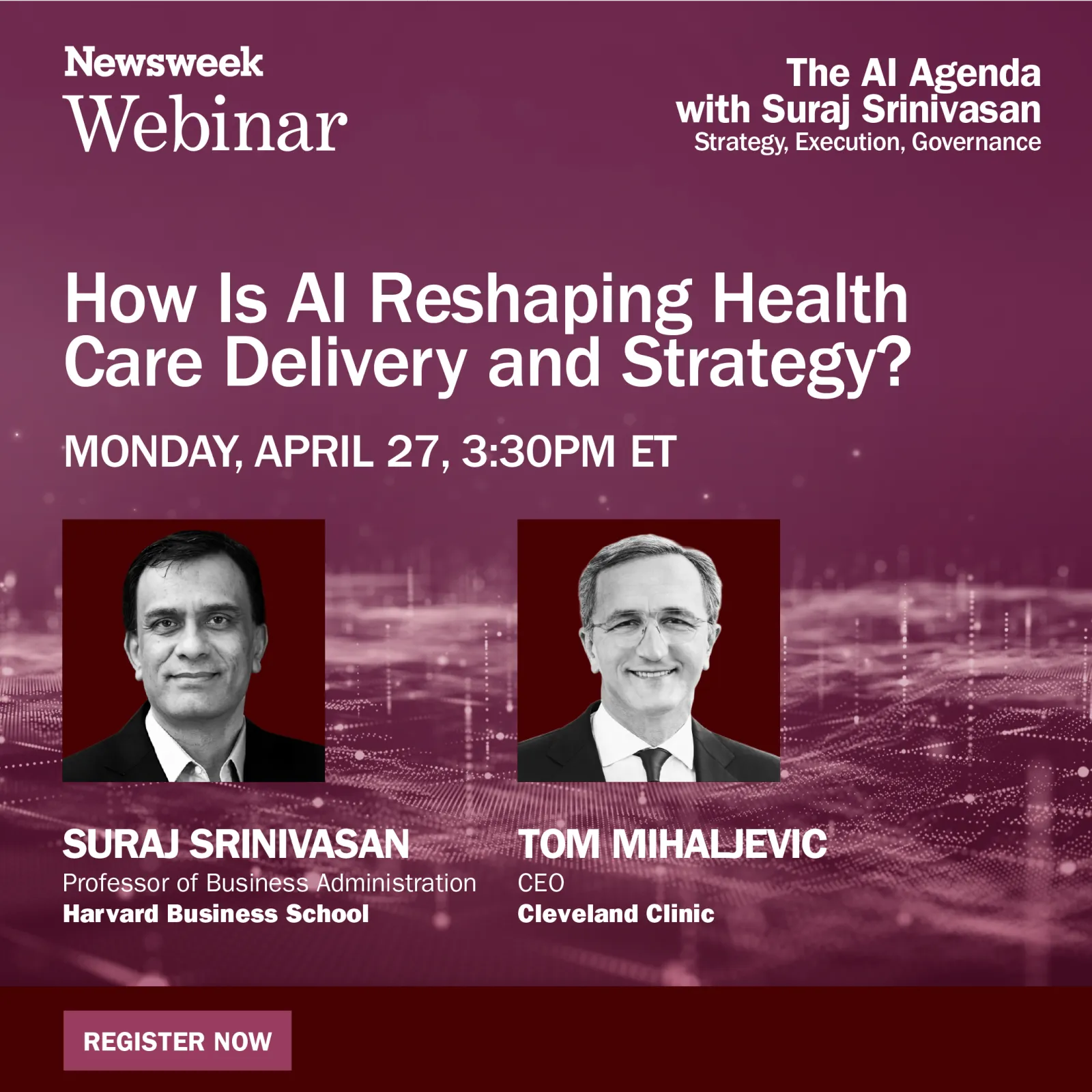
If companies want to see those pilots reach production, they might consider taking a page from Cleveland Clinic’s playbook. On April 27, Mihaljevic will be joining "The AI Agenda" webinar series, hosted by Harvard Business School Professor Suraj Srinivasan, to discuss how the Clinic’s AI successes could offer transferable lessons for other sectors. Click here to register for the fireside chat, platformed by Newsweek.
Cleveland Clinic is a rare success story in AI scalability, particularly in health care—a highly regulated industry with high, human stakes. Hospitals and health systems are generally reliant on aging, legacy infrastructures that complicate integration and technological adoption. Coupled with rising concerns around data privacy and security, health care is not the most agile breeding ground for AI innovation.
However, the Clinic—which operates 23 hospitals and roughly 300 outpatient facilities—has managed to embed AI in medical care, research and back-end operations. The organization rolled out ambient listening software in early 2025, and within a year, more than 5,000 providers have been trained on it and have used it at least once. Clinicians report that this AI platform from Ambience (which transcribes their conversations with patients and converts them into usable clinical notes) saves time, preserves detail and allows them to fully engage with their patients instead of a screen.
Cleveland Clinic is a trove of such success stories: an AI platform used to identify sepsis is now in use at all of its U.S. hospitals. Another AI tool has improved the accuracy and efficiency of a complex revenue cycle, processing more than 100 documents in 1.5 minutes. And an AI-enabled virtual command center enabled the system to reduce unused operating room time by 40 percent and increased its ability to transfer patients to the main facility by seven percent, helping patients to get care sooner.
The corporate discipline that Mihaljevic referenced has accelerated AI initiatives across the system, according to Rohit Chandra, Cleveland Clinic’s chief digital officer.
“Cleveland Clinic has a tightly integrated health system and operating model throughout our locations,” Chandra told Newsweek. “This allows us to more quickly and effectively scale AI applications.”
There is another unique approach at play here, Mihaljevic told Newsweek. Cleveland Clinic knows where it shines—and is not afraid to work with partners who have the expertise it lacks.
"We happen to be a dominant force in health care, but we do not have any of the attributes of a digital company,” Mihaljevic told Newsweek. “Therefore, for many things that we do at Cleveland Clinic, we started to rely heavily on well structured, comprehensive partnerships in the digital space in particular.”
“We are keenly interested not just to have a vendor-customer relationship,” he continued, “but to really have a true partnership, meaning co-investments, co-development, refining the digital products and a targeted deployment."
As such, the Clinic sports an impressive list of AI collaborators: Palantir, Oracle and IBM among them.
Tech partnerships are gaining traction in the health care industry, but they aren’t necessarily table stakes. Throughout the business world, companies have been swept up in the “excitement” of the AI era and tried to build tools that they aren’t always equipped to maintain.
“The trap that [businesses] can fall into is to believe that technology products and services are a capability that we can easily build,” Srinivasan said. “Because we are good at something else, we can get good at this as well.”
But, “there's a reason Google is very good at what it does, and there's a reason Palantir is very good at what it does,” Srinivasan continued. “They can't try to become each other. Certain DNA and expertise is needed to be good at what you do."
Srinivasan advocates for Cleveland Clinic’s collaborative approach to AI development and deployment, both inside and outside of the health care industry.
“Carefully, strategically consider, ‘What is our core competence, and what should we be bringing to the table?’” he said. “A partnership is a very good way of doing that.”
If you want to learn more, click here to register for the April 27 discussion between Suraj Srinivasan and Dr. Tom Mihaljevic.
View 0 Comments
Submit Correction
View Editorial & AI Guidelines