10
Loading video...

By Tom Howarth
Science Reporter (Nature)
0
Share
Newsweek is a Trust Project member
See more of our trusted coverage when you search.Prefer Newsweek on Googleto see more of our trusted coverage when you search.
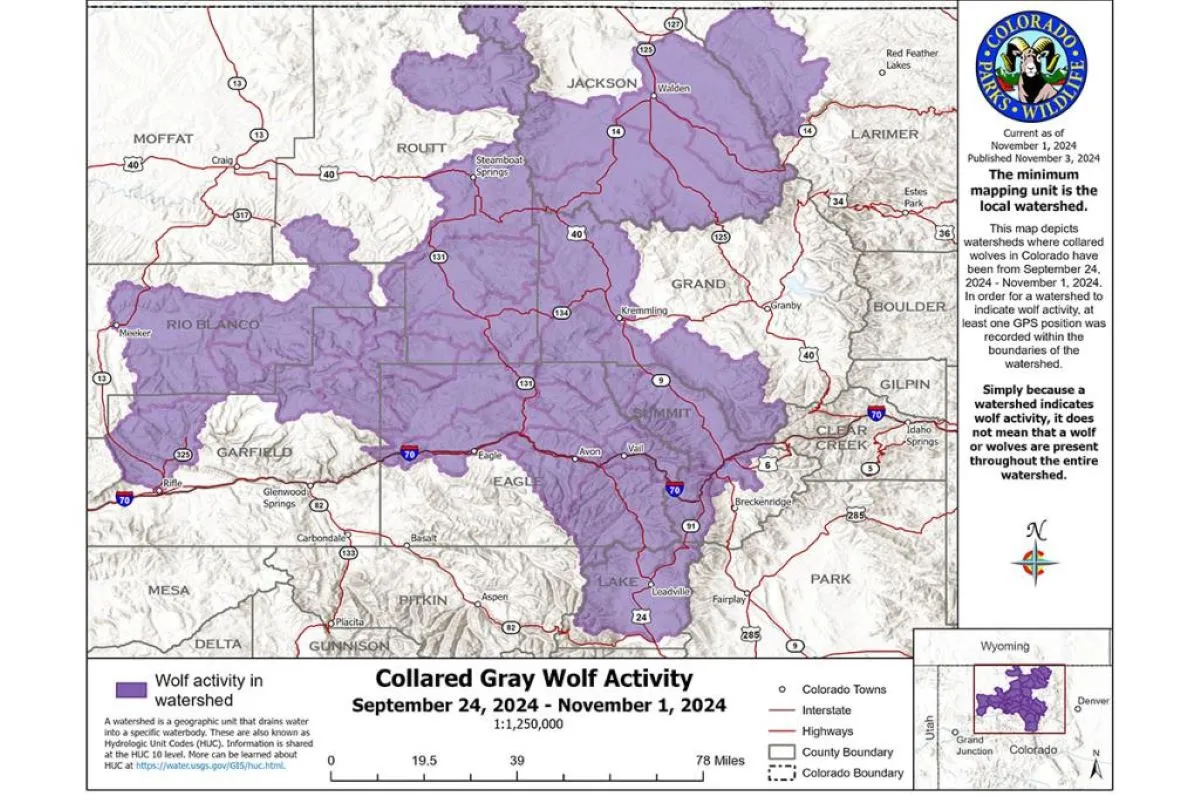
Colorado's reintroduced gray wolves have made a historic move, crossing south of Interstate 70, according to Colorado Parks and Wildlife (CPW).
For the first time since reintroduction efforts began last year, GPS-tracked wolves are venturing beyond I-70, marking a significant step in their exploration of new terrain within the state. CPW, which typically provides monthly wolf location updates on its Collared Gray Wolf Activity Map, made this special announcement on Sunday in light of the notable movement.
The southward expansion reflects an expected pattern for the wolves, who need abundant prey, large wild landscapes, and minimal human interference to thrive.
Read More on News
"While wolves crossing I-70 was anticipated at some point, wolf movement across I-70 is significant due to the major barrier the highway presents to all wildlife," Travis Duncan, public information officer at CPW, told Newsweek.
"CPW has been working diligently to improve connectivity for all wildlife along the I-70 corridor and elsewhere throughout the state, including building overpasses and underpasses. CPW has received many questions from the media and public about this topic."
...
Experts believe these wolves, referred to as "habitat generalists" by the CPW, can adapt to a wide range of environmental conditions as long as they have sufficient prey, meaning that similar southward expansions may continue in the future.
The reintroduction plan, mandated by a 2020 voter-approved initiative, aims to rebuild a sustainable wolf population in the state by releasing 10 to 15 gray wolves each winter through 2028.
The agency introduced the first 10 wolves from Oregon in December 2023, and an additional 15 are set to arrive from British Columbia, Canada, between December 2024 and March 2025.
These releases, however, have not been without challenges. Of the original wolves reintroduced, three have died, with one fatality occurring during a relocation effort near Copper Creek in late August.
The Copper Creek area, where one wolf pack settled near livestock herds, emerged as a particular point of concern. The wolves' proximity to livestock led to several reported animal deaths, prompting CPW to launch a capture and relocation mission for the Copper Creek pack.
This operation aimed to reduce conflicts with local ranchers, but it resulted in the unfortunate death of the pack's adult male wolf, leaving officials and stakeholders to evaluate future strategies.

...
CPW has since provided nonlethal deterrent training for ranchers to prevent such conflicts and has encouraged the use of tools like fladry fencing and guard dogs.
"The decision to capture and relocate the Copper Creek pack was made with the careful consideration of multiple factors and feedback from many different stakeholders," CPW Director Jeff Davis said in a statement at the time.
"Our options in this unique case were very limited, and this action is by no means a precedent for how CPW will resolve wolf-livestock conflict moving forward. The ultimate goal of the operation is to relocate the pack to another location while we assess our best options for them to continue to contribute to the successful restoration of wolves in Colorado."
To support wolf conservation and public safety, CPW relies on its GPS-tracking program. These locations, however, are shared sparingly to protect the wolves and reduce human-wildlife interactions.
Wildlife officials encourage Colorado residents and visitors to report potential wolf sightings using CPW's wolf sighting form, available on its website.
As the state prepares to welcome a new group of wolves this winter, CPW expects the population to continue adapting to Colorado's diverse landscapes.
"As long as prey is available, wolves can use a variety of areas. It is anticipated that wolves will expand widely over time," the agency stated.
According to reports from The Denver Post, Colorado's wolf reintroduction program has cost taxpayers $4.8 million to date—double the original estimate for the initiative's first three-year period.
Do you have a tip on a science story that Newsweek should be covering? Do you have a question about gray wolves? Let us know via science@newsweek.com.
Update 11/13/24, 8:46 a.m. ET: The article was updated with comments from Travis Duncan.
View 0 Comments
Submit Correction
View Editorial & AI Guidelines