10
Loading video...

By Jess Thomson
Science Reporter
0
Share
Newsweek is a Trust Project member
See more of our trusted coverage when you search.Prefer Newsweek on Googleto see more of our trusted coverage when you search.
The brightest comet of the year was spotted skimming just past the sun by a satellite orbiting our star.
The comment, named Comet ATLAS (C/2024 G3), came within 8.3 million miles of the sun on January 13 as it reached its perihelion, or its closest point to the sun.
During its close call with the sun, the comet glowed brightly to a magnitude of -3.4, just shy of the brightness of Venus in the sky, which shines at a magnitude of about -4.5 at its brightest.
Read More on Science
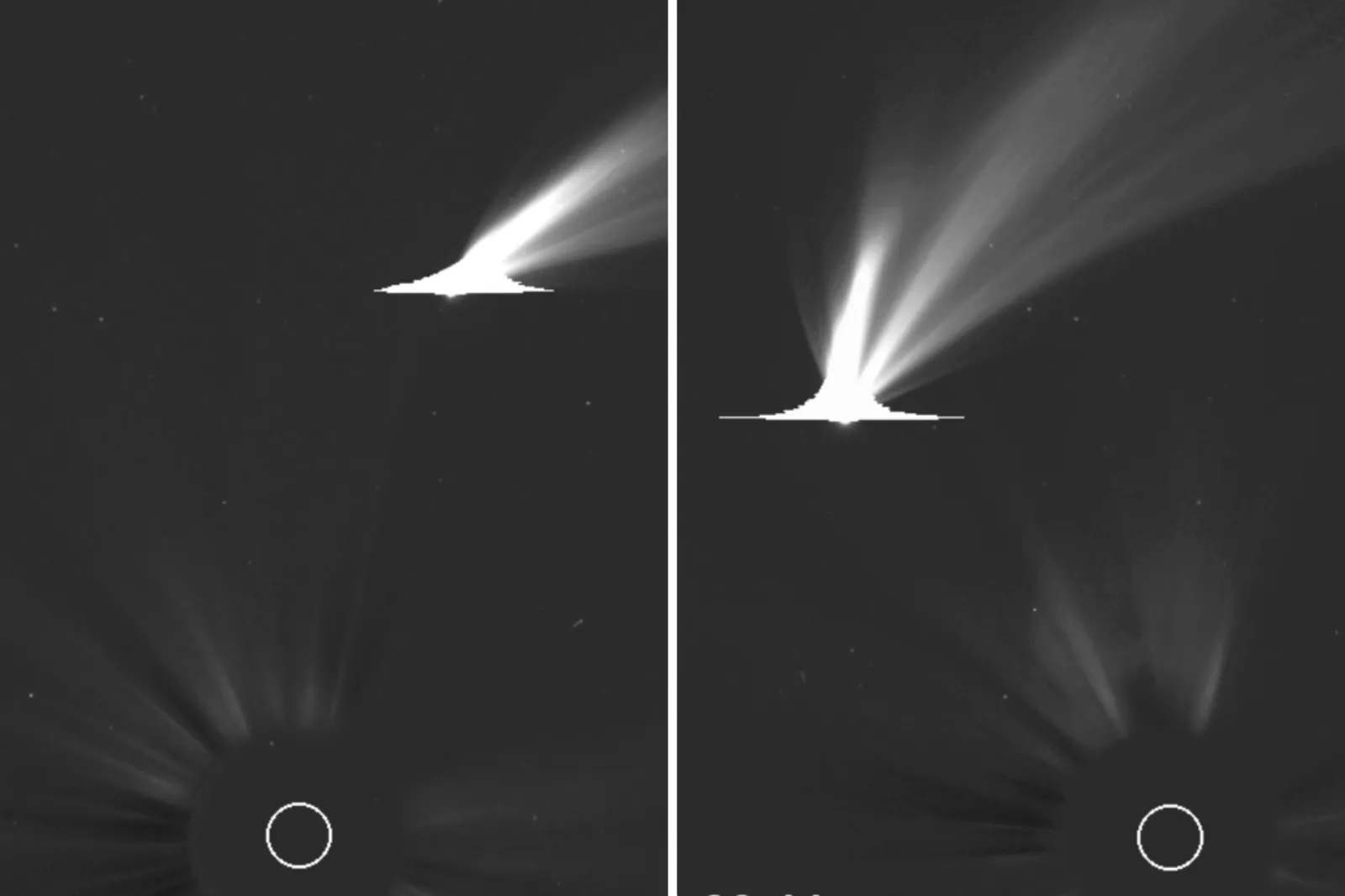
NASA and ESA's SOHO (Solar and Heliospheric Observatory) spacecraft snapped a video of the comet as it passed three times closer to our star than the orbit of Mercury, and ten times closer than the Earth.
...
The video was taken by an instrument on SOHO called the LASCO (Large Angle and Spectrometric Coronagraph), which covers the bright glare of the sun using a disk, allowing more delicate details of the sun's corona and other passing objects to be seen more clearly.
"The head of the comet became so bright, it overwhelmed LASCO's sensor, creating artificial horizontal bands (known as "bleeding") in the images," NASA explained.
The comet was only first discovered on April 5 last year by the Asteroid Terrestrial-impact Last Alert System (ATLAS) survey, which has discovered around 5,000 comets so far, according to NASA.
C/2024 G3 was thought to originate in the Oort cloud, an enormous cloud of rock and ice surrounding our solar system, with the comet taking about 160,000 years to orbit the sun.
"This relatively close approach classifies it as a sun-skirting comet, though not close enough to be a true 'sungrazer'," Shyam Balaji, astroparticle physics and cosmology researcher at King's College London, told Newsweek.
Unfortunately, this was C/2024 G3's final trip, as during its close pass with the sun, the comet was blasted with intense heat and radiation from the sun, surviving for only a week after its perihelion before possibly disintegrating.
In the days following its perihelion, people around the world snapped some stunning pictures of the comet and its spectacular tail. While not visible from the Northern Hemisphere, people in the Southern Hemisphere were able to catch a glimpse of the comet soaring just above the horizon at sunrise and sunset.
Astronaut Don Pettit even managed to take a picture of the comet from the International Space Station.
"It is totally amazing to see a comet from orbit. Atlas C2024-G3 is paying us a visit," he posted to X.
The comet is now suspected to have broken apart, and is "headless", making its tail even more spectacular of a sight.
However, as the remains of the comet head further away from Earth, this rare sight will slowly fade into oblivion.
Do you have a tip on a science story that Newsweek should be covering? Do you have a question about comets? Let us know via science@newsweek.com.
View 0 Comments
Submit Correction
View Editorial & AI Guidelines