...

By Steve Mollman
News Editor
0
Share
Newsweek is a Trust Project member
See more of our trusted coverage when you search.Prefer Newsweek on Googleto see more of our trusted coverage when you search.
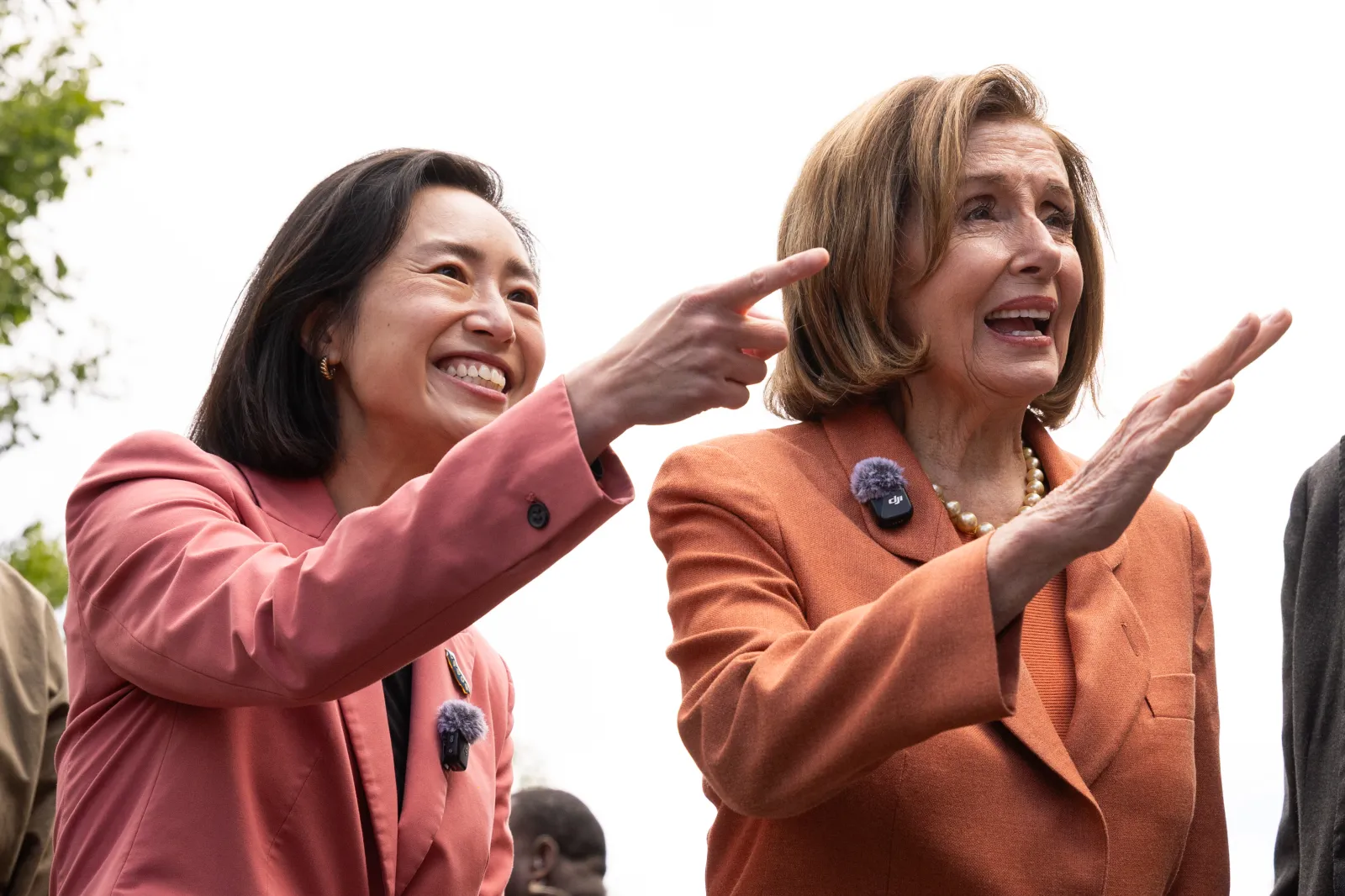
Connie Chan has a major advantage in the race to succeed former House Speaker Nancy Pelosi in Congress: an endorsement from Pelosi herself. But the San Francisco supervisor faces uncertainty heading into California’s June 2 primary, with polls showing her locked in a tight race for second.
The state uses a nonpartisan primary system in which all candidates appear on a single ballot, with the two highest finishers advancing to the general election. Polling suggests Chan is locked in a tight battle for second place with Saikat Chakrabarti—a wealthy former tech engineer and previously chief of staff to New York Representative Alexandria Ocasio-Cortez—while state Senator Scott Wiener remains the clear front-runner.
When contacted by Newsweek, however, Pelosi’s office noted that the major polls were conducted before Pelosi’s late-arriving endorsement on May 18. Prediction markets are giving Chan a better chance of advancing.
Read More on Politics
If Chan does advance, it will be a sign of Pelosi’s continued sway among Democrats and in California’s 11th Congressional District, which she’s long dominated. If Chan fails to advance, it will mark another disappointment for Pelosi as she winds down her career after decades in Congress, having already stepped away from House leadership.
The former speaker also saw a major political setback when President Donald Trump returned to power. She had long framed preventing his comeback as a key goal, at one point saying her aim was that “that man would never step in the White House again,” while frequently avoiding using his name in public, instead referring to him obliquely as “what’s-his-name.”
Newsweek reached out to Chan, Chakrabarti, and Wiener for comment.
Pelosi Endorsement Power
Pelosi’s team had maintained since her retirement announcement last fall that she had no plans to endorse. When she finally did wade in, Pelosi called Chan the candidate best prepared to represent San Francisco.
“Connie Chan is the leader best prepared to carry forward the fight for San Francisco in the Congress of the United States,” Pelosi said in a letter to residents. “At a time when fundamental freedoms and democratic values are under assault, we need a leader in Congress who is prepared to fight—forcefully and effectively.”
“She would just be so fabulous,” Pelosi added at a rally in the city. “I’m so excited about her…It’s thrilling because you know what it’s about: the future.”
Pelosi was the first woman to serve as Speaker of the House, holding the gavel during two nonconsecutive terms and becoming one of the most powerful Democrats in Washington. Her endorsement lends institutional weight and fundraising advantages, but by the time she made it, Wiener had already built a substantial lead and secured backing from party organizations.
...
Who Is Connie Chan?
Chan has served on the city's Board of Supervisors since 2021. Born in Hong Kong and raised in San Francisco, she built her career in city government and community advocacy before winning her seat. She moved to San Francisco when she was 13 years old and graduated from the University of California, Davis.
She is viewed as a progressive fixture in San Francisco politics who has clashed with former Mayor Breed at times during her tenure. She has also served in numerous municipal roles, including as an aide and liaison to the Asian American and Pacific Islander (AAPI) community for Kamala Harris when she was the San Francisco District Attorney.
"We have done the work in San Francisco and have been delivering for San Franciscans, but I also have been working in city government for over 20 years," Chan told Newsweek last week. "We want to bring a San Francisco voice and San Francisco values [to Washington]. San Francisco is a union town, and we're very proud of the working people's agenda. We know this is a time that we got to deliver for the working people."
Julie Edwards, campaign spokesperson for Chan, told Newsweek on Monday evening:
"We are feeling incredible momentum heading into the final 24 hours. We are ready to bring the working people's agenda from San Francisco to Washington and every day we hear from more voters who are right there with us. With the support of Speaker Emerita Pelosi, teachers, nurses, firefighters and working people, we know we will advance tomorrow and continue to build our coalition for victory in November."
General Election Outlook
Regardless of who advances, the general election is expected to remain in Democratic hands. Analysts widely rate the district as safely Democratic, with no credible Republican path to victory. That means the primary is effectively a contest between factions of the Democratic Party, with Wiener often seen as representing a more establishment-oriented approach and Chakrabarti positioning himself as a more insurgent progressive. Chan, meanwhile, draws support from organized labor and community networks.
Pelosi said of her at the rally: “She walks in the shoes of working moms. She knows their challenges. She walks in the shoes of immigrant families. She walks in the shoes of laborer families.”
What the Polls Say
With the caveat that the polls below were conducted before Pelosi’s May 18 endorsement, here’s what they indicated:
The latest poll from EMC Research showed Wiener with 38 percent support, compared to Chan’s 22 percent and Chakrabarti’s 21 percent. It surveyed 542 likely voters from May 3-7, 2026, Politico reported.
A Sextant Strategies poll showed Wiener up with 40 percent, with Chakrabarti at 18 percent and Chan at 17 percent. Other candidates received 18 percent, while 7 percent were still undecided about whom they would vote for. It polled 819 likely voters from April 28 to May 3, the San Francisco Chronicle reported*.*
A Lake Research Partners survey, sponsored by Chan, showed Wiener with 47 percent, compared to Chan’s 20 percent and Chakrabarti’s 17 percent. It polled 500 likely voters from April 29 to May 3.
What the Prediction Markets Say
Prediction markets like Kalshi and Polymarket measure trader sentiment at a given moment, though, like polls, they do not always accurately predict the future. They allow traders to buy and sell contracts tied to political outcomes and current events, aggregating wagers into probability estimates. Prices fluctuate as traders react to polling, fundraising, candidate developments (including endorsements), and broader political trends.
On Kalshi, Chan’s chances of advancing to the general election have surged, rising from 15 percent on May 1 to 71.7 percent on June 1. By contrast, Chakrabarti’s have fallen in the same period from 82.4 percent to 31.5 percent. Wiener stayed relatively stable, inching up from 96 percent to 97 percent.
Other factors besides Pelosi’s endorsement are at play, of course. One is the fact that Ocasio-Cortez has not endorsed Chakrabarti, despite having worked with him. Chakrabarti has also been hit with ads questioning his San Francisco roots.
Polymarket wagers focused more on who will place first tomorrow, giving Wiener a 95 percent chance as of June 1, with Chan and Chakrabarti both below 2 percent.
But the real question seems to be who will place second—and how powerful a late Pelosi endorsement can be.
View 0 Comments
Submit Correction
View Editorial & AI Guidelines